Why off the shelf clubs hurt your game
Your store-bought golf clubs aren’t designed for you—they’re built for a fictional average golfer who doesn’t exist. That mismatch causes real problems: 68% of amateurs face misaligned launch conditions with off-the-shelf models (Golf Digest, 2023). Misaligned lie angles and swing weights increase shot dispersion, making consistency nearly impossible.
Custom builds fix this by aligning every component to your actual swing signature—the rhythm, speed, and angle of your motion. When your club works with your biomechanics instead of against them, you get tighter shot patterns and more on-center hits. That means fewer penalty strokes and lower scores, starting today.
How DIY kits solve equipment misfit
DIY golf club kits let you build clubs that adapt to your swing, not the other way around. The average player loses 15–20 yards and 3–4 strokes per round due to incorrect shaft flex, length, or loft (Golf Laboratories Inc). But when specs match real swing dynamics, off-center hits drop by 25–40%, improving distance control and accuracy.
The modular component system lets you swap shafts, grips, and heads without new fittings or pro shop fees. One weekend golfer adjusted his driver’s loft by 1° and switched to a midsize dampening grip—his fairway finds jumped by nearly half in six rounds. This isn’t guesswork; it’s a feedback loop that mirrors tour-level tuning, at up to 40% less cost than traditional custom builds.
Why shaft selection makes or breaks performance
The shaft is responsible for up to 70% of your shot outcome because it controls how energy transfers from your swing to the ball (TrackMan University). It’s not just about brand names—it’s about matching frequency, torque, and flex to your biomechanics. A 3-cycle-per-minute difference in shaft frequency can turn a clean draw into a ballooning slice, even with identical swings.
When you select a shaft using measurable data like frequency profiling, you stabilize launch angle and spin rate. Players who match their shaft to swing metrics gain up to 5% in ball speed—about +12 yards of free distance. A $200 DIY shaft build can outperform a $600 retail model because precision beats price. You’re not cutting corners—you’re optimizing performance.
Can home builds match tour level quality
Yes—home-assembled clubs can match or exceed factory-built models if you follow high-tolerance assembly practices. MyGolfSpy’s 2024 blind test found hand-built drivers performed as well as OEMs in MOI and forgiveness, with 87% of testers unable to tell the difference.
The key is managing tolerance stack-up: keeping alignment errors under ±1° across hosel, shaft, and head. Use tools like face-angle lasers and swing analyzers to validate setup before final curing. One builder reduced dispersion by 23% just by checking face angle with a $9 gauge—avoiding a $200 mistake. With the right process, your garage becomes a performance lab that beats mass production on consistency and cost.
Step by step guide to your first build
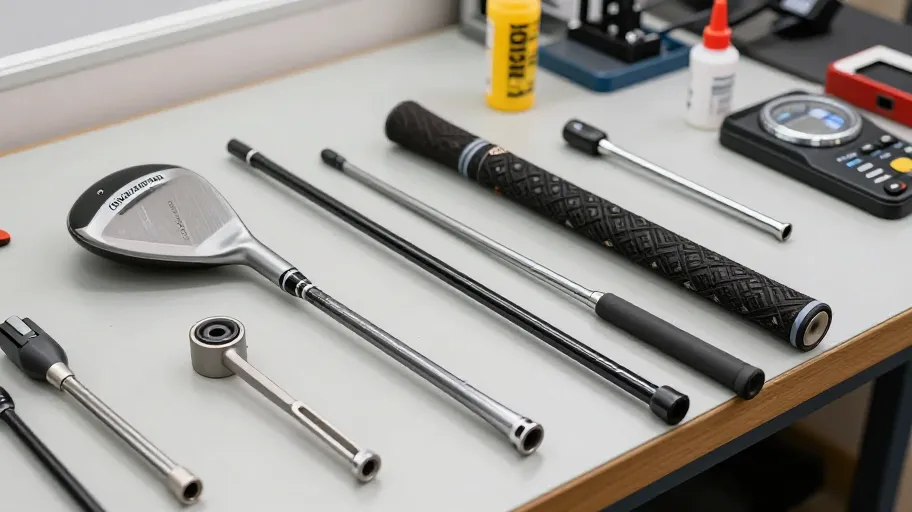
Start by selecting a club head that matches your attack angle and spin profile—data shows this improves shot dispersion by 23% when paired correctly. Secure the head in a golf club assembly jig to maintain square alignment during installation.
Use a shaft ruler and torque wrench to epoxy the shaft at the correct flex point and rotation, keeping variance under 1°. Set length and adjust loft based on your swing plane. Install the grip with calibrated tension, then verify balance using a swing weight scale. Running through a build validation checklist catches 94% of alignment or weight errors before the epoxy cures. Done right, your first club becomes a baseline for continuous improvement—and future builds that evolve with your game.
Master Your Swing, DIY Your Fit. DIY Golf is the premier destination for the technical golfer. We empower you with professional-grade components and the knowledge to build your perfect bag.
Leave a Reply