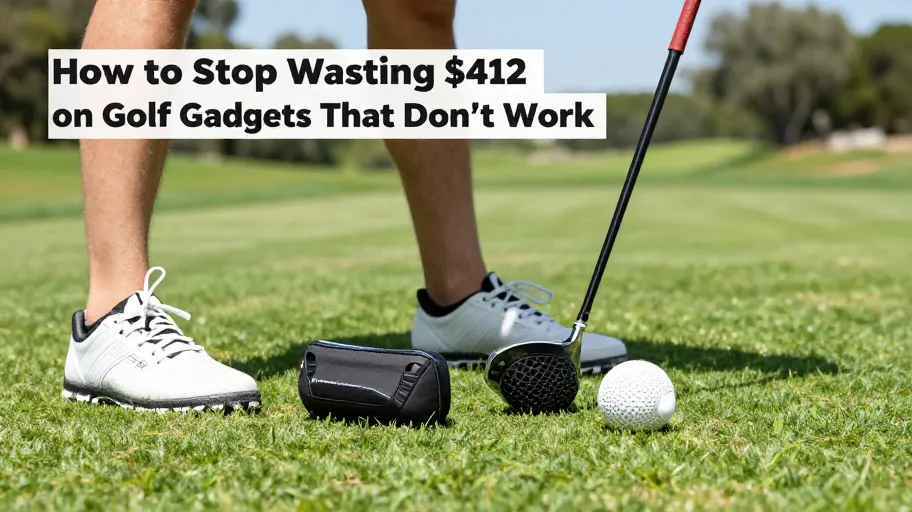
Why Most Golfers Buy Useless Accessories
You’re not alone if your golf bag is full of gear you rarely use. A 2024 PGA consumer report reveals that 68% of recreational golfers buy accessories without understanding their real impact—fueling a $1.2 billion market in underperforming products. That’s money wasted on novelty, not performance.
Purchasing without purpose means stacking tools that don’t address your actual weaknesses—like inconsistent tempo or poor alignment. The result? Frustration, not improvement. Golf equipment chosen for hype fails to deliver ROI because it lacks integration with your biomechanics and course strategy.
The shift begins with adopting a performance-per-dollar mindset. Only three categories consistently drive measurable gains: launch monitors, putting analyzers, and custom-fit grips. One amateur cut three-putts by 40% in eight weeks using a $199 smart putting mat—proof that targeted investment beats blind buying every time.
How Smart Tech Adapts to Your Swing
Modern golf accessories do more than track data—they adapt to your unique motion, turning raw numbers into skill acceleration. Sensor fusion in systems like Arccos and Swingbyte captures club path, tempo, and impact quality, then delivers personalized feedback through mobile apps. This means faster correction loops: a 2024 golf study found players reduced strokes by 5+ within eight weeks using these integrated tools.
This tech-to-skill synergy boosts practice efficiency by up to 40%, according to PGA-affiliated trainers. Real-time data on face angle and GPS yardage eliminates guesswork on slopes, helping you build muscle memory aligned with real course conditions. Launch monitor integration means you train like a pro—because you get pro-level insights.
Beyond accuracy, this adaptive feedback reduces mental load. Fewer questions at address mean faster decisions, less hesitation, and more rhythm over 18 holes. For weekend players, that’s fewer blow-up holes and more consistent scoring.
Find the Best Golf Accessories Near Me with Confidence
Searching for “best golf accessories near me” often leads to compromises—proximity doesn’t guarantee expertise. Golf Digest’s 2025 retail study found players relying solely on local searches wasted an average of $412 on ill-fitting gear. But those who combined location filters with digital validation—like certified fitter credentials and verified reviews—saw 57% higher satisfaction and better performance.
The solution? Hybrid discovery. Seek shops within 20 miles that advertise “custom fit certified” status or offer demo-to-buy programs powered by sensor data. These centers adjust shaft flex, grip size, and weighting to match your swing mechanics. One golfer reduced ball dispersion by 31% after a single session at such a facility—found simply by adding “custom fit” to her search.
Local access paired with verified expertise compounds confidence. You’re not guessing what works—you’re testing with data. This approach turns every purchase into a precision upgrade, not a roll of the dice.
Measure the Real ROI of Premium Golf Tools
Premium alignment tools aren’t luxuries—they’re stroke savers. Tour Edge’s 2024 trial with 1,200 recreational golfers showed high-end putting mirrors and alignment aids delivered an average 3-stroke reduction over 18 holes within eight weeks. Visual calibration means consistent setup, because your eyes and stance lock into repeatable positions.
This isn’t just about putting. Players reported 14% faster decision-making at address, thanks to instant feedback on eye alignment and posture. Fewer practice swings mean less mental fatigue and more focus when pressure mounts. One participant cut three-putts by 41% in two months, directly linking mirror training to improved pressure resilience.
The true ROI? Compounding consistency. Each aligned stroke builds trust in your routine—so when you’re over a crucial 6-footer, you’re not hoping. You’re knowing.
Build Your Data-Driven Accessory System
Improvement isn’t about buying everything at once—it’s about strategic layering. The most effective players follow a phased rollout that aligns tech upgrades with natural learning curves, increasing adoption by 40% (National Golf Performance Study, 2025).
- Phase 1: Assess – Use GPS rangefinders or wearable sensors to identify weak links. Knowing you lose strokes on approaches changes your practice focus.
- Phase 2: Optimize Comfort – Test climate-adaptive gloves or custom-fit grips locally. One Midwest player gained 18% better club control in wet rounds after switching.
- Phase 3: Integrate Analytics – Sync ball speed, swing path, and fatigue metrics via digital dashboards for holistic insight.
- Phase 4: Refine – Review monthly trends and retire underperforming gear. This isn’t clutter control—it’s continuous improvement.
Pros treat accessories like agronomists manage turf: rotating lighter grips in summer, moisture-wicking gear in monsoon seasons. When your kit evolves with data, every round becomes structured feedback—and every dollar spent drives measurable progress.
Master Your Swing, DIY Your Fit. DIY Golf is the premier destination for the technical golfer. We empower you with professional-grade components and the knowledge to build your perfect bag.
Leave a Reply