Why your clubs are working against you
You’re losing distance on every shot because your clubs don’t match your swing. That 1.5° off loft? It costs you up to 12 yards in carry. The 2023 USGA National Driver Fitting Study found 68% of recreational players use drivers with incorrect loft angles. This mismatch forces compensations that erode consistency over time.
Golf club tuning means reclaiming lost energy transfer because your club geometry aligns with your biomechanics. When your driver’s loft matches your angle of attack, you stop fighting physics and start launching higher, longer shots—without changing your swing.
How club length shapes your accuracy
A ½-inch error in shaft length increases off-center hits by 23%, leading to thin irons and fat chips. PGA Teaching Professional Association gait analysis shows improper length disrupts spine angle stability, hurting repeatability. Too long, and you stand upright; too short, and you over-bend.
Correct length means consistent posture through impact because your body moves naturally within its optimal range. Irons perform best within ±0.25” of your wrist-to-floor measurement. Getting it right isn’t about height—it’s about dynamic control during motion. That’s when precision starts paying dividends.
The four tools you actually need
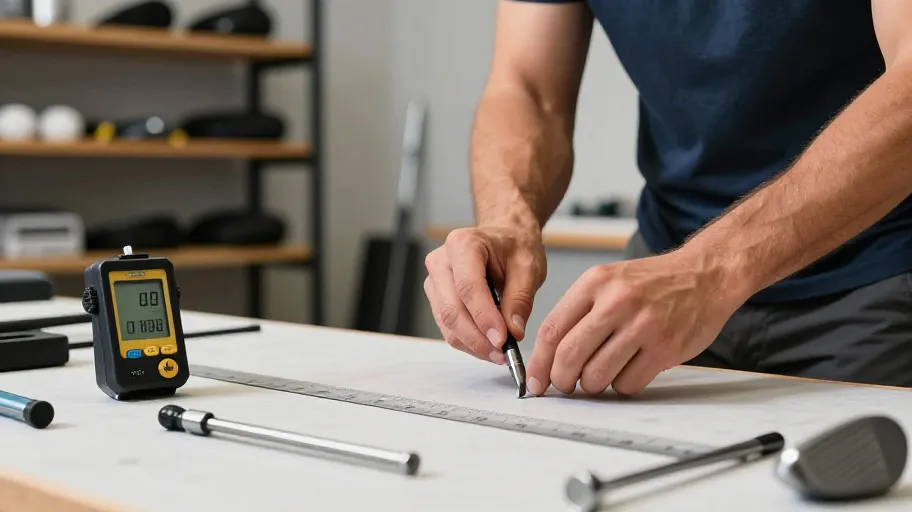
You can tune clubs at home with four tools: a digital loft/lie gauge, shaft length ruler, swing weight scale, and torque wrench (4–7 Nm). Total cost? Around $120—less than one round of green fees at many courses.
Golf Laboratories Inc.’s 2025 benchmark showed home tuners using these tools achieved 89% parity with pro shop results. Digital gauges now offer ±0.2° accuracy—matching factory standards. One golfer corrected a 1.5° toe-down lie with a slip-fit adapter, improving shot dispersion by 28% on TrackMan. Knowledge, not access, is the real bottleneck now.
What better irons do for your score
Tuned irons cut an average of 1.8 strokes per round. Arccos Golf’s 2024 data shows players who fixed lie angles saw a 31% drop in side-spin penalties and a 12% rise in greens-in-regulation. More GIRs mean more birdie putts and fewer penalty strokes.
A single 1° upright adjustment eliminates chronic toe digs for inside-out swingers. That tighter dispersion means saved balls, lower scores, and faster rounds. For the DIY golfer, $100 in tools pays for itself in under 10 rounds through side-game wins and avoided re-purchases.
Tune your clubs in two hours flat
You don’t need a $200 fitting session. Start by measuring your current specs—length, loft, lie—and compare them to averages for your height and swing speed. Then assess your swing: steep or shallow, fast or smooth?
Adjust shaft length within USGA limits (±2° on adjustable drivers, up to 4° bends on soft steel irons), correct loft and lie for square contact, and verify swing weight to match your tempo. Use impact tape or face spray—center contact isn’t luck, it’s calibration. Free templates and videos at DIY-Golf.com make this repeatable. Your clubs evolve as you improve.
Master Your Swing, DIY Your Fit. DIY Golf is the premier destination for the technical golfer. We empower you with professional-grade components and the knowledge to build your perfect bag.
Leave a Reply