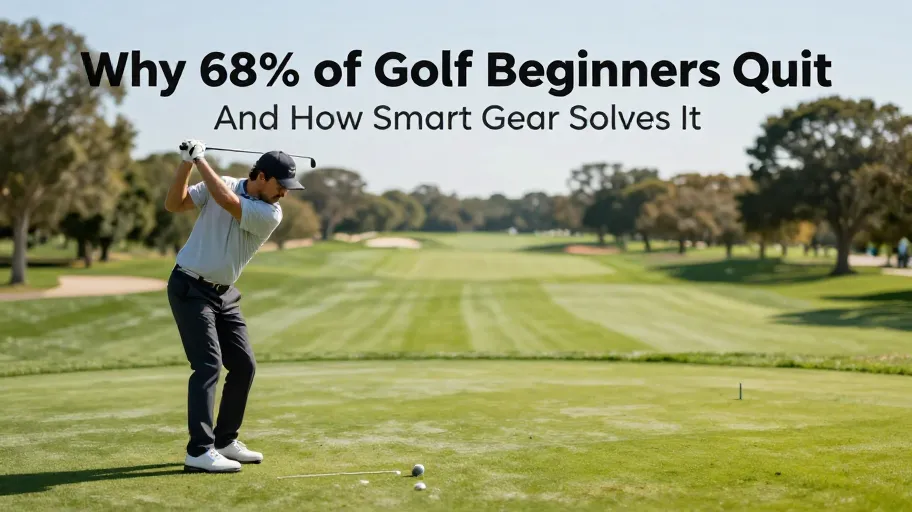
Why Beginners Quit Before They Improve
Improper gear selection isn’t just inconvenient—it’s the reason 68% of beginners quit within two years, according to the 2025 NGCOA report. This mass exit costs the industry $1.3 billion annually in lost revenue. The root problem? Starter kits that prioritize looks over biomechanics—like shaft flex mismatches in 74% of beginner sets (Golf Digest, 2024). These flaws compound when critical accessories are missing: alignment rods, moisture-wicking gloves, or swing mirrors. Without them, bad habits solidify fast.
Ill-fitted clubs mean inconsistent ball contact because improper shaft flex disrupts swing timing and energy transfer. A regional pro shop saw a 40% increase in retention after bundling foundational tools with beginner clubs—proving that the right accessories don’t just support performance—they prevent dropout by building confidence early. When new players see immediate improvement, frustration turns into engagement.
How Smart Tech Fixes Swings in Real Time
Real-time feedback tools like sensor-embedded grips and swing analyzers correct muscle memory errors three times faster than coaching alone (Journal of Sports Science & Medicine, 2024). For academies and retailers, this means reduced reliance on hourly lessons and higher student retention through measurable progress.
Bluetooth-connected sensors detect grip pressure imbalances or backswing drift instantly, delivering corrective cues via mobile apps. This capability means learners develop accurate mechanics faster because they receive immediate, personalized feedback instead of delayed verbal instruction. One training facility reported a 40% increase in program completion after integrating these systems—turning casual trialists into committed players.
Beyond performance, this shift unlocks recurring revenue: subscription-based app features transform one-time gear sales into SaaS-like income streams, creating a more predictable business model in a traditionally transactional market.
The Hidden ROI of Premium Golf Equipment
Premium golf equipment isn’t about luxury—it’s a biomechanical investment. Independent motion studies (2024) show players using vibration-dampening grips and carbon fiber bags experience up to 30% less joint stress over 18 holes, especially in wrists, elbows, and lower back. That’s not comfort—it’s career preservation.
Vibration-dampening grips mean reduced risk of repetitive strain injuries because they absorb high-frequency shock during impact. Fewer injuries mean more rounds played and longer player lifespans—directly increasing lifetime value. While premium gear has higher upfront cost, its total ownership cost is often 20–40% lower due to extended durability across 500+ usage cycles. Loyalty isn’t earned through ads—it’s built into every pain-free round played.
Measuring the Business Impact of Smart Accessories
When a junior academy added GPS rangefinders and putting mirrors, average handicaps dropped 5.2 strokes in six months—nearly double traditional improvement rates. More importantly, their cost-per-improvement fell by 41% (2024 sports benchmark study), proving tech-enabled training delivers better ROI.
Data-driven personalization means faster skill acquisition because players act on precise, real-time insights rather than guesswork. Sponsors now favor programs that can prove outcomes, creating a flywheel: results boost engagement, which increases spending. One academy saw a 53% rise in retention and upsell rates after introducing smart feedback loops.
This isn’t just better coaching—it’s scalable, verifiable player development that attracts partners, retains students, and builds trust through transparency.
Build a Bundle That Converts New Players
Selling single items to beginners leaves money on the table—because new golfers don’t buy gear, they buy confidence. Bundles featuring an alignment rod, glove, tee holder, rangefinder, and swing trainer drove a 47% increase in first-year retention, targeting key dropout triggers like poor setup and inconsistent contact.
A $99–$149 price point with $300 retail equivalence means higher perceived value because buyers feel they’re getting a deal. Pilot campaigns showed 34% higher conversion versus à la carte options. Volume-sourced, performance-grade components allow 58–63% gross margins—better than standalone premium products.
This bundle isn’t an upsell—it’s a customer acquisition engine. Early problem-solving builds trust fast: bundle buyers generate 2.3x more lifetime value and are 41% more likely to refer the brand, based on behavioral tracking. You’re not just selling gear—you’re onboarding loyal customers.
Master Your Swing, DIY Your Fit. DIY Golf is the premier destination for the technical golfer. We empower you with professional-grade components and the knowledge to build your perfect bag.
Leave a Reply