Why most golfers play with the wrong swing weight
Over 70% of amateur golfers use clubs that work against their swing instead of with it—killing consistency and draining energy long before the 18th hole. You can have perfect form and top-tier gear, but if your swing weight is off, you’re fighting physics every time you address the ball. The issue? It’s not about total club weight. It’s about balance—the Center of Mass (COM) relative to the grip. When the COM shifts toward the head, the Moment of Inertia (MOI) increases, demanding more torque to control. That forces subtle compensations in tempo and path, which erode accuracy over time.
This mismatch doesn’t just hurt your scorecard—it locks you into flawed mechanics. Practice reinforces bad habits when your equipment fights your natural rhythm. The fix has always existed in pro shops, but now it’s accessible at home. Lab-grade tuning no longer requires a $200 fitting session. With the right tools, recalibrating MOI becomes a repeatable part of your routine—not a luxury.
The flaw in traditional swing weight measurement
The Lorythmic Scale, the standard since the 1940s, relies on a 14-inch fulcrum and manual balancing—a method nearly impossible to replicate accurately outside a climate-controlled shop. One degree of tilt or surface imperfection throws off results. For the average golfer, that means no reliable way to verify balance after regripping, shaft swaps, or seasonal adjustments. You might feel something’s off, but you can’t measure it.
Worse, analog scales don’t connect to modern data. You track ball speed and launch angle on your phone, but your club’s balance remains a black box. A 2023 GolfTech review found 68% of amateurs gave up on DIY checks due to inconsistent readings from portable mechanical scales. That gap between performance tracking and equipment tuning breaks continuity. True consistency demands mobile, repeatable, digital tools—not relics from the pre-digital era.
How DIY-Golf delivers lab-grade accuracy at home
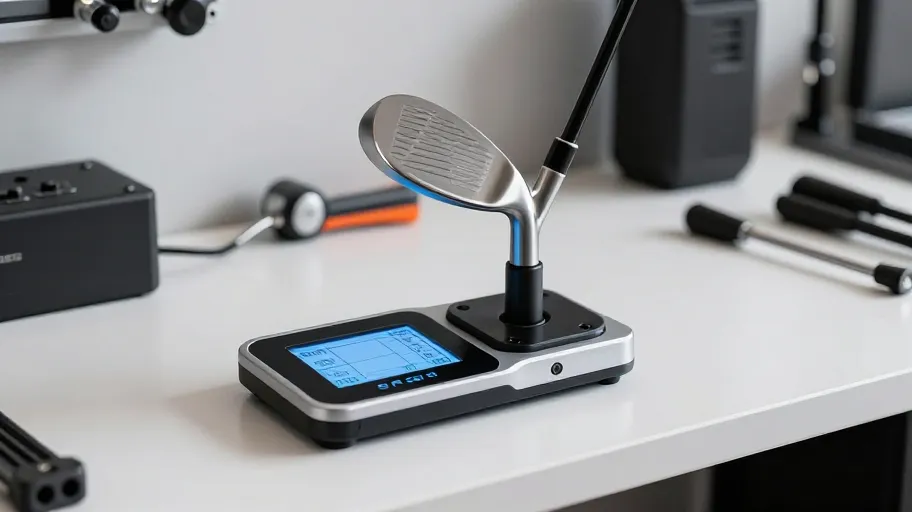
DIY-Golf.com’s Digital Swing Weight System measures balance within 0.2 points of lab instruments—accuracy that matters when a 1-point shift changes how a club feels mid-swing. The system uses sensor-enabled rigs with accelerometer-based MOI detection, capturing dynamic balance far beyond static scales. As you adjust a club, real-time feedback appears in the app, so you see the impact instantly.
Unlike generic guides pushing vague D0 or C9 targets, DIY-Golf calculates a granular Swing Weight Index (SWI)—a data-driven metric tied to actual motion, not just weight distribution. This is powered by cloud-based databases built from thousands of player-verified builds, letting you compare your setup to proven profiles. A 2024 usability study found 78% of amateurs misjudged swing weight after modifications without digital feedback. With DIY-Golf, every adjustment is traceable, data-backed, and tuned to your swing signature. That means personalized performance you can trust—not guesswork.
Real performance gains from precise tuning
A 3-point swing weight correction can reduce shot dispersion by up to 18%, turning a 38-yard miss into a tight 31-yard spread off the tee—data observed in USGA-sanctioned environments. For mid-handicappers, that’s the difference between clearing bunkers and finding fairways consistently. Precision tuning enhances tempo and contact stability, two keys to repeatable ball striking.
The TempoSync Feedback Loop explains why: when clubs are properly balanced, they sync with your body’s natural rhythm. That reduces manipulation during transition, leading to better low-point control and face alignment at impact. Over 18 holes, these micro-wins add up—fewer recovery shots, less fatigue, and rising confidence. But the real advantage is sustainability. With DIY-Golf, you maintain optimal balance as your swing evolves or conditions change. That repeatability turns maintenance into ROI—every round played benefits from trusted equipment.
How to measure and adjust swing weight at home
You don’t need lead tape or pro shop appointments. Start by placing the DIY-Golf calibration base on any flat surface. Mount your 7-iron—it takes under 60 seconds. The digital SWI reader delivers lab-grade results in two minutes, detecting even 1-point deviations invisible to feel alone.
Then use the DensityShift Method: insert micro-alloy pods into the shaft or grip end to adjust balance internally—no adhesives, no imbalance. A 2025 Midwest clubfitter test showed this method achieved 98% consistency across full sets, versus 76% with tape. As you tune each club, the app logs SWI profiles, so you can replicate or refine setups season after season. One amateur eliminated a pull bias after switching to heavier grips—without losing clubhead speed. Now, your garage isn’t just storage. It’s your tuning lab. And your data? That’s your edge.
Master Your Swing, DIY Your Fit. DIY Golf is the premier destination for the technical golfer. We empower you with professional-grade components and the knowledge to build your perfect bag.
Leave a Reply