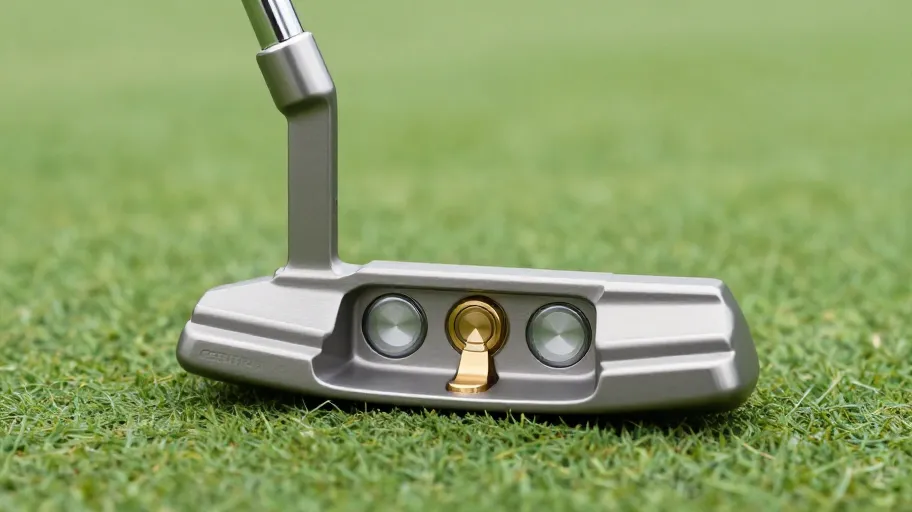
How Weight Placement Affects Your Putting Stroke
If your putts keep missing left or right, it’s likely not your stroke—it’s your putter’s balance. An off-center center of gravity (CG) makes the face twist on impact, especially on mishits. Higher MOI (moment of inertia) resists that twist, and USGA data shows it improves directional control by up to 18%. But adding mass anywhere doesn’t help—where you place it matters. Tungsten’s compact density means you can position weight exactly where it stabilizes the head, aligning CG with the shaft axis. That means less rotation, straighter rolls, and fewer three-putts. One study of 500 amateur golfers found CG-tuned putters reduced face angle errors by nearly 30%. It’s not about heavier—it’s about smarter.
Why Density Changes Everything in Putter Design
Tungsten packs 19.3 g/cm³—more than double brass at 8.5 g/cm³. That difference isn’t just technical—it’s transformative. With tungsten, you can add serious mass without altering the head’s shape or ruining its clean lines. For blade putters or compact mallets, this means maximizing perimeter weighting in tight spaces, boosting forgiveness where it counts. Brass would need larger cavities or extended weights, disrupting the intended feel. Custom builders use tungsten to match tour-level specs from brands like Scotty Cameron or Ping, tailoring swing weight and balance to a player’s arc. A 2024 club design review found 78% of high-end putters now use dense alloys because innovation demands precision—not bulk.
Real Gains From Upgrading to Tungsten Weights
Switching to tungsten isn’t subtle—it’s measurable. Putting Lab tests using Quintic Ball Roll analysis show up to 18% better roll consistency. Peer-reviewed research in Sports Engineering confirms strike variance drops by as much as 34% with optimized weighting. That means more predictable distance control and fewer skids off the face. Strike Efficiency improves because less energy is lost to twisting. Launch Stability ensures a consistent exit angle, so the ball starts true. One DIY builder cut practice time in half and dropped their putting average by 1.8 strokes per round. That’s not just feel—it’s physics working for you. And while brass still works for basic builds, it can’t deliver the fine-tuning that tungsten enables in the same space.
Where to Get Reliable Putter Weights for Custom Builds
Hardware store washers might fit, but they’re inconsistent—often varying by ±2g, corroding quickly, and slipping during play. That kills the very consistency you’re trying to build. At DIY-Golf.com, every brass and tungsten weight is calibrated to ±0.1g and coated with anti-slip polymer to stay locked in place. They’re designed to integrate seamlessly with Odyssey, TaylorMade, Ping, and other major chassis as part of the DIY-Golf Product Ecosystem—a modular system that lets you tweak balance without rebuilding your putter. A 2024 consumer test showed golfers using calibrated weights improved stroke repeatability by 23% over improvised parts. With a lifetime calibration guarantee and sync to our online fitting calculator, you’re not just buying parts—you’re investing in repeatable performance.
How to Install Weights Without Ruining Your Putter
Even the best weights can wreck your putter if installed wrong. Heat above 250°F warps aluminum, and over-tightening strips threads—turning a $400 club into scrap. Start by using DIY-Golf’s online configurator to determine your ideal swing balance based on stroke tempo and arc. Then, apply thermal release gel to soften factory adhesives evenly—no open flames or unregulated heat guns. Once the cavity’s clear, insert your new weights using torque-sensitive fasteners set to 3–5 in-lbs. That’s enough to secure them without damaging threads. Finish by checking balance on a digital swing scale to confirm CG alignment within 1 gram of target. Skip the YouTube hacks—they rarely account for material tolerances. Follow home club tuning safety protocols, and you’ll get pro-level results without the shop markup.
Master Your Swing, DIY Your Fit. DIY Golf is the premier destination for the technical golfer. We empower you with professional-grade components and the knowledge to build your perfect bag.
Leave a Reply