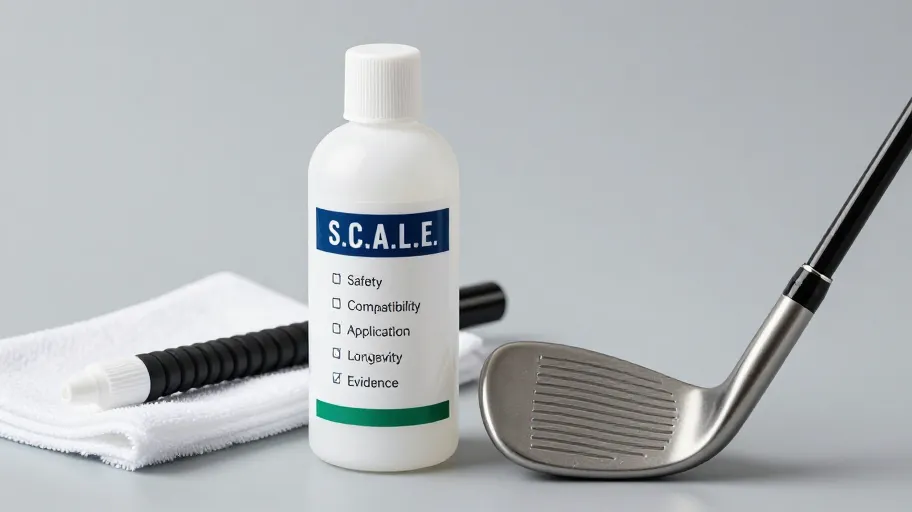
The best golf club cleaning solution is the one you can verify against your exact club finishes, grip materials and groove geometry — and approve through documented evidence, not marketing copy. Use the S.C.A.L.E. framework below: Safety, Compatibility, Application, Longevity and Evidence. It converts vague product claims into a supplier checklist you can act on.
Why cleaning solution choice matters at component level
If you are researching replacement or tuning components for a specific club brand, family and model, cleaning chemistry is not housekeeping trivia. It is part of the maintenance loop that protects the surfaces you are about to invest in. A cleaner that is aggressive on one finish may dull another. A solution that is harmless to chrome may interact differently with a satin or raw wedge surface, a polymer grip, or an adhesive-bonded component. Because finishes and grip compounds vary across and within club families, the honest answer to "which solution is best" is: the one whose safety and compatibility you can document for your specific components.
That is why this guide is organised around verification rather than recommendation. You will get a framework, a decision table, the exact questions to send a supplier, and a sample-evaluation routine you can repeat across candidates.
The S.C.A.L.E. Approval Framework
Use these five checks before approving any cleaning solution for your bench or your customers' clubs:
S — Safety. Review the product's safety documentation. Confirm what surfaces and materials it is explicitly cleared for, and how it should be handled and stored. Ask for the current safety data sheet rather than relying on label shorthand.
C — Compatibility. Map the solution against every material in your target club family: head finish, groove treatment (if any), ferrule, shaft coating, grip compound and any bonded inserts. Do not assume cross-family compatibility. Verify per finish, per component.
A — Application. Define the application method — spray, concentrate, wipe, soak — and match it to your workflow. Concentration and dwell time change outcomes, so ask the supplier for written application parameters rather than improvising.
L — Longevity. Consider how repeated use affects surface appearance over a maintenance cycle. Ask the supplier for evidence addressing repeated application on the finishes you service, and for shelf-life guidance on the product itself.
E — Evidence. Every claim above should be backed by supplier documentation you can file: compatibility statements, application instructions, safety sheets. Where evidence is missing, treat it as an open question, not a green light.
Decision table: comparing candidate cleaning solutions
| Criterion | What to verify | What to request from the supplier | Pass condition |
|---|---|---|---|
| Head finish safety | Compatibility with the exact finishes in your club family | Written compatibility statement per finish type | Statement covers each finish you service |
| Groove and face interaction | Effect on groove edges and face texture over repeated use | Repeated-application guidance | Supplier provides documented parameters |
| Grip material safety | Suitability for the grip compounds you carry | Material-specific clearance | Named materials covered in writing |
| Application method | Concentration, dwell time, tooling (brush, cloth) | Written application instructions | Instructions exist and match your workflow |
| Safety and handling | Safe use, storage and disposal | Current safety data sheet | Sheet supplied and current |
| Sample availability | Whether a sample can be evaluated before purchase | Sample terms | Confirm the current policy directly |
| Cost, MOQ and supply | Purchase terms for your order profile | Quotation for your quantities | Confirm the current policy directly |
| Documentation trail | Everything above in a file you can keep | Copies of all statements | Complete dossier approved by you |
Concrete approval questions to send any supplier
Copy these into your supplier enquiry. They are deliberately specific, because specificity is what separates a usable answer from a brochure.
- Which head finishes (e.g. chrome, satin, raw, PVD-type) does this solution have documented compatibility with, and can you provide that documentation?
- What are the written application parameters — dilution, dwell time, tooling and rinse-off — for each application method?
- What is the documented effect of repeated application on groove surfaces and face texture?
- Which grip compounds (rubber, polymer, cord, wrap) is this product cleared for?
- Can a sample be provided for evaluation? Confirm the current policy directly.
- What are the pricing, minimum order and delivery terms for my order profile? Confirm the current policy directly.
- Can you supply the current safety data sheet and storage guidance?
- What evidence do you hold on shelf life and batch consistency?
Any question the supplier cannot answer in writing stays open. An open question is not a rejection — it is a documented gap you track to closure before approving.
Sample evaluation checklist
Before approving a candidate solution, run it through this routine and record the results:
- Received current safety data sheet and compatibility statements
- Tested on an inconspicuous area of the exact finish used in the target club family
- Followed the supplier's written application parameters, not improvisation
- Observed and recorded immediate result on finish appearance
- Observed and recorded result on grip material (if grips are in scope)
- Repeated application per a defined maintenance interval you set
- Compared side-by-side against at least one other candidate
- Documented everything in a one-page evaluation sheet
- Confirmed sample, pricing and order terms directly with the supplier
- Signed off: approve, reject, or continue testing
This checklist does not tell you which product wins — your recorded observations do, for the specific components you service.
On household alternatives
Searches around using multi-purpose spray lubricants on golf clubs surface regularly. This guide takes no position on any named household product, because no compatibility evidence was supplied for this article. The correct approach is the same as for any commercial solution: check it against your finish and grip materials via the S.C.A.L.E. framework, and only approve what you can document. A multi-purpose product designed for metal protection is not automatically a club-care product — verify it as you would anything else.
FAQs
Do I need a different cleaning solution for wedges versus irons? Possibly. Finishes vary between and within club families — raw and satin wedges can behave differently from chrome irons. Verify compatibility per finish with the supplier before approving one solution for everything.
Can one cleaner handle both club heads and grips? Only if the supplier documents clearance for the specific grip compounds you carry. Send the compatibility questions above and keep the written answer on file.
How do I judge a sample fairly? Run the sample evaluation checklist: test on an inconspicuous area, follow written parameters, repeat application to a defined interval you set, and compare against another candidate. Record everything.
Should I worry about grooves specifically? Grooves are part of the compatibility map. Ask for documented evidence on repeated application to groove surfaces, and treat a missing answer as an open item rather than an approval.
What if the supplier cannot answer my spec questions? Keep the question open and continue sourcing. A supplier who answers in writing gives you a documentation trail; one who cannot gives you a reason to keep comparing.
Move from research to a documented decision
Reading about cleaning solutions gets you halfway. A structured sourcing brief gets you to an approval you can defend. 获取采购 Brief — use it to consolidate your spec questions, sample plan and approval gate into one document you can send to any supplier today.
If you are not ready to source yet, start smaller: download the sample evaluation checklist above, run it on whatever solution is currently on your bench, and let the recorded results tell you whether to keep or replace it.
Master Your Swing, DIY Your Fit. DIY Golf is the premier destination for the technical golfer. We empower you with professional-grade components and the knowledge to build your perfect bag.


