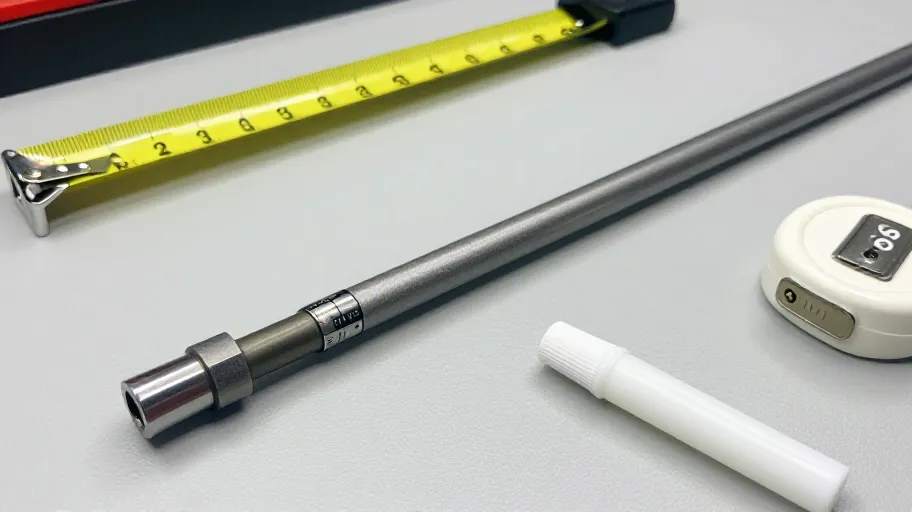
Choosing the right putter length starts with your own setup, not a chart: measure the putter you use now, check whether your eyes, arms and hands sit naturally at address, and confirm your stroke feels consistent — then verify the brand, family and model of the putter the new component must match.
Why putter length matters before you order a component
Putter length shapes where your hands sit at address, how your eyes line up over the ball, and how consistently the face returns to square. When you replace or tune a component — a shaft, an adapter, a weighting piece — the length you order interacts with everything else about the club as built. That is why this guide treats putter length as a verification problem, not a guessing exercise.
The approach here follows a widely referenced fitting protocol described in Odyssey's 2023 putter fitting guide: the fitter measures the golfer's current putter and then tests shaft lengths while observing address posture and impact consistency. You do not need a fitting studio to borrow the logic — you need a tape measure, a mirror or a helper, and a flat stretch of carpet or a practice green.
One boundary worth stating up front: this article does not claim that any specific component on our site fits your specific putter. Component fitment depends on the exact brand, family and model of your club. The on-site fitment selector is the tool for that verification, and you should confirm the result before checkout.
The Posture–Stroke–Spec Check
We call the sequence below the Posture–Stroke–Spec Check. It adapts the approved fitting logic into three steps a golfer or club builder can run at home or on the bench.
Step 1: Measure your current putter
Measure from the end of the grip to the centre of the sole with the club set flat, exactly as a builder would. Note the number and keep it — it becomes your baseline for comparison. If you are replacing a shaft, also record how the length is achieved: one-piece shaft, extension, or an adjustable adapter, because the component you order must reproduce the assembled length you actually play.
Ask yourself:
- Does my current putter measure the length I assumed, or is it different?
- Was the club ever cut down or extended before I owned it?
- Do I know how the assembled length is built into this specific model?
Step 2: Observe address posture
Set up to a ball as you would on the first tee of a Saturday round — not a demo-day stance. Look at three things: where your eyes sit relative to the ball, how much your arms bend, and where your hands fall relative to your thighs. If your arms are cramped, the putter may be too short for your posture; if you are reaching, it may be too long. The point is observation, not a verdict — posture is individual, and the approved fitting protocol treats posture as something to observe while testing lengths, not as a rule that assigns a number.
Step 3: Confirm impact and stroke consistency
Roll putts on a flat surface and watch the strike. Consistent centred contact with a putter at its current length is strong evidence that length is close to right for your setup. Repeated strikes toward the heel or toe, or contact that drifts when your hands move slightly, is a signal worth investigating before you commit to a new length. If possible, test a putter at a different length — a coach's spare, a shop demo model — and note whether your posture and contact change.
Decision table: what you observe and what to verify next
| What you observe at address or in your stroke | What it may suggest | What to verify before ordering |
|---|---|---|
| Arms bent tightly, hands close to thighs | Current length may be shorter than your natural posture wants | Measure the current putter; compare with the assembled length the component order will produce |
| Reaching, weight on heels, eyes well inside the ball line | Current length may be longer than your posture wants | Confirm whether the exact model supports the length you want before ordering a component |
| Consistent centred contact | Current length appears close to right for your stroke | Order a like-for-like component; verify brand, family and model in the fitment selector |
| Contact drifts toward heel or toe | Setup or length mismatch worth investigating | Test another length if you can; confirm component specification matches the model |
| Assembled length differs from the measured shaft | Extension, cutting or adapter is affecting length | Ask how the component interacts with your model's existing assembly before buying |
The table is deliberately conservative: it describes what to verify, not what a part will do, because outcomes depend on the exact club and the exact component.
Questions to confirm before you order
Before you commit to a putter length or any related component, put these questions to the seller and get written answers:
- Does this component fit my exact putter — brand, family and model? Use the fitment selector, then confirm the result covers the full model name, not just the family.
- What assembled length will my build produce with this component? Ask how the component's specification translates into the final length on your specific putter.
- What is the current return or exchange policy if the length is wrong? Policies change; confirm the current terms directly before checkout.
- What does this component cost, and is anything else required to complete the build? Confirm current pricing and whether additional pieces are needed for your model.
- What is the current shipping timeline to my address? Ask directly rather than assuming, since timing details are not something this article can state for you.
FAQ
Is putter length measured the same way across all brands? Measurement conventions can differ in detail between makers. Measure your current putter from grip end to sole centre with the club flat, and verify against the manufacturer's stated spec for your exact model where you can find it. When in doubt, ask the seller how the component's stated length is defined.
Can I just copy the length of a tour player's putter? Not safely. A tour player's length reflects their posture, stroke and preferences on that specific model. Use your own posture and contact evidence from the Posture–Stroke–Spec Check instead of a borrowed number.
Does changing putter length change anything else about the club? Changing length can influence how the club sits and feels, but this article does not make performance or spec claims beyond the approved fitting protocol. If you are also changing weight or lie characteristics, verify with the seller how each change interacts on your exact model before ordering.
Do I need a professional fitting before buying a component? The approved Odyssey protocol describes how a fitter measures and tests lengths, but whether to book a fitting is your call. Many golfers can narrow the choice with the checks in this article; a fitting can add observation you cannot easily do alone. We do not claim any fitting outcome for components sold on this site.
Does the fitment selector also cover grips? Confirm this on the site before relying on it. This article only states that the fitment selector exists for verifying club brand, family and model — check the tool's actual capabilities for anything beyond that.
Use the fitment selector before you choose
When you have your measurements and observations, the single most important step is verification: use the on-site fitment selector and verify the club brand, family and model before choosing a component. It takes the guesswork out of matching a part to your exact putter, and it is the step most likely to save you from an order you cannot use.
Low-friction checklist: five checks in five minutes
Run through this list before any putter component purchase:
- Measured my current putter from grip end to sole centre, club flat
- Noted whether the club has been cut, extended or fitted with an adapter
- Observed eyes, arms and hand position at a natural address posture
- Watched contact point over a series of flat-surface putts
- Verified brand, family and model in the fitment selector
- Confirmed current pricing, return policy and shipping terms directly with the seller
If you can tick every box, you are ready to order with far fewer unknowns than when you started.
Master Your Swing, DIY Your Fit. DIY Golf is the premier destination for the technical golfer. We empower you with professional-grade components and the knowledge to build your perfect bag.