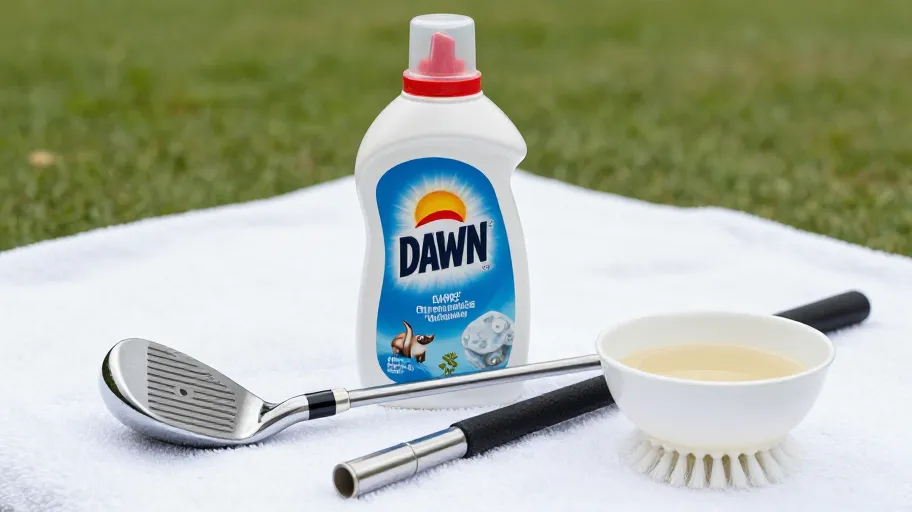
Can I use Dawn to clean golf clubs? A mild dish detergent diluted in warm water can be part of a careful cleaning routine for many clubheads, but safety depends on the specific finish, shaft material and grip of your exact club model. Verify the manufacturer's care guidance first, test on one club, and document what you use.
That answer is deliberately conditional. Cleaning questions look trivial until you remember that club components — heads, hosels, ferrules, shafts, grips — carry finishes and adhesives that vary by brand, family and model. What is harmless on one satin-finished wedge may dull a painted sole insert on another. The disciplined approach is not to hunt for a universal yes; it is to run a verification process on your own equipment. That is what the CLEAN Frame is for.
The CLEAN Frame
- C — Confirm materials. Identify the head finish (chrome, satin, painted, PVD-style, raw), the shaft type (steel, graphite, coated steel) and the grip material before any liquid touches the club.
- L — Limit exposure. Use diluted detergent, a soft brush, and short contact time. Avoid soaking hosels, ferrules and shaft tips where adhesives and collars sit.
- E — Evaluate finish risk. Painted surfaces, decals, polymer inserts and some coated shafts warrant extra caution. If you cannot identify the finish, treat it as high-risk until confirmed.
- A — Approve the method. Check the manufacturer's care instructions for your exact model, then test on the least visible area of one club.
- N — Note results. Record what you used, dilution, contact time and the observed result so the routine is repeatable — or reversible.
Surface-type decision table
| Component / surface | Risk consideration | Verification question before cleaning | Suggested first action |
|---|---|---|---|
| Chrome or satin steel head | Durable, but groove edges and any cosmetic coating need checking | "Is any coating or plating present on this model's head?" | Diluted mild detergent, soft brush, hand-dry |
| Painted or decorated head | Paint and decals can be affected by solvents and abrasion | "What finish system does this model use, and what is approved for cleaning?" | Minimal diluted contact, soft cloth only, test patch first |
| Graphite shaft | Abrasion and harsh exposure can affect surface layers | "What shaft finish and cleaning guidance applies to this shaft model?" | Damp soft cloth, no scrubbing, no soaking |
| Steel shaft | Corrosion risk if dried poorly | "Any coating on this shaft I should protect?" | Wipe clean and dry immediately |
| Grip (rubber or polymer) | Material varies; some degrade with certain products | "What grip material is fitted and what cleaner is approved?" | Mild diluted soap, rinse-wipe, air dry |
| Grooves | Debris removal is mechanical as much as chemical | "Is the groove treatment or face finish sensitive to brushes?" | Soft-bristle brush after confirming finish type |
This table does not assert that any specific outcome will occur on any specific model. It converts the unknowns into questions a builder or owner should answer before choosing a method.
Concrete approval questions
Before adopting any cleaning routine — and before using it on customer or high-value components — get these answered for the exact club model in hand:
- What finish and coating system does this head model carry, and what cleaning agents does the manufacturer approve?
- Does cleaning with any product affect the warranty terms for this model, and where is that stated in writing?
- Are there model-specific restrictions for painted areas, decals, polymer inserts or coated shafts?
- What brush stiffness and contact method does the manufacturer document as acceptable for the grooves and face?
- If I am sourcing replacement components, do the supplied components come with their own care or finish documentation?
If the answer to any of these is unavailable, treat the item as unverified and clean conservatively: damp cloth, mild dilution, short contact, immediate drying, one test club first.
Method-note discipline for builders
For club builders, cleaning sits inside a wider workflow of assessment and assembly. A consistent method note — product used, dilution, contact time, tools, observed result, dated — lets you compare results across components and avoid repeating a mistake across a batch. It also protects trade or resale conversations, because you can document that care followed a deliberate, recorded process rather than improvised practice. DIY-Golf's public guidance pages cover component selection and fitment considerations; maintenance documentation complements that research layer. No claim is made here about any specific product's suitability for any specific component — confirm the current documentation for whatever you are working on.
FAQ
Does dish detergent damage golf club finishes? It depends on the finish and how it is applied. Diluted mild detergent with a soft tool and short contact is a cautious starting point for many metal heads, but painted, coated and polymer surfaces require model-specific verification first. Confirm the finish system for your exact club before proceeding.
Should I use Dawn on graphite shafts or grips? Graphite shaft surfaces and grip materials vary. Wipe graphite shafts with a damp soft cloth rather than scrubbing, and confirm the grip material before choosing any cleaner. Ask the manufacturer what is approved for the specific shaft and grip model fitted.
How do I clean grooves safely? Confirm the face and groove treatment for the model, then use a soft-bristle brush with diluted detergent and moderate pressure. Dry the head immediately afterward. If the finish type is unknown, clean one groove area on one club and inspect before continuing.
Can improper cleaning affect warranty or component evaluation? Warranty terms are manufacturer-specific. Obtain written care guidance for the exact model before using anything beyond mild detergent and water, and keep records of your method in case documentation is requested.
What should component buyers ask suppliers about cleaning and care? Ask whether finish documentation, care instructions or handling guidance accompanies the components, and confirm current sample, cost, shipping and returns policies directly with the supplier — none of those details can be assumed from this article.
Next step
获取采购 Brief — download the DIY-Golf sourcing brief to structure your component research, care documentation and supplier approval questions in one place before your next build or tuning project.
Prefer to start smaller? Use the low-friction checklist below before your next cleaning session:
Pre-clean verification checklist
- Finish, coating and material identified for the exact model
- Manufacturer care guidance obtained (in writing where possible)
- Grip material and shaft type confirmed
- Dilution and contact method decided and recorded
- Single test club or test patch selected
- Results noted with date, product and dilution
- Warranty implications confirmed before proceeding
Master Your Swing, DIY Your Fit. DIY Golf is the premier destination for the technical golfer. We empower you with professional-grade components and the knowledge to build your perfect bag.


