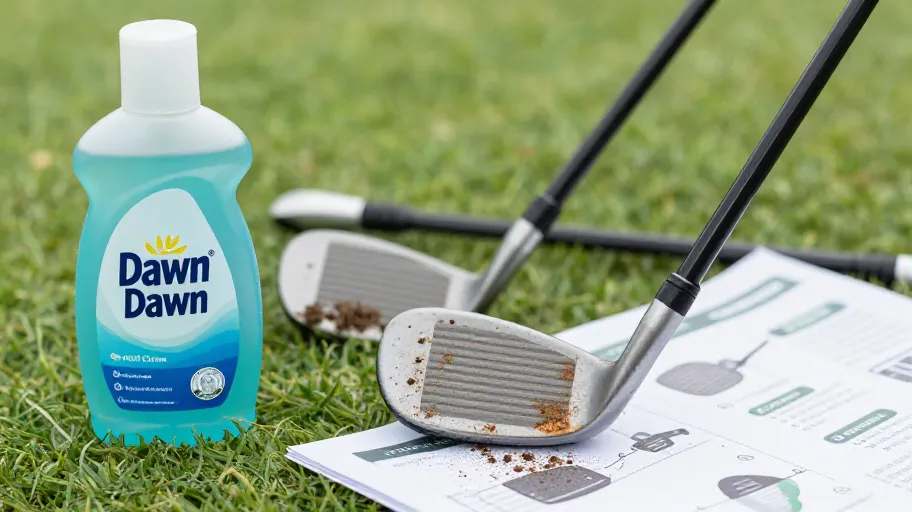
Can you use Dawn to clean your golf clubs? A mild dish soap like Dawn is a reasonable first choice for washing dirt and grass residue off clubheads and grips, and many golfers use it without issue. What matters more is what happens next: verify the finish, inspect for rust, and document condition before ordering any replacement component — ask DIY-Golf to confirm care guidance for your exact model.
Why a cleaning question is really a sourcing question
If you play twice a year with a stock set, "can i use dawn to clean my golf clubs?" ends at the sink. But if you are researching a replacement shaft for a specific driver family, matching a putter head to an existing build, or deciding whether a scuffed iron set justifies a component order, cleaning is the first act of assessment. What you see after the club dries — the true state of the finish, the extent of oxidation at the hosel, the real wear pattern on the face — is the evidence on which your entire purchase decision rests.
That is why this article treats dish soap as a door-opener rather than the answer. The real work is in what you verify, document and approve afterwards.
The Clean-Before-Commit Framework
Use this four-step framework every time cleaning feeds into a component decision:
- Assess. Clean the club with a mild detergent and warm water, then let it dry fully. Do not judge condition while the club is wet — water films mask oxidation and can exaggerate or hide finish blemishes.
- Verify. Compare the dried club against what you believe the original finish and spec should be. Check the hosel, shaft tip, ferrules and anybadged areas for oxidation, corrosion or finish changes.
- Document. Photograph the cleaned club in even light, note the model, serial or batch markings where present, and write down exactly what you used to clean it and what you observed. If a claim or return ever becomes relevant, your cleaning record is part of your evidence.
- Approve. Only now decide whether you need a replacement component — and put the approval questions below to DIY-Golf before you order.
Decision table: rust and residue on a shaft before you order a replacement
| What you observe after cleaning and drying | What it may indicate | Action before ordering a replacement component | What to ask DIY-Golf |
|---|---|---|---|
| Uniform light film wipes away cleanly, finish intact | Surface residue from storage or play | Clean, re-inspect, no purchase triggered yet | Confirm recommended finish care for the exact shaft model |
| Localised discoloration at the tip or hosel area | Possible oxidation at a bonded or clamped zone | Photograph, measure nothing yet, do not sand | Confirm whether tip condition affects fitment or prep guidance for this model |
| Flaking, pitting or texture you can feel with a fingernail | Potentially more than cosmetic | Stop cleaning; document; treat the shaft as suspect | Request a condition-based component comparison for this club family |
| Markings, serials or badges partially obscured | Uncertain provenance of the current shaft | Document what is legible; do not abrade markings | Ask what identification is needed to match a replacement part |
| Grip or ferrule swelling or softening after soap contact | Cleaning product may not suit those materials | Rinse, dry, stop using that detergent on this club | Confirm material-care guidance for grips and ferrules on this build |
Treat this table as an assessment aid, not a diagnosis. No observation here tells you whether a component is stock, compatible or warrantable — those are questions to verify for your exact brand, family and model.
Approval questions to put to DIY-Golf before you buy
Before approving any replacement or tuning component order, confirm directly — in writing, where possible — the following:
- Fitment confirmation: For my club's exact brand, family and model, does the component I'm considering fit as-is, or does it require adapters, shims or tip-trimming I need to specify?
- Finish and care guidance: What cleaning and rust-management approach does the maker document for this shaft or head finish, and does DIY-Golf have first-party guidance for this model?
- Spec verification: What lofts, lies, flexes, lengths and shaft combinations are verifiable for this component right now, and how will that be confirmed on my order?
- Condition documentation: If I am replacing because of rust or damage, what photos and descriptions does DIY-Golf need from me to match the correct part?
- Policy confirmation: What are the current terms on stock, dispatch, returns and any claim process for this specific component? Do not assume; ask, and get the answer in writing before you approve the purchase.
- Build compatibility: If I am reusing a current head or grip with a new shaft, what does DIY-Golf need from me to verify the combination before dispatch?
These questions convert an uncertain purchase into a documented one. No answer in this article replaces them — every commercial term is a confirm-directly item.
A cleaning-and-verification checklist
Print or screenshot this and work through it top to bottom:
- Use warm water and a small amount of mild dish soap on a soft cloth or brush; avoid harsh scouring pads and solvents unless the maker's guidance allows them
- Keep soap away from ferrule joints, grip edges and any badge or serial markings
- Rinse with clean water and dry completely with a soft towel
- Let the club air-dry before inspecting — never assess a wet shaft
- Photograph the dried club: full length, tip/hosel zone, face, and any suspect areas
- Record the club's brand, family, model and any visible serial or batch marking
- Note what cleaning product you used and the date
- Classify your rust/residue observation using the decision table above
- List the fitment details of the component you are considering
- Send the approval questions to DIY-Golf and wait for written confirmation before ordering
Frequently asked questions
Does dish soap harm graphite shafts? A mild soap-and-water wash on the outer surface is a widely used approach, but "widely used" is not a specification. Whether it suits your particular shaft model — and any coating it carries — is something to verify with DIY-Golf for your exact model rather than assume. If the shaft has aftermarket coatings, decals or a refinish, treat it as a special case and confirm before cleaning.
I found rust on my shaft after cleaning. Do I need a replacement shaft? Cleaning is assessment, not verdict. Visible oxidation can range from cosmetic surface residue to something structural, and you cannot tell which from a photo alone. Document what you see using the decision table, then ask DIY-Golf to confirm what condition evidence they need and whether the matching replacement for your club family and model is verifiable.
Will cleaning my club change whether a warranty or claim applies? Possibly — which is precisely why you should ask before you clean, not after. If the club might be subject to any claim, confirm directly with DIY-Golf and, where relevant, the original manufacturer what care methods and documentation they require. Do not rely on this article or any general guidance to answer that for your specific case.
Should I clean a club before sending photos for a component match? Yes — a clean, dry, well-lit set of photographs is the strongest starting point for any component match. Clean gently, dry fully, photograph in even light without flash glare, and include the tip and hosel zone along with any markings. Then ask DIY-Golf to confirm exactly what they need for your specific club brand, family and model.
What should I use on grips and ferrules instead if soap seems to affect them? Stop using that product on those materials first, rinse and dry, and document the change. Material-care guidance varies by grip compound and ferrule type, and no general answer is safe for every build. Confirm care guidance with DIY-Golf for the specific components on your club before choosing a replacement cleaning method.
Ready to move from cleaning to a confirmed component decision?
Request the Sourcing Brief (获取采购 Brief). Send us your club's brand, family and model, what you observed after cleaning, and the component you are considering. We will return the verification points you need — fitment, spec, condition-matching and current policy questions — so you can approve your order with documentation instead of assumptions.
Or start smaller: use the checklist above, keep your photos and notes, and reach out when your condition record is ready. Either way, confirm every commercial detail directly with DIY-Golf before you buy.
Master Your Swing, DIY Your Fit. DIY Golf is the premier destination for the technical golfer. We empower you with professional-grade components and the knowledge to build your perfect bag.


