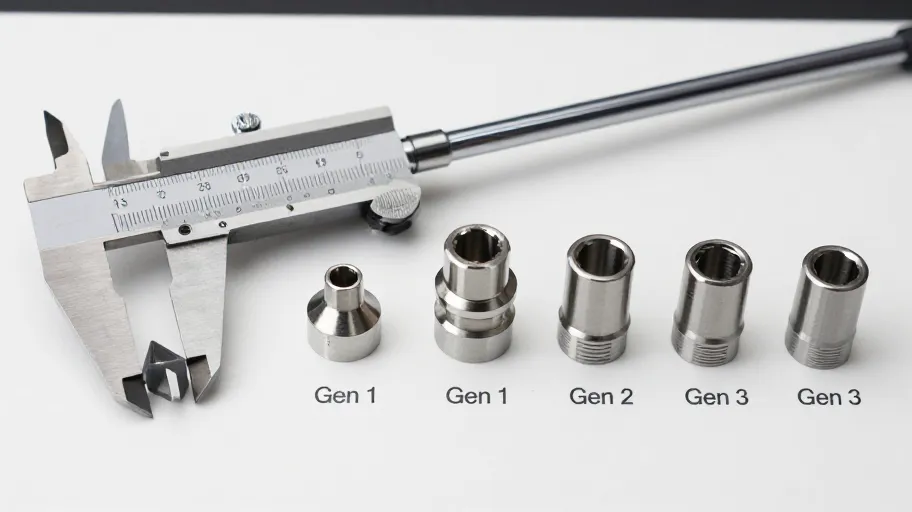
No. An adapter can only go on a shaft whose tip diameter, insertion depth and taper match that adapter's bore, and the adapter must belong to the family designed for your specific head model. Verify tip diameter, adapter generation and head interface in writing before you buy or bond anything.
The SHAFT framework for adapter–shaft compatibility
When a builder asks whether an adapter fits a shaft, they are really asking six smaller questions. Grouping them makes the approval process repeatable across brands and models.
S — Specs of the shaft. Start with the shaft's documented tip diameter and butt-to-tip geometry for the exact model. The supplier's spec sheet — not a listing title — is the source you approve against.
H — Head interface. Confirm the head's brand, family, generation and model. Adapter families differ within a single brand, and a sleeve that seats one head model may not seat another in the same family.
A — Adapter family. Match the adapter part reference to the head model reference, not to the brand name alone. Ask DIY-Golf to confirm the adapter-to-head pairing for your exact combination before ordering.
F — Fitment check. Dry-fit the adapter onto the prepared tip without adhesive. Confirm full seating, correct alignment marks and orientation relative to the head's adjustability positions.
T — Tolerance and prep. Ask the supplier what tip prep the adapter expects — abrasive treatment, cleaning, chamfer — and what torque value applies at final assembly. Do not assume a torque figure from a different product line; request the documented value for the exact adapter.
Documented approval. Record the spec sheet, the confirmed pairing, the dry-fit result and the torque value in one short log. That log is your defence when a build needs review or a component needs replacing.
Decision table: adapter–shaft scenarios
| Scenario | Compatibility status | Approval action |
|---|---|---|
| Tip diameter matches adapter bore; adapter family matches head model | Candidate for fitment | Dry-fit, then bond only after recording spec sheet and torque value |
| Tip diameter matches, but head model generation unclear | Unconfirmed | Request written confirmation of adapter-to-head pairing from DIY-Golf for the exact model |
| Adapter is for a different brand or family | Do not proceed | Source the correct adapter family; do not modify bore or tip to force fitment |
| Tip diameter differs from adapter bore | Do not proceed | Re-specify shaft or adapter; ask supplier for a matched pairing |
| Pre-owned adapter, history unknown | Unverified | Inspect for bore wear and thread damage; confirm part reference with supplier before use |
Spec questions to send before purchase
Treat these as a written exchange with the supplier; verbal reassurance is not an approval record.
- What is the confirmed tip diameter this adapter accepts?
- Which head models — brand, family, generation — does this adapter family pair with?
- What tip preparation does the adapter require before bonding?
- What torque value applies to final assembly for this exact adapter?
- What is the current stock position for the adapter and the shaft model you intend to pair?
- What is the current sample policy, cost position and shipping arrangement — and where are those documented?
- What inspection or defect-handling process applies if a delivered component does not match the confirmed spec?
DIY-Golf's public guidance pages can help you frame these questions, but the answers that matter are the ones returned for your specific model, in writing.
Sample and approval protocol
Once a sample is in hand:
- Measure the bore and compare against the shaft's documented tip diameter.
- Dry-fit and photograph full seating and alignment marks.
- Rotate through the head's adjustability positions to confirm index alignment.
- Log the result, then bond.
Pre-bond checklist
- Shaft tip diameter documented from the spec sheet
- Adapter family confirmed against the exact head model in writing
- Dry-fit completed; seating and alignment photographed
- Tip prep method confirmed for this adapter
- Torque value obtained for this exact adapter
- Sample, cost, shipping and returns policy confirmed directly with DIY-Golf
- Approval log assembled in one place
Get the sourcing brief. 获取采购 Brief — request the purchase-ready specification brief from DIY-Golf and confirm every compatibility question above for your exact club brand, family and model before you order.
FAQ
Does tip diameter alone determine adapter fit? It is necessary but not sufficient. Tip diameter, insertion depth, adapter family and head interface must all align. Approve the full combination, not one dimension.
Can I reuse an adapter from another club in the same brand? Only if the adapter family and generation match the target head model. Ask DIY-Golf to confirm the part reference against your head before reuse.
What if the adapter dry-fits but the alignment marks don't match the head's settings? Stop before bonding. Index mismatch signals the wrong adapter family or orientation; confirm the pairing in writing with the supplier.
Do I need a sample before ordering in quantity? For component sourcing, a sample or written spec confirmation lets you verify geometry before commitment. Confirm the current sample policy directly with DIY-Golf, including cost and shipping, since no terms were supplied here.
Where do torque values come from? From the supplier's documentation for the exact adapter. Request the value in writing; do not transfer a figure from a different product line or an undocumented source.
Use the pre-bond checklist above as your gate. Keep the checklist CTA simple: download or copy the checklist, run it once per build, and hold every order until every box is ticked.
Master Your Swing, DIY Your Fit. DIY Golf is the premier destination for the technical golfer. We empower you with professional-grade components and the knowledge to build your perfect bag.


