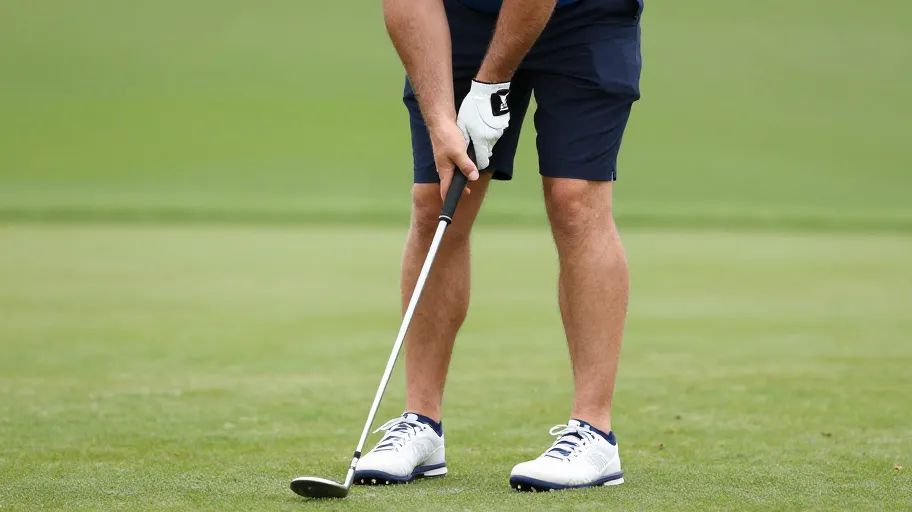
Does Rory McIlroy have a strong or weak grip? Based on widely circulated tournament footage and still photography, McIlroy plays a neutral-to-strong lead-hand grip: his lead hand sits rotated toward the target side of the handle rather than away from it. Treat this as a visual reference only — it is not a fitting prescription, and no measurable spec is published here.
What the Footage Actually Shows
Broadcast angles and grip-close photographs let you see knuckle counts, the trail-hand palm orientation and the "V" lines formed by thumb and index finger. In McIlroy's case, the visible pattern is consistent with a neutral-to-strong lead hand. That is an observation drawn from supplied and publicly visible footage — not a launch-monitor result, not a swing diagnosis and not a claim about any product he uses or endorses.
For club builders, the value of a tour reference is limited but real: it gives you a vocabulary for talking with a customer about what they want their hands to feel on a specific handle. It is not evidence about grip model, core size, layer count or fitment on any club you are building.
Strong, Weak and Neutral: A Builder's Classification
When builders discuss grip classification, they are describing hand position on the handle, not the grip product itself:
| Classification | Visible cue | What builders listen for |
|---|---|---|
| Strong | More knuckles visible on the lead hand; lead "V" points toward the trail shoulder or beyond | Customer wants a draw bias or releases the club early |
| Neutral | Roughly two knuckles visible; "V" lines point between chin and trail shoulder | Customer wants to keep ball flight options open |
| Weak | Fewer knuckles visible; lead "V" points at chin or lead shoulder | Customer fights a hook or delays release |
None of these classifications tells you which replacement grip to order. Classification informs conversation; component selection requires specs.
The GRAF Framework for Component Selection
Use the Grip-Reference Alignment Framework to move from "what does McIlroy do" to "what do I order":
- Gather the reference. Note the visible grip classification and, separately, the customer's own hand position and preferences. Do not merge the two.
- Relate it to the build. Record the club family, model, shaft butt diameter and desired final feel. A reference grip on one player's build does not transfer directly to another.
- Ask for specs. Request core size, wall construction, layer count and any build-up guidance from the supplier for the exact product and model you are considering.
- Fit-check before committing. Confirm fitment against the exact club and shaft combination on your bench, and document what you verified.
Decision Table: Translating a Reference Into a Sourcing Brief
| Situation | Reference reading | Sourcing action | Approval gate |
|---|---|---|---|
| Customer asks for "the McIlroy grip" | Neutral-to-strong lead hand, visually | Translate into feel targets, not a product name | Customer confirms feel goals in writing |
| Player fights a hook | Weak-to-neutral reference is irrelevant; map to their pattern | Ask supplier for options across the feel range | Supplier confirms specs for exact model |
| Re-gripping an existing club family | Reference is context only | Record butt diameter and current grip removal condition | Builder verifies core size compatibility |
| New build for a specific model | Reference grip classification recorded | Request spec sheet for the exact grip model and layer count | Fit-check on shaft before final assembly |
Approval Questions for Your Supplier
Before approving any order, document answers to these questions for the exact product and model:
- What is the core size and stated tolerance range for this grip model?
- What layer count options exist, and how does each affect final feel and size?
- What build-up tape configuration does the supplier document for this model?
- What is the recommended installation technique and solvent/tape guidance?
- What does the current sample policy include? Confirm the current policy directly.
- What are the current terms for cost, shipping and order quantities? Confirm the current policy directly.
Sourcing Checklist Before You Order
- Customer's own grip classification documented (not just the tour reference)
- Club brand, family and model recorded
- Shaft butt diameter measured on the bench
- Supplier spec sheet received for the exact grip model
- Fitment verified against the specific club and shaft
- Sample and order policies confirmed in writing — confirm the current policy directly
- All unknowns converted into supplier questions, not assumptions
FAQs
Does Rory McIlroy's grip classification tell me which grip to buy? No. It is a visual reference for hand position. Component selection depends on the specs of the exact grip model, the shaft and the club you are building.
Is a neutral-to-strong grip better for amateur players? There is no universal answer. Grip classification should be matched to the player's release pattern and shot goals, verified in a fitting context, not copied from a tour player.
How do I verify grip fitment for a specific club model? Measure the shaft butt diameter, obtain the supplier's spec sheet for the exact grip model, and fit-check on the actual component before final assembly.
Can I use a tour player's grip as a fitting starting point? You can use it as a conversation reference. You cannot use it as evidence about a product, its fitment or its performance on your build.
Where do I record supplier answers before approving an order? Use a structured sourcing brief so every spec, policy and fitment check is documented and comparable across supplier options.
Next Steps
获取采购 Brief — a structured template for documenting grip specs, fitment checks and supplier answers before you commit to any order.
Prefer to start small? Download the free sourcing checklist above and work through it on your next re-grip job.
Master Your Swing, DIY Your Fit. DIY Golf is the premier destination for the technical golfer. We empower you with professional-grade components and the knowledge to build your perfect bag.


