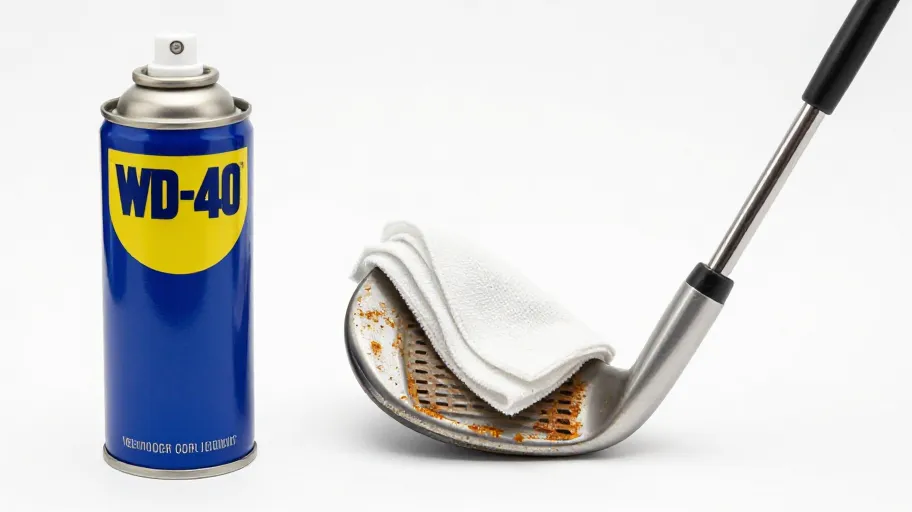
Does WD-40 remove rust from golf clubs? Yes — WD-40 can loosen light surface rust on clubheads, soles and shafts enough to wipe it away, but it is a penetrating lubricant rather than a dedicated rust remover. It works best on recent, shallow oxidation on plated or stainless surfaces, and it will not reverse pitting, plating loss or corrosion that has eaten into the metal. Used carelessly, it can also leave residue that affects grip adhesion and is worth keeping away from faces, grips and ferrules. The practical question for a golfer or club builder is not just whether it works, but whether the cleaned component is still worth playing — and, for anyone sourcing parts for a specific brand, family and model, when a verified replacement component is the sounder decision.
The Rust-Removal Readiness Check
Before you reach for any product, work through four gates. This framework keeps the decision disciplined and gives you a documented basis for approving or rejecting a component.
Gate 1 — Assess the surface. Determine whether you are dealing with surface discoloration, actual rust bloom, or pitting. Wipe the club with a dry cloth first. If a faint orange film comes off and the metal underneath is smooth, you have surface oxidation. If you feel roughness with a fingertip, the corrosion has a mechanical profile that no spray can restore.
Gate 2 — Match the method to the metal. Chrome-plated steel, raw stainless, raw carbon steel, and plated or painted shafts all tolerate different treatments. WD-40 is comparatively gentle on plated surfaces; abrasives, wire wool and acidic household remedies are where finishes get destroyed.
Gate 3 — Judge the risk to the finish. Any solvent can migrate. Keep penetrants away from grips (they can degrade adhesive and rubber), ferrules, epoxy joints, painted shaft graphics and, above all, the face and grooves, where residue could affect spin and ball interaction until fully cleaned.
Gate 4 — Decide: clean, keep, or replace. A cleaned club is not a restored club. If corrosion affects structural areas — hosel bore, neck, threads, or deep pitting on a shaft that will be epoxy-set — the correct sourcing move is to verify a replacement component for your exact model rather than approve a compromised part.
Decision table: rust condition, method and risk
| Rust condition | Reasonable first method | Finish risk | Approval verdict |
|---|---|---|---|
| Light orange film on chrome or stainless head | Apply WD-40 sparingly to a cloth, not the club; wipe, then wash with mild soap and water | Low if kept off grips and face | Approve for play after inspection |
| Rust spots on a plated shaft below the grip area | Solvent on a cloth, gentle wipe; re-wrap grip only after full drying | Moderate — residue under a new grip traps moisture | Approve only if the shaft is smooth underneath |
| Surface rust on raw carbon-steel wedges or irons | Dedicated rust remover or fine abrasives acceptable to the owner | High — changes appearance permanently; document before starting | Owner's call; record the finish change |
| Pitting, flaking or plating loss | None — cleaning cannot reverse it | Any attempt worsens appearance | Reject; source a verified replacement |
| Corrosion at hosel, bore or ferrule line | None — solvent can wick into the epoxy joint | High — bond integrity is not visually verifiable | Reject; do not reuse without professional inspection |
The safe method, step by step
If the decision table points you toward the solvent route, the work itself is simple:
- Clean the club with mild soap and water and dry it fully, so you are treating rust rather than dirt.
- Spray a small amount of WD-40 onto a soft cloth — never directly onto the club, which invites migration into grips and ferrules.
- Work the cloth over the affected area in light circles. Let the penetrant sit briefly on stubborn spots rather than scrubbing hard.
- Wipe away all residue, then re-wash with soap and water and dry completely. Residue left on the face or grooves is a playing-quality issue, not just a cosmetic one.
- Apply a light coat of a golf-specific protectant or oil appropriate to the finish, and store the club dry.
Note what this process is not: it is not restoration, and it is not a licence to use steel wool on plated finishes. If you find yourself reaching for abrasives to fix what a solvent could not, the component has moved from the cleaning column to the replacement column.
Approval questions before you reuse a cleaned club
Whether you are a golfer clearing a backup wedge back into the bag or a builder deciding whether a customer's shaft is serviceable, answer these before sign-off:
- Is the metal smooth under the removed rust, with no pitting you can feel with a fingernail?
- Is any corrosion clear of the hosel, bore, threads and ferrule line?
- Does the finish change matter to the owner — and has it been documented before and after?
- If this shaft will be re-epoxied, has the tip surface been inspected and prepped for bond?
- If this head will be resold or passed on, can you honestly describe its post-cleaning condition?
If any answer is "no" or "unsure," the component should not be approved for reuse on that basis alone. That is precisely the moment to verify a replacement part.
When replacement components are the better sourcing decision
For a reader researching a specific club brand, family and model, cleaning and replacing are not rivals — they are different answers to different corrosion severity. But replacement becomes the clear sourcing move when:
- The corrosion affects a bonded joint or structural area you cannot verify visually.
- The finish loss changes the club's value or the customer's acceptance criteria.
- The part is a matched-set member where an unmatching replacement would be worse than a documented used part — in which case fitment verification becomes the core task.
- You need the replacement to match a specific shaft model, flex, finish or adapter configuration.
That last point is where most sourcing projects stall. Compatibility across club families and model years is model-specific, and claims about fitment must be verified against current, first-party information for the exact product — not assumed from a photo or a part number that looks close. DIY-Golf publishes component selection and fitment guidance precisely so you can check family, model, adapter type, bore size and finish before anything is ordered; the current published page for the specific product is the evidence to rely on, and anything else should be confirmed directly.
FAQ
Does WD-40 damage chrome plating on golf clubs? Used sparingly on a cloth and wiped off thoroughly, it is a gentle option for light surface rust on plated finishes. The risk comes from residue left behind or from people escalating to abrasives when the solvent alone is insufficient. Keep it off the face, grooves, grips and ferrules.
Can I use WD-40 on a graphite shaft?
Will WD-40 remove rust from grooves? Do not rely on it for grooves. Groove contamination is a playing-performance issue, and any residue needs complete removal. Clean grooves with soap, water and a groove brush; if rust is established in the grooves, evaluate the face condition on its own merits.
How do I stop rust coming back after cleaning? Dry the clubs after every round, store them in a low-humidity environment rather than a damp car boot, avoid headcovers on wet clubs, and apply a protectant appropriate to the finish. Recurrence on a previously pitted area is a sign the corrosion was not purely surface-level.
The rust came back under my grip after cleaning — what does that mean? It means moisture was trapped, and the shaft surface under the grip needs proper inspection before any new grip goes on. If the shaft steel is rough or corroded beneath the grip tape, treat the shaft as a candidate for replacement and verify a matching component for your model rather than re-taping over the problem.
How do I confirm a replacement component fits my exact club model? Check the published fitment guidance for your brand, family and model, confirm the adapter or bore configuration, finish and length specification against the current product page, and raise any remaining questions directly with DIY-Golf before ordering.
Get your procurement brief
If the Rust-Removal Readiness Check has told you a component is past cleaning, the next step is a verified replacement. Request your procurement brief from DIY-Golf: tell us the club brand, family, model and the component you need, and we will confirm the relevant selection and fitment details with you before you commit. Request your procurement brief today.
Quick checklist before you source a replacement component
- Photograph the affected component before and after any cleaning attempt.
- Record the exact brand, family, model and, where applicable, the serial or batch marking.
- Confirm the shaft adapter or bore configuration for your model from the published fitment guidance.
- Note the finish and specification you need to match.
- List any questions about availability, condition or compatibility to confirm directly with DIY-Golf.
- Request the procurement brief with this information attached.
Master Your Swing, DIY Your Fit. DIY Golf is the premier destination for the technical golfer. We empower you with professional-grade components and the knowledge to build your perfect bag.


