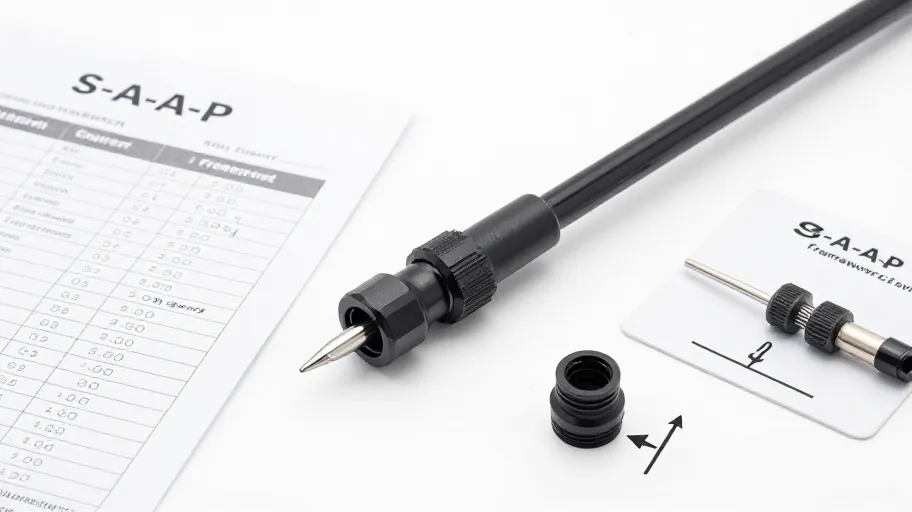
A driver shaft adapter must be verified against four things before you consider buying it: the exact club head brand, family and model; the adapter's connection type and orientation; the shaft tip diameter and prep method for your build; and the supplier's current sample, fitment and return policies. Use the S-A-A-P framework — Specs, Adapter family, Adapter-to-hosel check, Pre-approval — and document each stage in writing before the next.
Why adapter buying is a compatibility problem first
Most driver shaft adapter problems are not quality problems. They are documentation problems. A component that looks identical to the sleeve in a club head can differ in thread pattern, collar geometry, orientation marks, bore depth or shaft-side dimensions, and none of those differences are visible in a product photo. The buyer who ends up with an unusable adapter skipped a verification step, not a quality step.
That is why this guide treats adapter sourcing as a sequence of gates. You cannot meaningfully compare two adapters until you have written down what your build actually requires. You cannot request a sample until you know which sample to request. And you cannot approve a purchase until the sample has answered a defined set of questions.
Stage S — Collect the spec sheet for your build
Before comparing any driver shaft adapter, document the following from the club head and shaft you are working with:
- Club head: brand, family (model line), exact model name/markings, and generation or year if the family has been revised
- Hosel connection: the adapter's visible connection features as documented by the club manufacturer or your own measurement of the installed sleeve
- Shaft: tip diameter, and whether the shaft is prepared for the adapter's bore and clamp method
- Orientation and adjustability: the settings you need the adapter to support (face angle, loft adjustability), and the marking system on the adapter collar
- Hardware: what screw or wrench interface the adapter uses, and whether hardware is included with the component you are evaluating
None of these items should be assumed from a product listing image. Where a listing does not state a dimension or connection type explicitly, treat it as unverified and ask.
Stage A — Confirm the adapter family
Adapter families change between club generations even when model names stay close. When you compare a candidate adapter against your spec sheet, confirm the family mapping explicitly: ask the supplier to state, in writing, which club brand, family and model the adapter is designed to fit — and against which generation. If the supplier cannot state this, or answers only with a generic descriptor, that is a signal to escalate to a sample evaluation or walk away from that candidate.
Stage AA — The adapter-to-hosel and adapter-to-shaft check
The adapter sits between two components, so it has two fitment faces:
- Head side: does the adapter's connection geometry match your documented hosel? Confirm thread or spline features, seating depth and collar orientation against your spec sheet.
- Shaft side: does the bore accept your shaft tip diameter with your intended prep method? Confirm bore diameter, depth and any clamp or bonding requirements as project-specific questions for the supplier.
Record the answers. A verbal "yes it fits" is not a fitment record; a written statement of the dimension or connection type is.
Decision table: matching your build situation to the right checks
| Your situation | Priority check before ordering | What to request from the supplier | Approval condition |
|---|---|---|---|
| Replacing an adapter in a known current-model driver | Confirm the adapter family maps to the exact model and generation | Written compatibility statement naming brand, family and model | Statement matches your club head markings exactly |
| Cross-family build or tuning project | Confirm both fitment faces: head-side geometry and shaft-side bore | Dimensional description of bore and connection features, stated in writing | Both faces match your documented spec sheet |
| Buying for inventory across multiple club families | Confirm which families each SKU covers, SKU by SKU | A family-coverage list per SKU, not a combined claim | Each SKU has its own documented coverage list |
| Adapter supplied with unknown hardware | Confirm screw/wrench interface and whether hardware is included | Itemised contents of what ships with the component | Contents list matches your build requirements |
| Supplier cannot confirm fitment in writing | Escalate to sample evaluation before any quantity commitment | Current sample policy, terms and shipping arrangements — confirmed directly | Sample passes the approval questions below |
Stage P — Sample evaluation and pre-approval
If the compatibility documentation is incomplete, a sample is the cheapest risk control available — but only if you define acceptance before the sample arrives. Confirm the current sample policy, any associated costs and shipping arrangements directly with DIY-Golf or the supplier; do not rely on listings or third-party descriptions for commercial terms.
When the sample arrives, evaluate it against these concrete approval questions:
- Identity: does the sample carry the markings, collar references and features the supplier described in writing?
- Head-side fit: does the adapter seat into the target club head hosel as documented, with correct orientation behaviour at the settings you need?
- Shaft-side fit: does your shaft tip enter and align with the bore per your prep plan, without forcing?
- Adjustability: do the settings the adapter presents match the adjustability you specified in your spec sheet?
- Documentation: has the supplier provided the written compatibility statement you requested, naming your exact model?
- Commercial terms: have you confirmed current pricing, quantity terms, lead time expectations and return handling directly with the supplier, in writing, for this project?
If any answer is "no" or "unverified", the sample fails that gate and the finding goes back to the supplier before any approval.
Approval checklist before you commit
- Club head brand, family, model and generation documented
- Adapter family mapping confirmed in writing by the supplier
- Head-side connection features match the documented hosel
- Shaft-side bore matches tip diameter and prep method
- Hardware and contents confirmed itemised
- Sample (if used) passed all six approval questions
- Current sample, pricing, quantity, lead-time and return policies confirmed directly and in writing
- Approval decision recorded with date and evidence attached
FAQ
How do I know which driver shaft adapter fits my club? Start with the club head: document the brand, family, exact model and generation. Then ask the supplier for a written compatibility statement that names all of those fields. If the statement matches your head and your documented shaft-side requirements, the candidate advances to sample evaluation or purchase. If any field is missing, the adapter is unverified for your build.
Do adapters from the same brand fit every model in that brand's range? Do not assume family-wide coverage. Adapter geometry changes between generations even when model names are similar. Confirm the specific model and generation mapping per SKU with the supplier, in writing, before ordering.
Should I request a sample before buying an adapter? If the written compatibility documentation is complete and matches your spec sheet, a sample may be unnecessary for your decision. If any fitment face is unverified, request a sample and evaluate it against defined approval questions. Confirm the current sample policy and terms directly with the supplier.
Can I use one adapter with different shafts? The adapter's shaft-side bore is designed around a tip diameter and prep method. Any shaft you intend to use must match those documented requirements. Confirm the bore specification for your project and verify each shaft against it before assembly.
What records should I keep for a club-building project? Keep the spec sheet, the supplier's written compatibility statement, the completed approval checklist, and any sample evaluation findings. These documents are what let you re-order the correct component later or resolve a dispute about what was supplied.
Your next step
获取采购 Brief — download the sourcing brief and turn the S-A-A-P framework into a written record for your project: every spec question, every supplier statement and every approval decision in one document.
Low-friction option: if you are not ready to source yet, start with the approval checklist above. Run it against your current build and note which items are still unverified — that list is your next conversation with the supplier.
Master Your Swing, DIY Your Fit. DIY Golf is the premier destination for the technical golfer. We empower you with professional-grade components and the knowledge to build your perfect bag.


