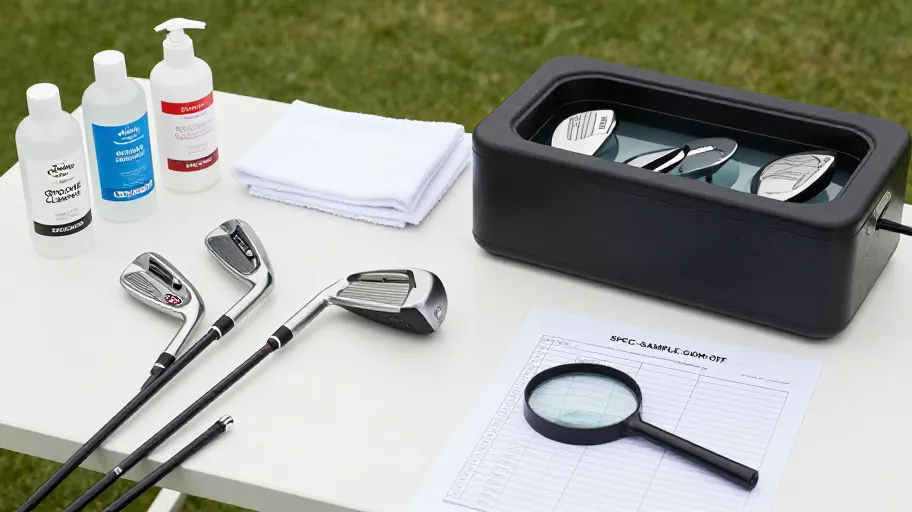
A golf club cleaning service is worth commissioning only when you can specify what will be cleaned, on which exact club brand, family and model, with which documented process, and against written sign-off criteria you approve in advance. The safest buying path is SPEC–SAMPLE–SIGN-OFF: define the specification, require a sample outcome on a low-value component, and approve a written gate before any batch is released. Everything else — price, turnaround, shipping of goods, rework terms — must be confirmed directly with the provider, because none of it can be assumed from a service description.
Why builders treat cleaning as a sourcing decision
If you service clubs for customers, resale, or your own workshop inventory, cleaning sits inside your quality chain, not alongside it. A cleaning process that dulls a satin finish, swells a ferrule, degrades a shaft's coating or leaches under a laser-etched logo creates a warranty conversation you did not plan for. That risk is why the buyer's job is not to find "a cleaner" but to define a controllable process with a provider who will confirm, in writing, what they do to each component class.
The reader of this guide is assumed to be working on a specific club brand, family and model. That matters: processes that are acceptable on a stainless cavity-back may be unacceptable on a raw carbon wedge, a chromed forging, a painted crown or a urethane-covered head. Model-level confirmation is the core of the specification.
The SPEC–SAMPLE–SIGN-OFF framework
| Stage | What you do | Output |
|---|---|---|
| SPEC | Document component types, finishes, model families, contamination to remove, and any no-go processes (abrasives, solvents, heat, ultrasonic exposure) | A written specification sheet you can send to the provider |
| SAMPLE | Ask the provider to process one low-value or sacrificial component first, and to document the method used | A physical reference plus a stated process description |
| SIGN-OFF | Compare the sample against agreed acceptance criteria; get rework, liability and communication terms in writing before batch release | An approval record that protects both sides |
The framework is deliberately boring. Boring is what you want in a handover document. Every point the provider will not put in writing becomes a point of dispute later.
Decision table: commission or clean in-house?
| Situation | Commission a service? | Rationale |
|---|---|---|
| High-value heads, rare finishes, client-owned clubs | Yes, but only after a signed-off sample | Damage risk justifies a documented third-party process |
| Bulk shop inventory of durable, plain finishes | Compare options | Process control matters more than speed; request the spec sheet first |
| Single personal set, low sentimental value | Reader's choice | Weigh cost of the service against replacement value — confirm pricing directly |
| Components pending resale or photography | Yes, sample-first | Presentation quality is the sale; approval criteria should be visual and measurable |
| Unknown finish or unmarked components | Stop | Identify the material/finish before any process; ask the provider how they classify unknowns |
Writing the specification
Your spec sheet should ask the provider to confirm, per component class:
- Which cleaning agents and tools they apply to heads, hosels, shafts, ferrules and grips.
- Whether any process involves heat, ultrasonics, abrasives or solvent immersion, and on which materials these are excluded.
- How they protect removable or sensitive parts: weights, screws, decals, custom paint fill, shaft labels.
- How they handle disassembly and reassembly, and who performs it.
- What they will not accept, and how they communicate refusals before work starts.
- How outcomes are inspected and recorded, and what the sign-off evidence looks like.
- Their current policy on damage, rework and item return — confirm each point directly; do not rely on a verbal summary.
Sample and approval questions
Before releasing a batch, put these questions to the provider and keep the answers:
- Will you process one sample component first and document the exact method used on it?
- Can you confirm in writing that the process is compatible with [brand / family / model] and its specific finish?
- What acceptance criteria do you propose, and can we agree them before work starts?
- If the sample fails my criteria, what is your rework position and cost treatment? (Confirm current policy directly.)
- How are items packed and returned, and who is responsible in transit? (Confirm current policy directly.)
- What is your current sample policy, fee structure and lead time? (Confirm directly; these are project-specific.)
Sign-off checklist
- Specification sheet sent and acknowledged in writing
- Model-level compatibility confirmed by the provider for each family
- Sample processed on a low-value component and physically inspected
- Sample method documented and matched against the spec
- Acceptance criteria agreed before batch release
- Rework, damage and liability terms confirmed in writing
- Return packaging and transit responsibility confirmed
- Batch approval recorded with date, scope and criteria
FAQs
Is ultrasonic cleaning safe for golf clubs? It depends on the component, its finish and the solution used. Some assembled heads and finishes tolerate it; others do not. Ask the provider to state which of your specific models they will and will not ultrasonically clean, and to put it in writing.
Can a cleaning service remove rust from forged wedges? Rust removal on raw or chromed forgings is finish-sensitive: some methods alter surface texture. Request a sample on a sacrificial wedge and inspect texture and edge finish against your criteria before approving.
Should grips and shafts be cleaned by the same service? Treat them as separate scope items. Shafts have coatings, wraps and labels with different tolerances than heads; grips are elastomeric and absorb solvents differently. Ask the provider to specify their process per component class.
How do I verify the provider actually used the documented process? Ask for the process record tied to your sample and batch, and inspect a random component against the approved sample. Consistency between the record and the physical outcome is your evidence.
What if the provider refuses a sample first? That refusal is itself a decision input. A provider who cannot demonstrate their process on one low-value component has given you no basis for approving a batch — compare alternatives instead.
Primary CTA: 获取采购 Brief — request the DIY-Golf procurement brief, a ready-to-send specification and approval questionnaire for commissioning a golf club cleaning service against your exact brand, family and model.
Low-friction checklist CTA: Download the free SPEC–SAMPLE–SIGN-OFF checklist above and use it on your next provider enquiry — no purchase required.
Master Your Swing, DIY Your Fit. DIY Golf is the premier destination for the technical golfer. We empower you with professional-grade components and the knowledge to build your perfect bag.


