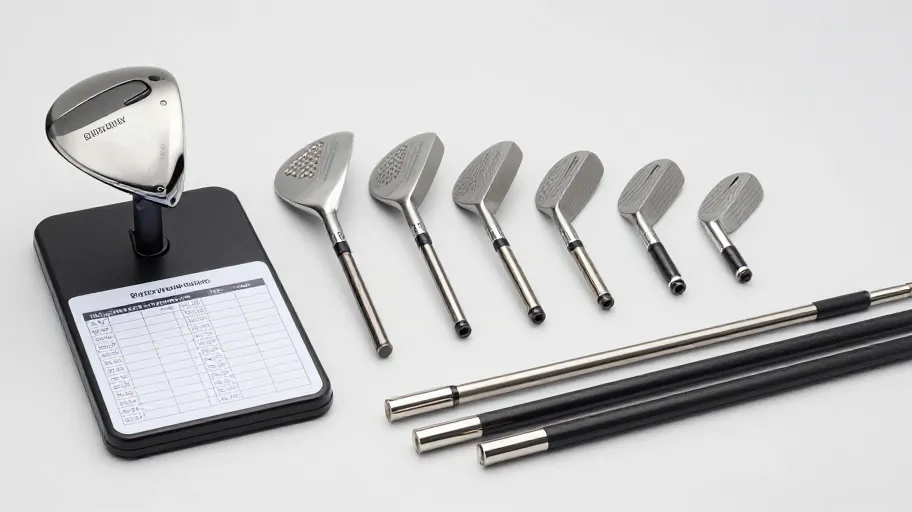
Golf club head weights are the grams assigned to the club head — or added to it — to move the finished club toward a target swingweight and feel. To choose the right one, verify the exact club model and hosel configuration, document the current head weight, shaft weight, grip weight and playing length, then compare candidate components against that baseline. Confirm the current policy directly on any sample or ordering question before you commit.
The W.E.I.G.H. framework for head weight selection
Use this framework to turn a component purchase into a documented decision:
- W — Weigh the baseline. Record the current assembled club's total weight and, where possible, the head weight alone. Without a baseline, every comparison is a guess.
- E — Evaluate your target. Define what you want to change: swingweight, feel at impact, or build consistency across a set. Each goal needs different data.
- I — Identify model fit. Confirm the candidate weight component matches the exact club brand, family, model and hosel or port configuration. Confirm the current policy directly on fitment claims and stock.
- G — Gather samples. Request a sample and measure it yourself before approving a batch. Sample and ordering terms vary by supplier and order. Confirm the current policy directly.
- H — Hold the approval gate. Only approve after documented measurement, fitment confirmation and a written record of what you accepted.
Decision table: matching your goal to verification steps
| Your goal | Key question | Verification step | Approval gate |
|---|---|---|---|
| Hit a target swingweight | How many grams does the head need to gain or lose? | Weigh baseline components; calculate change against shaft, grip and length | Calculated spec recorded and sample measured |
| Match a set build | Are heads consistent across clubs? | Weigh every head; record spread | Each head documented against spec |
| Replace a lost weight component | Does it fit the exact model and port? | Confirm part reference against club model; inspect sample fitment | Fitment verified on the actual club |
| Tune feel without full rebuild | Is a weight change the right lever? | Compare with shaft/grip alternatives before buying | Change justified in notes before purchase |
| Source for multiple builds | Can the supplier hold spec across a batch? | Ask for written spec commitment; sample first | Written spec acknowledged by supplier |
Spec documentation: what to request and record
Ask every supplier or store for, and keep on file:
- Stated head weight in grams for the exact product reference
- Material description, confirmed against first-party evidence rather than marketing copy
- Compatible club family, model and hosel or port type — verified, not implied
- Finish and any markings, so you can match a replacement to an existing set
- Any dimensional details relevant to fitment, confirmed against your own measurement of the club
Do not treat a marketplace listing as spec documentation. Photograph and weigh what arrives, and keep the record with the invoice.
Sample approval questions
Before approving a component, get written answers to these:
- What is the stated head weight for this exact product reference, and how is it verified?
- Which club brands, families and models is it confirmed to fit — and by whom?
- What does a sample order include, and what are the current terms? Confirm the current policy directly.
- If a delivered component does not match the documented spec, what is the resolution path? Confirm the current policy directly.
- Can the spec be held across a batch if I reorder the same reference?
- Is any return or exchange available for fitment mismatches? Confirm the current policy directly.
FAQs
Do heavier golf club head weights always increase swingweight? Adding head weight raises swingweight relative to the same build, but the final number depends on shaft weight, grip weight and playing length. Weigh and document the full build before predicting an outcome.
How do I know a head weight fits my specific club model? Confirm the club brand, family, model and hosel or port configuration against the component's stated compatibility, then verify fitment on a sample. Do not rely on implied compatibility from a listing image.
Should I buy a sample before ordering more? For club builders sourcing components, measuring a sample against documented specs is the safest approval path. Sample terms differ by supplier. Confirm the current policy directly.
Can a head weight change fix an off-spec set? It can be one lever, but first document where the inconsistency sits: head weight, shaft, grip or length. Approving a weight purchase without that baseline measurement creates more variance, not less.
What records should I keep after approval? Keep the spec sheet, your own measurements, photos, supplier correspondence and the acceptance note. If you reorder, this record is your reference for checking whether the batch matches what you originally approved.
Next step
Get the sourcing brief — a one-page template that structures spec requests, sample measurements and approval notes for golf club head weight purchases, so every reorder is measured against a documented baseline.
Before you buy: a five-minute checklist
- Baseline club weighed and recorded
- Exact club brand, family, model and hosel identified
- Candidate component spec sheet requested in writing
- Sample planned for measurement before batch approval
- Fitment, policy and resolution questions sent to the supplier
- All answers documented in one file
Master Your Swing, DIY Your Fit. DIY Golf is the premier destination for the technical golfer. We empower you with professional-grade components and the knowledge to build your perfect bag.


