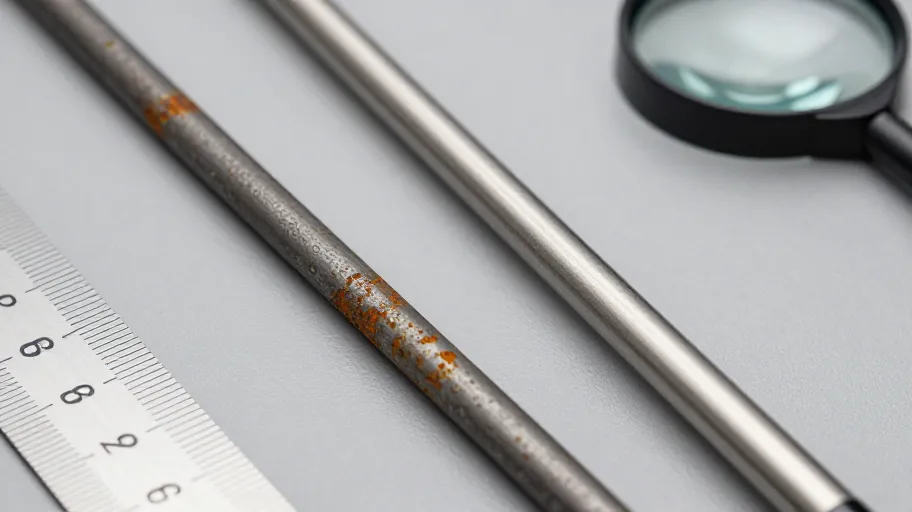
Rust on golf club shafts is a sourcing question before it is a cleaning question: if you are replacing or tuning components for a specific club brand, family and model, the way to prevent corrosion surprises is to confirm the shaft's material and finish in writing, inspect a sample against those specs, and get written sign-off before any larger order moves. This guide walks through that approval loop step by step.
Why "rusting" belongs in your spec sheet, not your maintenance routine
As a buyer working to a defined club model, you are in a stronger position than a consumer: you can demand documentation. The right move is not to hope the finish holds up, but to make finish behaviour an explicit, verifiable line item in your specification.
The Spec-to-Sample Approval Loop
Use a three-gate framework before committing to any shaft order:
- Spec. Write down, for the exact brand, family and model you are matching, the shaft material, finish description, flex and weight options, and the corrosion behaviour you require. Ask the supplier to confirm each line in writing.
- Sample. Request a sample of the specific shaft variant. Inspect the finish, any markings, and how the surface responds to handling and storage conditions in your workshop.
- Sign-off. Document what you approved — photos, notes, the sample reference — so any later delivery can be compared against an agreed baseline rather than a memory.
Each gate exists because assumptions are where corrosion complaints start. A finish name on a product page is not a specification. A specification is a written confirmation from the supplier about that exact item.
Decision table: qualifying a shaft's finish before you order
| Question to resolve | What to confirm with the supplier | What you record at sign-off |
|---|---|---|
| Is the shaft steel or another material, and is the construction appropriate for the model? | Material and construction confirmed in writing for the exact variant | Material line in the spec sheet |
| What is the finish, exactly? | Named finish (e.g. plating, coating, raw) confirmed for the specific SKU, not the family | Finish description plus sample photos |
| How does the finish behave with moisture and storage? | Ask directly what care and storage conditions the supplier documents for that finish | Storage and care notes attached to the spec |
| Does the sample match the spec? | Compare sample finish, weight markings and labels against the written confirmation | Approved-sample reference noted on the order |
| What happens if delivered goods differ from the sample? | Ask the supplier to state its current policy for discrepancies; do not assume terms | Agreed discrepancy-handling step in writing |
| Can the supplier support repeat orders to the same spec? | Ask whether the same variant can be supplied consistently and how changes would be flagged | Change-notification question logged |
Read the middle column as your question list, and the right column as your evidence file. A buyer who can show an approved-sample reference resolves disputes far faster than one relying on a screenshot of a product page.
Approval questions to send before you commit
Turn every unknown into a direct question. None of the following answers should be guessed; ask and record:
- "Please confirm in writing the material and finish of this shaft for [club brand, family, model]."
- "Can you supply a sample of this exact variant before we place a larger order?"
- "What storage and handling conditions do you recommend for this finish, and is that documented anywhere I can keep on file?"
- "If the delivered shafts show surface corrosion on arrival, what is your current process for handling that?"
- "Will you notify us if the finish or supplier for this variant changes between orders?"
Note what these questions deliberately do not assume: sample fees, shipping costs, lead times, defect handling or any guarantee of performance. Those are the supplier's current policies to state — confirm them directly rather than reading an assumption into a listing.
Matching the shaft to the exact club model
Fitment is the other half of the rusting question. A shaft that corrodes differently from the head or hosel finish you are pairing it with can look mismatched even when both parts are sound. Before ordering:
- Record the full club identity — brand, family, model, and where relevant the generation year — and require the supplier to confirm the shaft is offered for that exact model. Do not accept "compatible" as shorthand; verify the match against the supplier's own fitment documentation.
- Confirm the shaft's flex, weight and tip dimensions against what your build requires, and ask the supplier to confirm each figure in writing rather than inferring from a category page.
- Keep the approved sample tied to the model record, so future rebuilds of the same club draw from the same approved spec.
Inspecting a sample for finish and corrosion risk
When your sample arrives, work through it methodically:
- Photograph the shaft under consistent light from several angles before you handle it extensively — that becomes your baseline.
- Check labels, banding and any printed model markings for legibility and consistency with the written spec.
- Look at ferrule area, tip section and any machined or stepped regions, where finish irregularities are easiest to spot.
- Store part of your stock as you actually store components — in your workshop's humidity and temperature — and inspect again after a realistic interval. Your storage conditions, not a catalogue photo, are the environment your stock lives in.
- Record findings against the spec sheet. If something deviates, raise it against the written confirmation, not against a verbal comment.
FAQ
Should I avoid shafts that can rust at all? Not necessarily. Different finishes serve different purposes, and some buyers deliberately choose finishes for their look or feel. The sourcing question is whether the finish matches what was confirmed in writing and whether you know how to store and care for it. Decide based on your spec, not on a general fear of rust.
Is surface rust on a new shaft a defect? That is a question for the supplier under the process you agreed at sign-off. What you can do as a buyer is document the condition on arrival with photos and reference the approved sample and written finish confirmation. Do not pre-judge what counts as a defect; let your agreed process answer it.
Can I just clean rust off a shaft and carry on? Cleaning addresses the symptom on the part in your hand. If you are sourcing at any volume, a shaft that arrives with corrosion raises a specification question: did the goods match the confirmed finish description? Compare against your spec and sample, and raise it with the supplier through the process you documented.
Do I need a sample for every variant? Sample each variant you intend to order — different flexes, weights or finishes of the same shaft family can differ in finish application and markings. If you extend to a new variant later, repeat the sample gate rather than assuming the earlier approval covers it.
What documentation should I keep after approval? Keep the written spec confirmation, sample photos, the storage and care notes the supplier provides, and your inspection record. Together these form the baseline you compare any future delivery against.
Request your sourcing Brief
DIY-Golf can turn the questions in this guide into a structured document for your project. [Request the sourcing Brief] and receive a question set organised around your club's brand, family and model — material, finish, sample handling, storage notes and discrepancy process — so you can put every confirmation point to the supplier in one pass and approve against written specs rather than product-page impressions.
Before you order: the six-point pre-order checklist
A lighter-weight step if you are not ready for a full Brief. Save this list and run it against any shaft listing:
- Club identity recorded: brand, family, model, generation.
- Material and finish requested in writing for the exact variant.
- Sample requested before any larger commitment.
- Storage and care notes obtained from the supplier and filed.
- Discrepancy-handling process agreed before delivery, not after.
- Approved-sample reference logged against the order.
Master Your Swing, DIY Your Fit. DIY Golf is the premier destination for the technical golfer. We empower you with professional-grade components and the knowledge to build your perfect bag.


