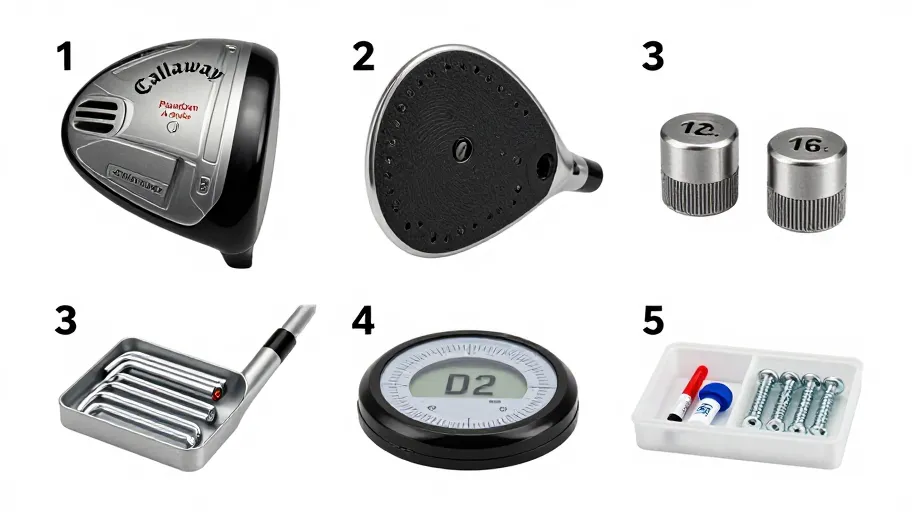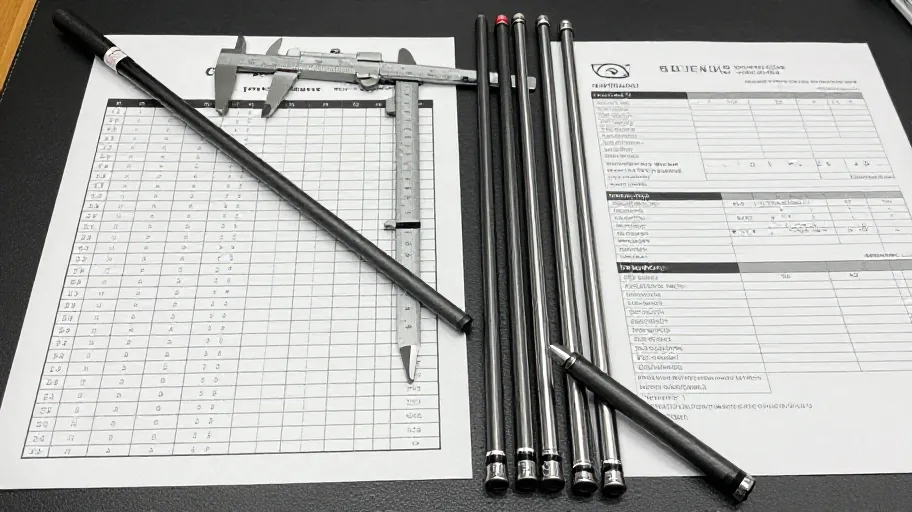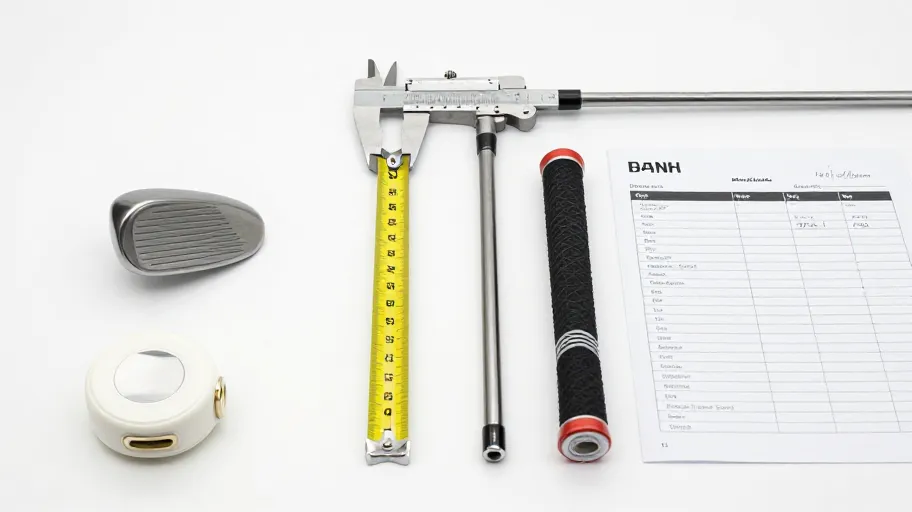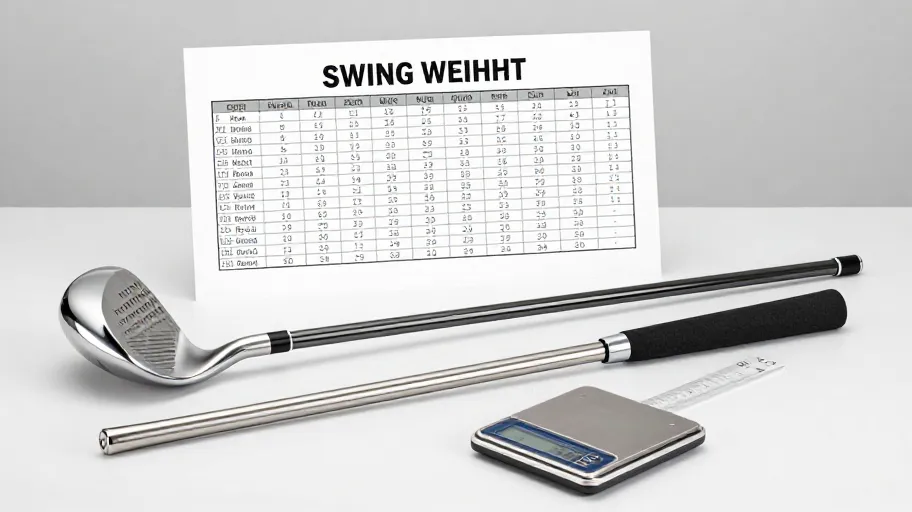
A golf club swing weight chart PDF is a reference table that maps a club's measured swing weight — its balance feel during the swing — against component variables such as head weight, shaft weight, shaft length and grip weight. For a club builder or sourcing researcher, the chart's real value is as a verification tool: it lets you cross-check whether a proposed replacement head, shaft or grip for a specific model will land near your target swing weight before you approve anything. Use it as part of a documented spec conversation with your supplier, not as a standalone promise of fitment.
How to read a swing weight chart
Swing weight is expressed on an alphanumeric scale (for example, C9, D0, D2). Each step on the scale reflects a shift in how the club's mass is distributed along its length — not the total weight of the club. When you read a chart:
- Identify the scale convention used in that specific PDF. Charts can differ in layout and labelling, so verify the source document before relying on it.
- Locate your measured value (from a swing weight scale) or your target value.
- Trace the component variables the chart tracks — head weight, shaft weight, length, grip weight — and note the stated increments.
- Remember that a chart is a model, not a measurement. Final confirmation requires weighing and measuring the actual components for your exact club model.
Because charts vary, document which PDF version you used in your build notes. If two charts disagree, treat the difference as a signal to verify with a physical scale rather than to pick the more convenient number.
The SPEC-KIT framework
When evaluating replacement or tuning components for a specific brand, family and model, apply the SPEC-KIT framework:
- S — Scale reading. Establish the current swing weight of the reference club on a calibrated scale. Record it alongside length, head weight, shaft and grip details.
- P — Part match. Confirm the exact component part numbers and model family match the club you are servicing. Do not assume cross-family compatibility without first-party confirmation.
- E — Effect target. Define the swing weight change you want, and translate it into the component variable you intend to change (head weight, shaft, grip or length).
- C — Chart cross-check. Use your golf club swing weight chart PDF to sanity-check that the planned change moves in the right direction and plausible magnitude.
- K — Kit consistency. Check the whole set. Matching one club to target while leaving others unchanged creates set progression gaps.
- T — Internal test. Verify the finished build on a scale and, where relevant, in a controlled hitting session before sign-off.
Decision table: applying the chart to component scenarios
| Scenario | What the chart tells you | What you must verify | Approval action |
|---|---|---|---|
| Replacing a head on an existing shaft | Directional effect of head weight difference on swing weight | Exact head weight of both old and new parts; hosel fitment | Weigh both heads; confirm fitment with supplier before approving |
| Re-shafting the same head | How shaft weight and length shifts map on the scale | Raw shaft weight, trim code, tip trim for the model | Confirm trim guidance and assembled length with the supplier |
| Changing grips only | Magnitude of grip weight change per scale step | Exact grip weight and core size | Weigh grips; confirm core matches shaft butt |
| Building a full set | Progression of swing weight across the set | Head weight tolerancing per club | Request per-club weights; verify each assembled club |
| Tuning with weighting tape or tip weights | Approximate step change per added increment | Where weight is added affects the reading | Test on a scale after each adjustment |
Supplier approval questions
These questions replace assumptions. Do not rely on any stated norm — ask, document and compare.
- What is the exact weight of this component for my specific model and family?
- Which swing weight scale convention does your documentation reference?
- Can you supply the current spec sheet matching the part number I am ordering?
- What is your current sample policy, cost and shipping arrangement for this component? Confirm the current policy directly.
- What fitment details (hosel, tip, butt, core) apply to this part for my club model?
- How do you document batch consistency across a set of components?
- What is your current arrangement for verifying a build before full order commitment? Confirm the current policy directly.
Sample approval checklist
- Reference club measured and recorded (swing weight, length, component details)
- Chart PDF version identified and noted in build documentation
- Exact part numbers confirmed against the target club family and model
- Component weights requested from supplier and compared against chart expectation
- Fitment dimensions and interface details confirmed in writing
- Sample policy, cost and shipping confirmed directly with the supplier
- Assembled sample measured on a calibrated swing weight scale
- Set progression checked across all clubs in the kit
- All discrepancies documented and resolved before approval
FAQs
Do all swing weight chart PDFs use the same scale? The alphanumeric scale convention is widely shared, but chart layouts, increments and supporting data can differ between documents. Verify the specific PDF you are using and record its source in your notes.
Can I predict final swing weight from a chart alone? A chart is a planning tool. Final swing weight depends on the actual weights and dimensions of your specific components, so verify on a calibrated scale after assembly.
How does grip weight affect swing weight? Grip weight is one of the variables charts track; a change at the grip end moves the reading in the opposite direction from a change at the head end of the same magnitude. Use your chart to estimate direction, then verify with the actual grip.
What should I ask a supplier before approving replacement components? Ask for exact component weights, spec sheets matching your part numbers, fitment details for your model, and their current sample and verification arrangements. Confirm the current policy directly.
Is a chart enough to match a set of clubs? No. A chart helps you plan the progression, but each assembled club should be individually measured and recorded before you approve the build.
Next steps
If you are sourcing replacement or tuning components for a specific club family and model, 获取采购 Brief to structure your supplier conversation around documented specs rather than assumptions.
Prefer to start lighter? Download or copy the sample approval checklist above and work through it against your current component shortlist — no further steps required.
Master Your Swing, DIY Your Fit. DIY Golf is the premier destination for the technical golfer. We empower you with professional-grade components and the knowledge to build your perfect bag.