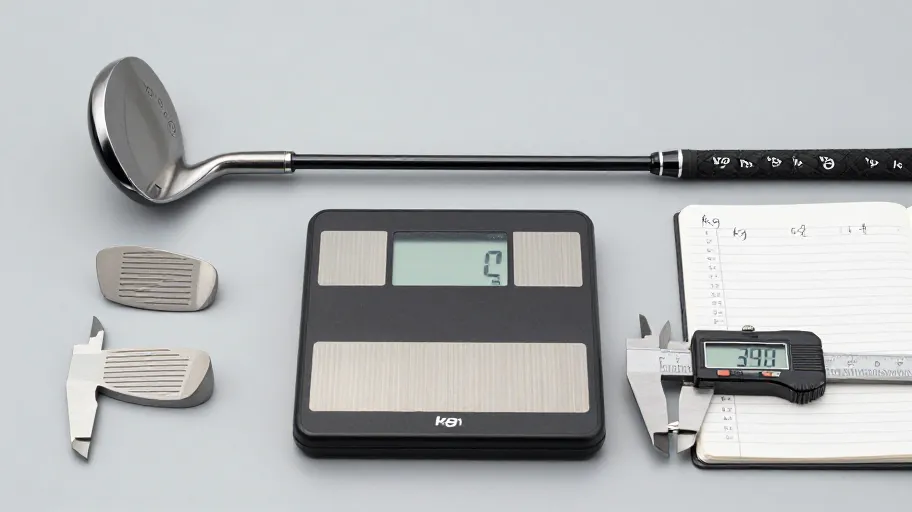
Golf club weight in kg is the mass of either a complete assembled club or an individual component, expressed in kilograms rather than grams or ounces. Before you compare or order any replacement part, define which mass the spec refers to, measure your reference club yourself, and document both figures in kg. That documented comparison — not the number on a listing — is what lets you approve a sample with confidence. This guide gives you a framework, a decision table and the approval questions to put to the supplier.
The W-S-A framework: Weigh, Standardise, Approve
When you are sourcing a replacement head, shaft or grip for a known club family, ad-hoc comparisons create risk. Use three disciplined steps:
Weigh. Put your reference component on a calibrated scale and record the reading. Write down the resolution of the scale, because a reading you cannot reproduce is not a specification you can approve against. If the club is currently assembled, weigh it complete, then record each component as you disassemble it — or plan the disassembly with your builder.
Standardise. Convert everything to kg and fix a rounding convention before you compare. Practical conversions:
- 1 kg = 1000 g
- 1 oz ≈ 0.02835 kg
- A figure quoted as "305 g" is 0.305 kg
Golf components are light, so small absolute errors matter proportionally. A mis-keyed conversion can shift your comparison more than any genuine difference between candidate parts. Round consistently — say, to three decimal places in kg — and record the convention on your build sheet.
Approve. Turn the comparison into a written acceptance question for the supplier: "Please confirm the mass of this component in kg, the measurement basis, and the tolerance you will hold." Never approve a weight-sensitive order on an unstated tolerance or an unverified figure.
What to weigh and record
A useful weight record for a sourcing decision contains at least four lines, all in kg:
| Line item | What to record | Why it matters |
|---|---|---|
| Assembled club mass | Complete club as played | The figure a golfer actually feels |
| Head mass | Head alone, no shaft or grip | Drives swingweight and feel after rebuilds |
| Shaft mass (raw and cut) | Uncut shaft and final cut length | Raw mass differs from installed mass; record both |
| Grip mass | Grip plus any tape allowance you apply | Small mass, but it affects the final balance |
Add two more fields if you can obtain them: measurement basis (who weighed it, on what scale) and the tolerance the supplier will confirm in writing. These two fields separate a usable specification from a marketing number.
Decision table: turning kg data into a sourcing decision
| Situation | What the weight data tells you | Sourcing action |
|---|---|---|
| Replacement head, same model family | Compare head mass in kg against your measured reference | Ask supplier to confirm head mass and tolerance before ordering |
| Tuning an existing build | Assembled mass is the reference; component swaps change it | Model the change on paper first; request component masses for each candidate |
| New shaft for a known head | Shaft raw mass plus expected cut length drives installed mass | Request raw shaft mass in kg and confirm cut-length assumptions |
| Grip replacement | Grip mass plus tape mass shifts balance modestly | Confirm grip mass and your tape method; document both |
| Cross-brand comparison | Different brands may quote different measurement bases | Ask each supplier for the same measurement basis in kg; do not compare mixed-basis figures |
| Sample received | Scale reading vs supplier's confirmed figure | Approve only if the reading falls within the tolerance the supplier stated in writing |
Approval questions to put to the supplier
Before any weight-sensitive order, send these questions and keep the answers on file:
- What is the mass of this exact component in kg, and is that figure for the raw part or the installed configuration?
- What measurement basis and scale resolution were used to produce that figure?
- What tolerance will you hold on mass for this component, and will you confirm it in writing?
- Is the sample you ship produced by the same process and tooling as the production parts you would deliver?
- What is your current policy on samples and on confirming specifications before an order? (Confirm the current policy directly; do not rely on second-hand descriptions.)
- If a delivered component's measured mass falls outside the stated tolerance, what is your resolution process?
These questions are not confrontational. A supplier who answers precisely is one you can document against; vague answers are themselves decision data.
Common pitfalls when comparing weights in kg
- Mixed bases. Comparing an assembled-club figure against a component-only figure. Always state what was weighed.
- Mixed units. Grams, ounces and kg in one spreadsheet. Standardise to kg first.
- Unstated tolerance. A nominal figure without an accepted range cannot be approved or rejected — it can only be believed, which is not a sourcing method.
- Undocumented reference. If you did not weigh your own reference club, every downstream comparison inherits that gap.
- Assumed fitment. Weight data alone does not confirm fitment for your specific brand, family and model. Verify fitment separately with first-party evidence for the exact product.
FAQ
Is golf club weight quoted in kg or grams? Both appear in the wild, which is exactly why you should standardise. Convert every figure you receive into kg and record the conversion so a reviewer can check it.
What is more important: total club weight or component weight? They answer different questions. Total assembled mass tells you how the club will feel; component masses tell you whether a replacement part will reproduce or change that feel. For sourcing decisions, record both.
How close should a replacement component's weight be to the original? That depends on the tolerance the supplier confirms and how sensitive the build is. Ask for the tolerance in writing, weigh the sample yourself, and approve against the stated range rather than a feel-based judgement.
Do I need a special scale to verify component weight? You need a scale whose resolution and calibration you can state. Record both on your build sheet so the measurement is reproducible and reviewable.
Does matching the weight in kg guarantee matching performance? No. Weight is one variable among several, and no compatibility, performance or fitting outcome can be claimed without verification for the exact product and model. Treat weight data as a gate to pass, not a promise of results.
Next step: 获取采购 Brief
Ready to turn this framework into a documented sourcing decision? 获取采购 Brief and use it to record your measured kg figures, the supplier's confirmed specifications and your approval criteria in one place before you commit to an order.
Low-friction checklist CTA
Not ready to request the brief? Download the component weight verification checklist — four weigh-ins, one conversion convention, six approval questions — and run it on your next sample review. No commitment; just a repeatable record you can hand to any supplier.
Master Your Swing, DIY Your Fit. DIY Golf is the premier destination for the technical golfer. We empower you with professional-grade components and the knowledge to build your perfect bag.


