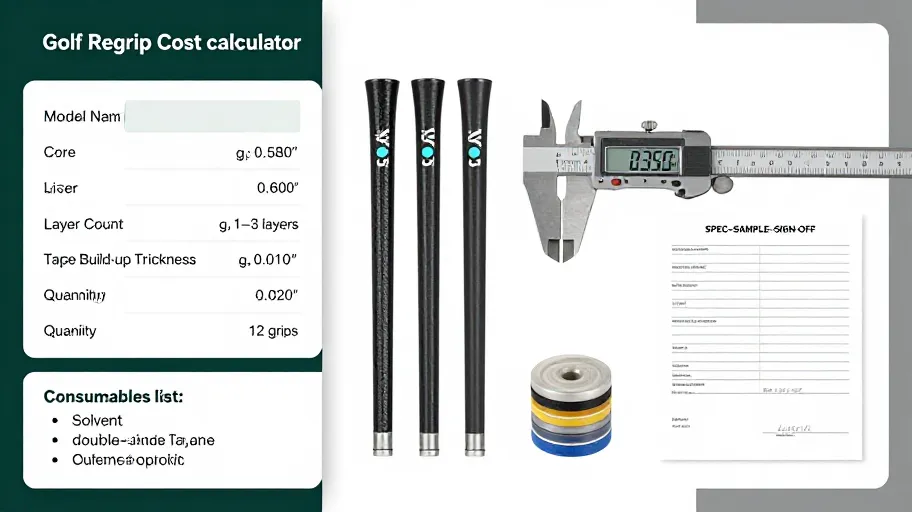
A golf regrip cost calculator is a budgeting and comparison tool: it converts your grip specification — grip model, core size, layer count, tape build-up, quantity and consumables — into an estimate you can test against supplier quotes. Its value depends less on the arithmetic than on whether the inputs match your project. Use the SPEC–SAMPLE–SIGN-OFF framework: define specifications precisely, verify physical samples, and approve terms in writing. Confirm the current policy directly for every supplier-specific term.
What a regrip cost calculator actually does
Any credible golf regrip cost calculator performs three jobs:
- Structures your inputs so nothing about the grip specification is left to assumption.
- Produces a comparable estimate you can hold against multiple supplier quotes on equal footing.
- Surfaces variables that change the total — grip model mix across a set, shaft butt diameter differences between clubs, tape build-up, solvent or tape consumables, and quantity breaks.
What it cannot do is know your supplier's current pricing, packaging, tooling or shipping terms. That is why the calculator output is a planning figure, and the signed quote is the decision figure. Treat the two as separate documents.
SPEC: the inputs you must lock before calculating
Before running any estimate — your own spreadsheet or an online tool — record the following per club or per batch:
- Grip model and manufacturer part reference
- Grip core size and whether it is a reduced-taper design
- Shaft butt diameter per club (may differ between irons, wedges and putters)
- Number of wrap layers or build-up tape required to reach target feel and size
- Quantity per model, and whether the set mixes grip models
- Consumables: tape, solvent or activation method, vise protection
- Tooling you already own versus need to acquire
If any of these are unknown, the calculator output is not yet usable for a sourcing decision. It is a placeholder, not a quote.
Decision table: evaluating a calculator and a supplier quote
| Evaluation dimension | What to check | Why it matters | Evidence to demand |
|---|---|---|---|
| Input granularity | Does the tool accept core size, layers and per-club differences? | Coarse tools hide build-up costs | Screenshot of inputs |
| Assumption transparency | Are tool assumptions documented and editable? | Hidden defaults distort totals | Assumption list in writing |
| Model mix handling | Can one project include multiple grip models? | Sets are mixed more than single-model | Test project breakdown |
| Consumables inclusion | Are tape and solvent inside or outside the estimate? | Boundary disputes at invoice time | Written inclusion list |
| Quote structure | Does the supplier quote the same line items you calculated? | Enables fair comparison | Itemised quote |
| Sample path | Can you evaluate the exact grip model before committing? | Fit and feel cannot be verified on paper | Sample of the exact part reference |
| Terms clarity | Pricing validity, packaging, shipping responsibility, change process | Prevents scope drift | Signed confirmation |
SAMPLE: verify physically before approving
A calculation — however careful — cannot confirm how a grip feels at target build-up, how a specific material behaves in your climate, or how a given core size seats on your shafts. Before approving any order:
- Request a sample of the exact part reference, not a similar model from the same family.
- Evaluate it at your intended build-up, not at factory presentation.
- Document diameter measurements with your own caliper method and record them in the project file.
- Note part markings and batch identifiers on the sample for traceability to the eventual order.
For sample fees, shipping responsibility, timelines and replacement terms: confirm the current policy directly.
SIGN-OFF: concrete approval questions
Put these questions to the supplier and approve the answers in writing:
- Is the quoted grip the exact part reference sampled, or an equivalent substitution? If equivalent, what changes?
- Which line items in the quote map to which lines in my calculator output — and which have no counterpart?
- How is a discrepancy between sample and delivered order handled?
- What is the change process if I adjust quantity or grip mix after approval?
- What documentation accompanies delivery — part references, batch identifiers, quantity confirmation?
- What are the packaging and shipping arrangements, and who is responsible at each stage? Confirm the current policy directly.
- How long is the quote valid, and what would invalidate it?
Only when these answers are documented does the calculator estimate become a procurement-ready figure.
Estimate-breakers: what invalidates a calculation
| Variable | How it breaks the estimate | Pre-emptive action |
|---|---|---|
| Mixed grip models across a set | Single-model calculations understate complexity | Itemise per model before calculating |
| Shaft butt diameter variation | Wrong core-to-shaft pairing forces rework | Measure every club, not one |
| Build-up layers | Each layer changes material use and feel target | Fix layer count in the spec sheet |
| Consumables boundary | Tool may exclude items the supplier includes | Align line items explicitly |
| Quantity changes after approval | Breaks the basis of both estimate and quote | Approve quantity as a locked input |
| Substitutions at fulfilment | Delivered part differs from calculated part | Require part-reference confirmation |
Pre-approval checklist
- Every grip model and part reference recorded
- Core size and shaft butt diameter measured per club
- Build-up layers specified
- Consumables listed and boundary agreed
- Calculator inputs documented and saved
- Sample of the exact part reference evaluated
- Supplier answers to all seven SIGN-OFF questions in writing
- Quote line items mapped to calculator output
- Change and discrepancy process confirmed
FAQ
Is a golf regrip cost calculator accurate enough to order from? It is accurate enough to compare suppliers and set a budget, provided your inputs are complete. It is not a substitute for an itemised, signed quote. Confirm the current policy directly on every supplier-specific term.
Which inputs matter most for grip replacement budgeting? Grip model and part reference, core size versus shaft butt diameter, build-up layers, model mix across the set, and the consumables boundary. Quantity matters as well, since it changes how suppliers structure quotes.
Do I need a sample if the calculator output looks reasonable? Yes, if feel, fit or material behaviour matters to your project. A calculation verifies cost structure; a sample verifies the physical part. Both belong in the approval file.
How do I compare two supplier quotes fairly? Map each quote line item to your calculator output. Any line without a counterpart — in either direction — is a question to resolve before approval. Compare structure first, totals second.
What if the delivered grips differ from what was calculated? That is what the SIGN-OFF questions exist to prevent. The written part-reference confirmation and discrepancy process you approve before ordering are your reference points. Confirm the current policy directly.
获取采购 Brief
Ready to turn a calculator estimate into a documented sourcing decision? 获取采购 Brief and use the SPEC–SAMPLE–SIGN-OFF framework to structure inputs, sample verification and written approval for your grip project.
Prefer to start smaller? Use the pre-approval checklist above for your next quote review — it works with any supplier, any grip model, and no tooling required.
Master Your Swing, DIY Your Fit. DIY Golf is the premier destination for the technical golfer. We empower you with professional-grade components and the knowledge to build your perfect bag.


