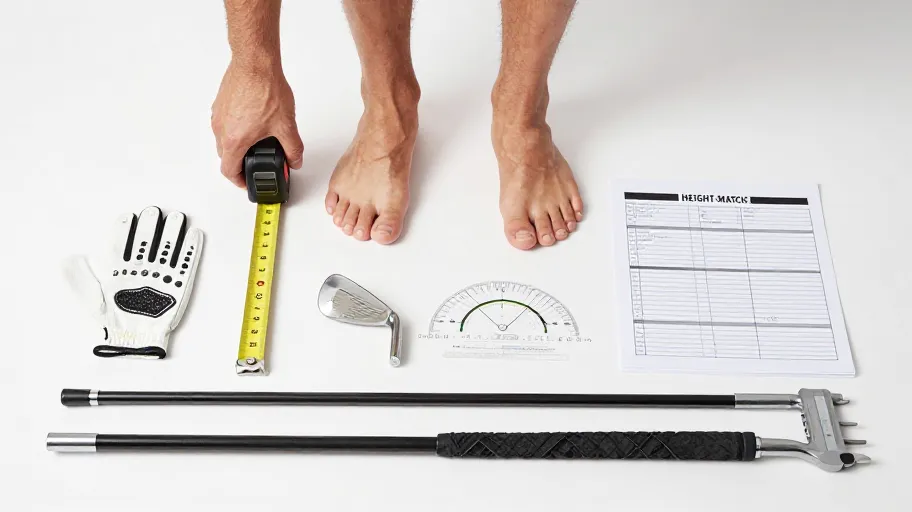
Sizing golf clubs for your height starts with three documented measurements — wrist-to-floor, height and glove/hand size — which you translate into target club length, lie angle and grip size, then verify each candidate component's raw specifications against those targets before approving an order. Height is only the entry point; the component specs make or break the fit.
The HEIGHT-MATCH Framework
Use this named framework to convert measurements into a documented component approval record:
- H — Height baseline. Record bare-foot height. This sets the starting band for overall club length.
- E — Establish wrist-to-floor. Measure from the crease of the leading wrist to the floor in a relaxed playing stance. This refines the length target beyond height alone.
- I — Identify hand size. Glove size and finger-to-palm ratio drive grip diameter selection.
- G — Gather swing context. Document tempo and typical ball flight tendencies you want to correct or maintain; these inform shaft flex and launch profile criteria you will verify against published component specs.
- H — Harmonise with the club family. Read the target club family and model's stated specifications — hosel diameter, tip diameter, butt diameter, adapter compatibility — and record them for each candidate component.
- T — Translate to a comparison table. Enter all candidate components into one decision table so differences are visible.
- C — Confirm compatibility in writing. Ask the supplier to confirm each spec for the exact model and batch before approval.
- H — Hold a documented approval step. Approve only what you have verified and recorded.
Decision table: measurements to component criteria
| Measurement you take | What it drives | What to verify on the component spec sheet | Approval evidence |
|---|---|---|---|
| Height (barefoot) | Starting length band for irons and woods | Stated assembled or raw shaft length for the target model | Written spec confirmation |
| Wrist-to-floor | Refined length target and lie direction | Lie angle adjustability range on the head or adapter | Written confirmation of adjustability range |
| Hand/glove size | Grip diameter | Grip core size and stated build-up guidance | Spec sheet and model match |
| Swing context | Shaft flex and launch profile | Flex label, torque and weight stated for the exact shaft model | Model-specific documentation |
| Existing club to replace | Direct like-for-like match | Brand, family, model, hosel/tip geometry | Side-by-side recorded comparison |
Treat every cell in the final column as a documentation requirement, not an assumption. If a supplier cannot confirm a spec for the exact model, that is a finding worth recording, not an obstacle to work around silently.
Concrete approval questions
Send these to the supplier before approving any component order:
- Can you confirm the exact model name, family and revision of this component?
- What are the stated tip diameter, butt diameter and length for this shaft model?
- Which club families and models does this head or adapter fit, per your current documentation?
- What is the stated lie angle or adjustability range for this head?
- Is this item currently available in the quantity I need, and how do you confirm that at order time?
- What does your current sample policy cover, and how do I request one for this model? Confirm the current policy directly.
- What documentation accompanies the shipment — spec sheets, batch references, packing list?
- How are discrepancies between listed and received specifications handled? Confirm the current policy directly.
Sample handling and documentation guidance
Samples exist to verify that a component's real measurements and finish match the fitment plan you built with HEIGHT-MATCH. When a sample arrives:
- Measure and record every critical dimension against your decision table.
- Photograph the item alongside its documentation.
- Log any deviation from the stated spec before approving a larger order.
Do not approve a production or bulk order on the strength of listed specs alone when a sample is available to you.
Frequently asked questions
Is height enough on its own to size clubs? Height sets a starting band, but wrist-to-floor measurement refines length and lie, and hand size sets grip diameter. Document all three before comparing components.
How do I know a shaft will fit the head I'm buying? Verify the stated tip diameter and adapter geometry for the exact head and shaft models in writing, and cross-check them in your decision table. Do not rely on brand family alone.
What if my measurements fall between standard bands? Record both neighbouring bands and ask the supplier which adjustments the specific head or adapter supports — for example, lie angle range — for the exact model.
Should I order one component first to test? A documented sample or single-unit verification step lets you measure the actual component against your fitment plan before committing to a set. Confirm the current policy directly for how single units are handled.
How do I keep multiple component options comparable? Use one decision table for every candidate, record the same fields for each, and approve only against written spec confirmations.
Next step
If you are comparing shafts, heads or grips for a specific club family, 获取采购 Brief — a structured worksheet that walks the HEIGHT-MATCH Framework end to end so your measurements, candidate specs and approvals sit in one document you can send to any supplier.
Low-friction alternative: Start with the five-question approval checklist above. Copy it, send it to your candidate suppliers, and file the written answers before you approve anything.
Master Your Swing, DIY Your Fit. DIY Golf is the premier destination for the technical golfer. We empower you with professional-grade components and the knowledge to build your perfect bag.


