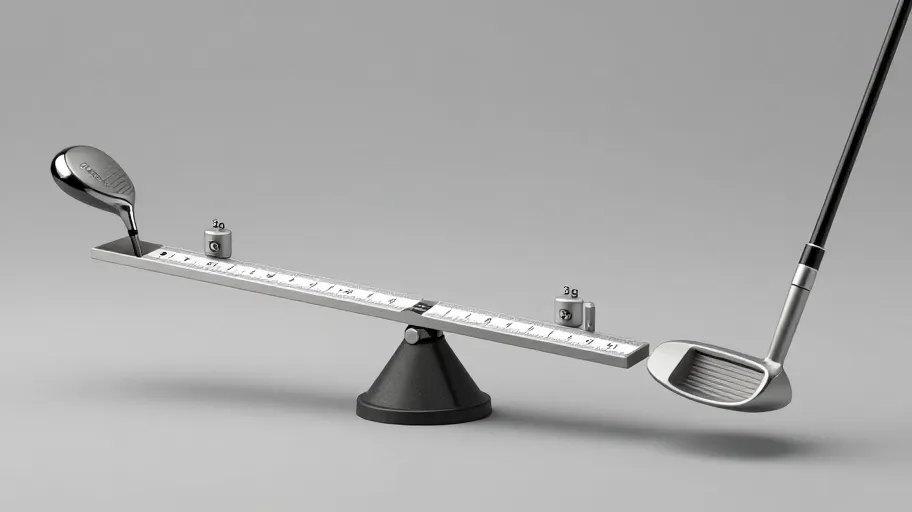
One swing-weight point does not equal one fixed number of grams. On a standard 14-inch fulcrum lorythmic scale, one swing-weight point represents roughly a 10 gram-inch change in torque about the balance point. In practice, that translates to about 2 grams of head weight at driver length, about 3–4 grams at 5-iron length, and about 5–7 grams at putter length. Before ordering any replacement or tuning component, confirm the measured weight of the exact head, shaft and grip model for your build.
Why the Answer Depends on Club Length
Swing weight is a ratio between total mass and balance point, measured on a 14-inch fulcrum. The scale runs A0 through F9 in tenths (for example, D2 is 24 points above C0 on the same letter scale when counted as ten-point letters). Because the measurement is a torque, the same gram change at the head moves the needle by different amounts depending on how far the head sits from the fulcrum — which is set by club length.
That is why a flat "one point equals X grams" answer misleads component buyers. A gram added at the tip of a 45.5-inch driver moves the reading far more than a gram added to a 33-inch putter, because the lever arm is longer. When you source components for a specific club model, you need the gram equivalent computed at your finished playing length, not a universal constant.
The working approximations below come from the mechanics of the lorythmic scale and are starting points for your own bench verification, not acceptance specs:
- Driver-length builds (~45–46 in): about 2 grams of head mass per swing-weight point.
- Fairway and hybrid builds: about 2.5 grams per point.
- 5-iron-length builds (~38 in): about 3–4 grams per point.
- Wedge-length builds (~35–36 in): about 4–5 grams per point.
- Putter-length builds (~33–35 in): about 5–7 grams per point.
Shaft and grip changes shift the balance point too. A heavier grip moves mass toward the butt, which lightens the reading; adding length at the tip end increases the lever arm, which increases the reading even with no mass change. Every one of these interactions should be resolved with a scale and a swing-weight scale at your target assembly length before you approve an order.
The Match–Measure–Approve Framework
Use this three-step framework to turn a swing-weight target into a purchasable spec:
- Match. Write down the exact club model, family, finished playing length, target swing weight, and the head, shaft and grip part numbers you are comparing. Record the current measured weight of the parts you are replacing, if available.
- Measure. Request measured (not nominal) weights for each candidate component — head weight, shaft raw and cut weight at your trim, and grip weight — plus hosel diameter, tip diameter and grip core size for your model.
- Approve. Convert the component weights into a predicted swing weight at your length, define an acceptance band in writing, and verify the physical sample on a scale before releasing the order.
Component Decision Table
| Decision factor | What to compare | What to demand from the supplier | Acceptance gate |
|---|---|---|---|
| Head weight | Head-only mass in grams for the exact model and loft | Measured weight per unit, plus any weight-adjustment hardware range | Predicted swing weight falls inside your written band at your length |
| Shaft weight | Raw weight and butt/tip trim figures for your model | Cut weight at your trim length and balance-point position | Cut weight within the band you define; no assumption of uniformity |
| Grip weight | Grip mass and core size | Measured grip weight and core diameter for the exact grip model | Grip confirms predicted reading or is re-spec'd before approval |
| Assembly length | Finished playing length and any tip-extension plan | Confirmation the component tolerates your trim plan | Documented trim plan approved before production |
| Tolerance band | Your acceptable swing-weight range (e.g., target ±?) | Written confirmation the band is achievable with the quoted parts | Band stated in the purchase brief and agreed in writing |
Note: no numerical tolerance, price, sample policy or lead time is asserted here. Define your own band and confirm the supplier can meet it for the exact model before you commit.
Sample Approval: Questions to Ask, Then a Bench Check
When evaluating a sample for a specific club model, put these questions in writing:
- What is the measured weight of this exact head, shaft and grip, per unit, as shipped?
- What is the measured hosel bore and tip diameter for this model family?
- How is swing weight measured and documented at your facility, and at what reference length?
- What is your current policy on samples, fees, shipping and remedies if a delivered unit falls outside my written band? (Confirm the current policy directly — no policy detail can be assumed.)
- What documentation accompanies each shipment — weight sheets, part numbers, batch identifiers?
Then run the bench check:
Sample Approval Checklist
- Sample part numbers match the quoted part numbers exactly.
- Head weight measured on a calibrated scale and recorded.
- Shaft cut weight recorded at your documented trim.
- Grip weight and core diameter measured and recorded.
- Assembly length measured and matches your spec.
- Assembled swing weight measured on a swing-weight scale and recorded.
- Result compared against your written acceptance band.
- Any deviation documented and remedy confirmed in writing before order release.
If any box cannot be checked, hold the approval. The point of the framework is that the buyer, not the catalogue, decides when a component is accepted.
FAQ
How many grams is 1 swing weight point at driver length? About 2 grams of head mass at driver length, because the head sits far from the 14-inch fulcrum. Verify with your own scale at your finished length, since shaft trim, grip weight and any tip weighting all shift the result.
Does adding length change swing weight even if weight stays the same? Yes. Adding length increases the lever arm from the fulcrum, raising the reading without adding mass. That is why finished playing length belongs in your purchase brief alongside target swing weight.
Can I use tip weights or lead tape to hit a target instead of changing components? Both shift mass toward the head and raise the reading, but the achievable range depends on your head, shaft and model. Confirm available adjustment hardware and head cavities for the exact model with the supplier before planning around them.
How do I spec swing weight when I cannot test the finished club first? Compute a predicted reading from measured component weights at your length, define a written acceptance band, and make sample verification part of the order. This converts an unknown into a documented gate.
Why did two identical-model heads give different readings? Manufacturing variation exists in every category, and no defect rate or uniformity claim can be asserted here. Request measured per-unit weights with your quote and set your acceptance band so the variation you will accept is explicit.
Get the Sourcing Brief
获取采购 Brief — download the DIY-Golf sourcing brief to lock in your target swing weight, finished length, component part numbers and acceptance band before you order. Every field you complete becomes a written confirmation point with the supplier.
Prefer to start smaller? Use the Sample Approval Checklist above as your pre-order gate — copy it into your next supplier email and require a check against every line before approval.
Master Your Swing, DIY Your Fit. DIY Golf is the premier destination for the technical golfer. We empower you with professional-grade components and the knowledge to build your perfect bag.


