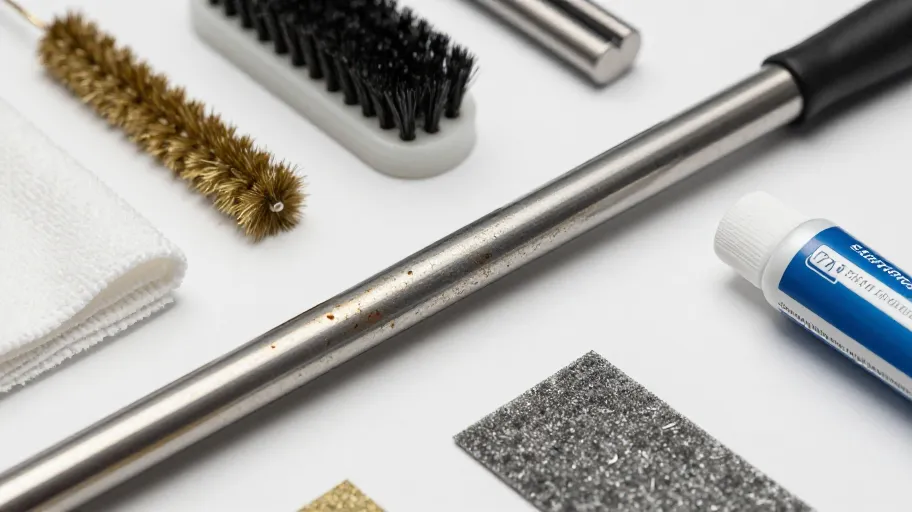
To clean rust off a golf club shaft, first identify the shaft material, then match the mildest effective method to the corrosion severity: surface wipe for light oxidation, controlled mechanical cleaning for embedded rust, and full replacement when corrosion affects the shaft wall. Confirm every method against the shaft's exact material and model before starting, and document the condition for any replacement order.
The SPECS Gate: a five-step decision framework
When a rusted shaft arrives on your bench, resist the urge to reach for the first solvent in the drawer. The SPECS Gate keeps the decision auditable:
- S — Surface. Grade the rust: light surface oxidation, pitting, or corrosion that reaches the shaft wall.
- P — Process. Match the cleaning process to the material. What is safe on a steel shaft may damage a graphite wrap or a coated finish.
- E — Evidence. Photograph the corrosion before and after each step. This protects warranty discussions and replacement spec decisions.
- C — Compatibility. Confirm the shaft material, tip diameter, butt diameter and model designation against the manufacturer's documentation for the exact club family.
- S — Sign-off. Decide — and record — whether the shaft is approved for play, approved for refinishing, or condemned for replacement.
The framework exists because the most expensive mistake in shaft work is not choosing the wrong solvent. It is cleaning a structurally compromised shaft and returning it to play.
Step 1: Grade the corrosion before touching it
Lay the shaft under consistent light and work through three questions:
- Does the discoloration sit on the surface, or can you feel pits with a fingernail?
- Is the corrosion near a stress point — the tip section, the hosel junction, or under a grip collar?
- Does the shaft show any visible bend, dimple or wall deformation alongside the rust?
Light surface oxidation on steel is a cleaning question. Pitting near stress points is a replacement question. A shaft that shows both corrosion and deformation should be removed from play immediately, whatever it looks like after cleaning.
For graphite shafts, rust on the shaft itself signals a coating failure; the underlying carbon does not corrode, but the wrap and resin can be compromised by the wrong solvent. Confirm the shaft material from the manufacturer's markings before selecting any product.
Step 2: Match the method to the material
| Shaft condition | Material | Safe approach | Approval question | Risk if mismatched |
|---|---|---|---|---|
| Light surface oxidation | Steel | Dry microfibre wipe, then mild solvent on a cloth, working away from graphics | Is the finish intact after wiping? | Minimal if tested on a hidden area first |
| Embedded surface rust | Steel | Fine abrasive pad used along the shaft axis only, minimal pressure | Does the wall remain smooth and unthinned? | Over-abrasion weakens the wall and removes finish |
| Rust under graphics or decals | Steel | Do not abrade over markings; assess whether corrosion is deeper than cosmetic | Are markings load-bearing for identification or purely decorative? | Losing model markings blocks later spec confirmation |
| Corrosion or white residue | Graphite/composite | Dry wipe only; no abrasives | Has the coating cracked or delaminated? | Solvents can attack resin and degrade the wrap |
| Pitting near tip or hosel | Any | Stop cleaning; assess for replacement | Has wall thickness been compromised? | Cleaning hides the evidence; the shaft may fail in play |
This table is a decision aid, not a material certification. For the exact shaft model in front of you, confirm the manufacturer's stated material and any care guidance before applying any product, including penetrating oils and household solvents, which some search results associate with this topic. Whether any specific product is appropriate for your shaft is a question to verify against the shaft documentation, not a general rule.
Step 3: Concrete approval questions before you commit
Run these questions and record the answers:
- What is the exact shaft material, and is it documented on the shaft or in the manufacturer's spec sheet for this club family and model?
- Has the corrosion been photographed from at least two angles with a scale reference?
- Does any pit catch a fingernail, and is any pit located within the tip section or under the grip collar?
- Is the shaft's model marking legible enough to support a replacement order if cleaning fails?
- If replacement is likely, have the tip diameter, butt diameter, length and weight designation been confirmed against the manufacturer's documentation rather than assumed?
- Who signs off — you or the club's owner — that the shaft is approved for cleaning, refinishing or replacement?
Question six matters for club builders. A written sign-off prevents a dispute when an owner expected restoration and receives a replacement recommendation.
Step 4: Sourcing checklist for replacement components
When cleaning is not the answer, the replacement order lives or dies on specification accuracy. Use this checklist before requesting components:
- Exact club brand, family and model documented
- Shaft material confirmed from manufacturer documentation
- Tip and butt diameters verified against spec sheet, not estimated
- Shaft length and trim instructions recorded
- Photos of the corroded shaft and hosel retained for reference
- Compatibility of the replacement shaft with the clubhead's hosel bore confirmed with the supplier
- Current sample policy, cost, shipping terms and lead times requested directly from the supplier — none of these are confirmed in this article
- Written confirmation of the above received before payment
For buyers sourcing components from DIY-Golf, the final two items are the gate. Sample availability, pricing, shipping arrangements and production timing are project-specific; request the current terms in writing for your exact order.
FAQs
Can rust on a steel shaft be removed without damaging the finish? Light surface oxidation can respond to a mild solvent on a cloth if the finish is intact. Embedded rust requires abrasion, which removes finish. Test on a concealed area first, and confirm the shaft's coating type before deciding — the answer depends on the specific model.
Is a penetrating oil safe for graphite shafts? This article does not certify any product for any material. Graphite shafts face different risks than steel because solvents can affect resin and coating. Confirm the shaft material from manufacturer documentation and verify any product's suitability for that material before use.
When should I stop cleaning and order a replacement shaft? Stop when corrosion pits near stress points, when the wall shows deformation, or when the model markings needed for a spec-matched order are at risk. Cleaning a compromised shaft removes the evidence you need for an accurate replacement specification.
How do I confirm a replacement shaft fits my club model? Document the exact brand, family and model, then verify tip diameter, butt diameter and length against the manufacturer's spec sheet. Confirm compatibility with the supplier in writing before ordering; do not rely on visual resemblance.
Should I record the corrosion before cleaning? Yes. Photograph the shaft from multiple angles with a scale reference. The record supports warranty conversations, replacement spec accuracy and your own sign-off decision.
If you are weighing cleaning against replacement and need to document the specification properly, 获取采购 Brief — request the sourcing brief and build a complete, verifiable component specification before you order.
Not ready to order? Download the low-friction alternative: the one-page shaft rust assessment and replacement checklist above — copy it, fill it in for your exact model, and use it as your approval record.
Master Your Swing, DIY Your Fit. DIY Golf is the premier destination for the technical golfer. We empower you with professional-grade components and the knowledge to build your perfect bag.


