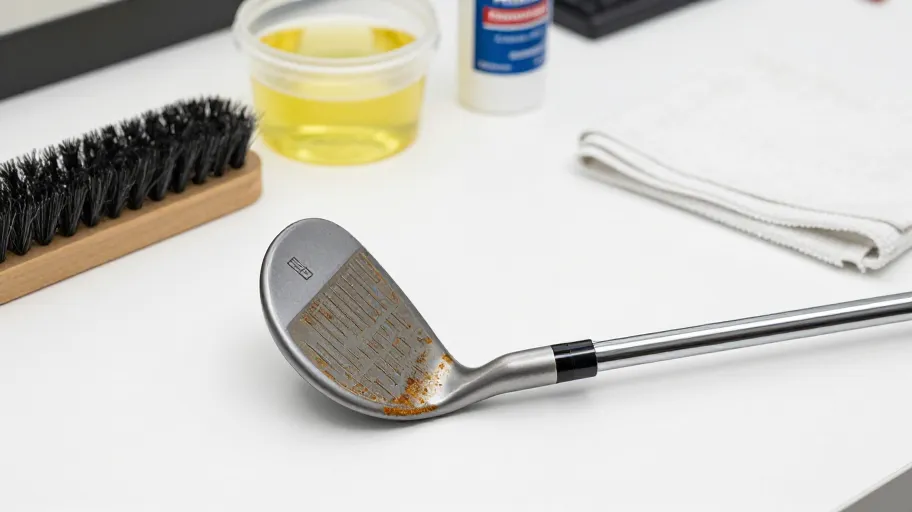
At DIY-Golf, component selection and club fitment guidance are the core of what we do, so we frame rust the same way we frame any component decision: as a sequence of verifiable steps. Use this five-rung ladder — Assess → Clean → Inspect → Verify → Approve — to move from "my club has rust" to a documented, confident decision.
Rung 1 — Assess. Identify the club's brand, family and model, and the affected surface: face, sole, back cavity, hosel or shaft. Photograph the affected areas in daylight. This record matters whether you clean, refinish or replace.
Rung 2 — Clean. Match the cleaning approach to the finish (see the decision table below). Work gently, stop if you see finish lifting, and keep abrasives away from plated and painted areas. After cleaning, dry the club fully and store it somewhere dry — recurring rust points to storage moisture, not just the cleaning method.
Rung 3 — Inspect. After cleaning, judge whether corrosion was surface-level or structural. Pitting that catches a fingernail, corrosion around a ferrule, or rust on a steel shaft warrants a closer look. If in doubt, a qualified club builder or fitter can inspect the club in person before you commit either way.
Rung 4 — Verify. If you decide to replace or tune components, verify every specification against the exact model: head model and loft, hosel bore and adapter type, shaft type and flex, length and grip. Do not assume cross-family or cross-generation compatibility — confirm it for the exact product and model with current, first-party evidence.
Rung 5 — Approve. Before any order, put the open questions to the supplier in writing: sample availability and current sample policy, any costs, shipping arrangements, lead time and what you will inspect on receipt. Approval is a documented step, not a vibe.
Surface-type decision table
| Affected surface | Cleaning approach to consider | Key verification question before deciding |
|---|---|---|
| Chrome or plated head (face/sole) | Gentle removal with a soft cloth and a mild, finish-safe rust remover or household acid solution; avoid abrasives and wire brushes | Did the plating stay intact after cleaning? If plating lifted, does the model still meet your standard for play or display? |
| Raw or unplated forged head | Light mechanical removal (fine abrasive pad or rust eraser) acceptable; expect patina changes | Is remaining pitting cosmetic, or does it affect the striking area on this specific model? |
| Painted or coated cavity | Soft cloth, mild solution only; no abrasives | Is the coating damaged, and can the exact model be matched with a replacement or refinish? |
| Steel shaft (the "clean rust off golf club shaft" case) | Gentle wipe-down for surface rust; inspect along the full length | Is corrosion localised or spreading? Surface specks versus scaling near the hosel are different decisions. |
| Graphite shaft | Never use abrasives; soft cloth and finish-safe product only | Has the clear coat or laminate been compromised? Verify with a builder before continued play. |
| Hosel, ferrule and adapter area | Dry thoroughly; treat any corrosion here as a priority | Does corrosion at the insertion point justify shaft replacement or a professional pull-and-inspection? |
Inspection guidance and approval questions
The ladder only works if you turn judgement into documents. When you reach the Verify and Approve rungs — especially if you are sourcing a replacement shaft, head or adapter for a specific brand and model — ask these questions and record the answers:
- Which exact brand, family and model does this component fit, and what evidence confirms that fitment for my build?
- What shaft, hosel bore and adapter specification does my current club use, and does the replacement match all of them?
- Is a sample available for my build, and what is the current sample policy, including any costs and shipping arrangements?
- What is the current lead time from order to dispatch for this component, and how will progress be communicated?
- What should I inspect on receipt, and what is the agreed process if the component does not match the approved specification?
- For refurbishment rather than replacement: what finish or coating options exist for this exact head model, and how is the result documented before dispatch?
Keep the answers in one place. A club builder reviewing your file later — or you, six months from now — will thank you for it.
Request the sourcing brief — send us your club's brand, family, model and condition notes, and we will return a brief that consolidates component options, fitment checks and the questions you still need answered before ordering.
Model-verification checklist
Before any cleaning experiment or component order, complete this checklist:
- Brand, family and model recorded (with loft and generation where applicable)
- Finish type identified per affected surface (chrome/plated, raw, painted, coated)
- Photos taken of all rust-affected areas, before and after any cleaning
- Shaft material, flex, length and grip recorded
- Hosel bore or adapter type recorded
- Corrosion location and depth noted (surface versus pitting)
- Sample policy, costs and shipping terms confirmed directly with the supplier
- Lead time and on-receipt inspection process agreed in writing
- Fitment of any replacement component verified for the exact model
If any box is unticked, that is your next question — not a reason to guess.
FAQ
How do I remove rust from a golf club without damaging the finish? Identify the finish first. For chrome or plated heads, use a soft cloth with a mild, finish-safe product and avoid abrasives entirely. For raw forged heads, light mechanical removal is more acceptable, but expect the surface appearance to change. Stop immediately if you see finish lifting, and photograph before and after so you can document the result.
Can I clean rust off a golf club shaft myself? Surface specks on a steel shaft can be wiped down gently with a finish-safe product. Inspect the full length afterwards: localised surface rust and scaling near the hosel are different situations. For graphite shafts, do not use abrasives at all — if the coating is compromised, have a club builder inspect it before you continue playing the club.
Does rust mean I need to replace the club?
If I replace a component, how do I know it fits my exact model? Verify, don't assume. Match head model and loft, hosel bore or adapter type, shaft type and flex, length and grip. Compatibility should be confirmed with current first-party evidence for the exact brand, family and model — which is precisely what our component selection and club fitment guidance pages are for.
What does DIY-Golf supply — and what do I still need to confirm? DIY-Golf is an English-language direct-to-consumer golf components store focused on component selection and club fitment guidance. Sample availability, costs, shipping arrangements, lead times and inspection processes are not stated on this page and vary by project — you must confirm the current policy directly with us as part of your brief.
Ready to move from diagnosis to decision?
Request the sourcing brief. Send your brand, family, model and condition notes, and we will return a brief covering component options, the fitment checks that apply to your exact club, and the questions to resolve before you order. No obligations, no assumptions — just a documented path from rusty club to approved build.
Master Your Swing, DIY Your Fit. DIY Golf is the premier destination for the technical golfer. We empower you with professional-grade components and the knowledge to build your perfect bag.


