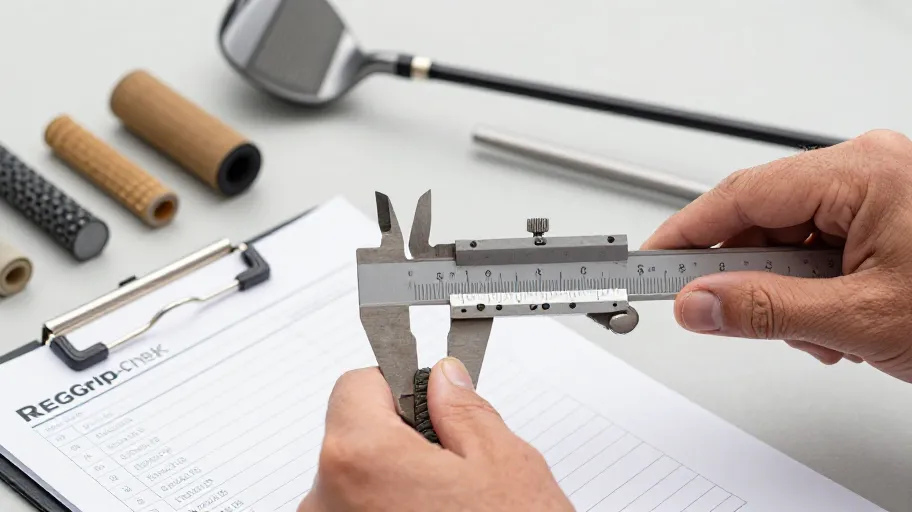
Yes — when the club family and model still suit the player and the underlying components are sound. Evaluate four things before ordering: residual usefulness of the head and shaft, whether the current grip size actually fits your hands, visible grip degradation, and risk of hidden shaft wear. Then confirm specs and sample policy with the supplier.
The REGrip-Check™ framework: a repeatable verdict
Rather than deciding on feel alone, work through four gates. This framework exists so two builders examining the same club reach a documented, comparable conclusion.
R — Residual value. Ask whether the head and shaft of this specific club brand, family and model still serve the intended player. If the club is due for replacement regardless, regripping it delays rather than resolves the decision. Document the model, loft, shaft label and playing length so any replacement components can be matched later.
E — Engagement fit. The grip is the only contact point between player and club. Assess whether the current grip size produced the shot feel and release the player wants. If hand size, glove size or preference have shifted, regripping is an opportunity to correct sizing through core selection and build-up tape — not merely to restore an old specification.
G — Grip condition. Inspect for slick surfaces, cracking, hardened material, spin loss on worn areas and any twisting on the shaft. Photographic records of the condition help if you later compare against a replacement sample.
R — Risk of hidden wear. Removing an old grip exposes the shaft beneath. Check for scoring, rust rings near the hosel on irons, hairline cracking, or evidence of prior re-shafting work. If hidden damage is plausible, plan the inspection before committing to a full set of grips.
Spec matching: what to document before ordering
Fitment errors are avoidable when the order is preceded by documentation. Before contacting a supplier, record:
- Core size vs butt diameter. Grip core size must suit the shaft butt diameter of the exact club model. Ask the supplier to confirm the grip's core specification in writing.
- Playing length and grip length. The grip length affects the effective playing length and, with build-up tape, swing weight. Ask which tape configuration the supplier assumes.
- Model-specific quirks. Some club families use removable or counterweighted grip systems; verify whether the replacement component is designed for the specific family and model rather than assuming interchangeability.
- Quantity per configuration. A mixed set may need different sizes in different hands. Document per-club requirements before requesting a quote.
None of these points can be confirmed generically. Each must be verified for the exact product and model you intend to buy.
Decision table: regrip, replace components, or retire
| Scenario | REGrip-Check™ outcome | Recommended path | Approval questions to resolve |
|---|---|---|---|
| Club suits the player; grip is worn; shaft sound | R, E pass; G fails; R-risk low | Regrip with matched core size | Core spec in writing; sample availability; current pricing |
| Grip worn but sizing was always wrong | G fails; E flags misfit | Regrip and resize via core/build-up | Build-up configuration; effect on swing weight |
| Hidden shaft wear suspected | R-risk high | Inspect before ordering | Whether supplier accepts post-inspection order changes |
| Club model no longer suits the player | R fails | Delay regrip; evaluate replacement components | Which component family matches current playstyle |
| Mixed set, multiple hand sizes | E varies per club | Split-spec order | Per-club quantities and labelling |
Sampling and approval: questions to send the supplier
Turn every unknown into a written question. Use or adapt this set:
- Can you confirm the core size and butt-diameter compatibility of this grip for the exact club family and model I have listed?
- What is your current sample policy — availability, any fees, and who covers shipping? (Confirm the current policy directly; do not rely on prior assumptions.)
- What build-up tape configuration do you recommend for my target grip size, and how does it affect swing weight?
- Can you supply a spec sheet for the grip covering material, weight and texture, so I can compare against what is being replaced?
- What are your current lead-time and minimum-order arrangements for this component?
- If a delivered grip does not match the documented specification, what is your resolution process?
Approval means: specification received in writing, sample evaluated in hand against the documented spec, and any deviation resolved before a full-set order. Anything less is a purchase on trust rather than on evidence.
Pre-purchase checklist
Before you place any order, confirm every item below:
- Club brand, family and model documented for each club
- Shaft butt diameter measured and recorded
- Grip core size confirmed in writing by the supplier
- Build-up tape plan agreed and its swing-weight effect understood
- Grip condition photographed; hidden-wear inspection completed or scheduled
- Sample policy, pricing and shipping confirmed directly with the supplier
- Spec sheet received and compared against the outgoing grip
- Resolution process for spec deviations documented in the order
FAQs
How do I know if my old grips actually need replacing? Check for a slick or hardened surface, visible cracking, and any grip that twists on the shaft. If traction is reduced enough that the player alters their hold to compensate, replacement is due. Photograph the condition for comparison later.
Can regripping change how an old club plays? The grip influences feel, release and, through weight and size, swing weight. Regripping restores the original interface or deliberately adjusts it via core size and build-up tape. Any specific performance outcome depends on the components chosen and the build executed — confirm the configuration rather than assuming a result.
Should I regrip the whole set at once? That depends on the condition of each club and the consistency you want across the set. Inspect every club first: if wear or shaft condition varies, a staged approach may be more defensible than a single order. Confirm with the supplier whether split deliveries or phased quantities are supported.
What grip size should I choose for older clubs? Size follows the shaft butt diameter plus any build-up tape, matched to the player's hand measurements and preference. Because sizes vary by manufacturer, request the written core specification and compare it against your measured shafts before ordering.
Is it better to regrip or buy new clubs? Use the REGrip-Check™ gates. If the head and shaft still fit the player and the wear is confined to the grip, regripping addresses the problem directly. If the model itself no longer suits the player, redirect the budget toward replacement components — and document what you have so the new build can be specified correctly.
Get the sourcing brief
Ready to move from verdict to order? Get the sourcing brief (获取采购 Brief) — a structured template covering spec confirmation, sample requests, approval gates and documentation, built for golfers and club builders evaluating grip components for a specific club family and model.
Low-friction checklist CTA
Not ready to contact anyone yet? Run the pre-purchase checklist above on one club today. If every box confirms, you have a documented case for regripping; if any box stalls, you have a precise question to send a supplier — and that is progress too.
Master Your Swing, DIY Your Fit. DIY Golf is the premier destination for the technical golfer. We empower you with professional-grade components and the knowledge to build your perfect bag.


