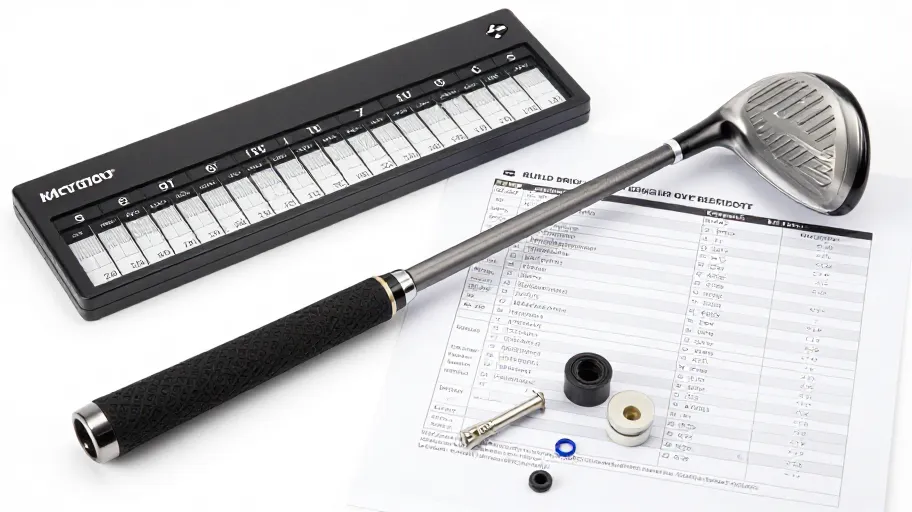
Rory McIlroy's driver swing weight is a build target you should document and verify for your own club, not a number to copy blindly — because head model, shaft, grip and adapter choices all shift the final measurement. This guide walks you through the Verify–Compare–Approve framework: verify the current spec against first-party evidence, compare the components that actually move swing weight, and approve a supplier's sample against a written build brief before you commit.
Why the number alone is the wrong starting point
Swing weight is the output of the whole assembly: head mass and its distribution, shaft length and balance point, grip weight, and any movable weights or hot-melt. A figure attributed to a tour player is a snapshot of one specific assembly on one date. If your head family, shaft profile or grip differs, replicating the number will not replicate the feel — and the underlying figure may not be verifiable in the first place. Treat any publicly reported value as a hypothesis to confirm against your own build sheet, not as a settled fact.
The practical task is this: define your target swing weight range for your exact head and shaft combination, identify which components let you reach it, and get written confirmation from your supplier on compatibility, sample terms and approval criteria before ordering.
The Verify–Compare–Approve framework
Verify. Confirm two things with first-party evidence only: (a) the current specification of your head family — weight port presence, stock and optional weight values, adapter and hosel options — directly from the manufacturer's current documentation for the exact model; and (b) your own build measurements on a calibrated scale, not estimates from memory. Do not treat forum figures, launch-monitor anecdotes or second-hand tour gossip as verification.
Compare. Lay your component options against your build intent. This is where DIY-Golf's component-selection pages are designed to help: you compare weight kits, shafts, adapters and grips against the target you documented, and note where compatibility for your exact family and model is confirmed versus where it needs supplier confirmation.
Approve. Before any volume order, agree in writing what a successful sample looks like: the measured swing weight range, the assembly method, and who measures it. Approve the sample, document the result, and only then scale the order.
Decision table: what actually moves swing weight
| Lever | Direction of effect | What to verify before ordering | Best suited to |
|---|---|---|---|
| Interchangeable head weights (port kit) | Heavier port weight raises swing weight at fixed length | Confirm port type and weight options for your exact head family and model from current manufacturer documentation | Movable-weight driver heads with user-swappable ports |
| Shaft length | Shorter lowers swing weight; longer raises it | Confirm finished-length tolerance expectations with the supplier in writing, since tolerance values vary by product and must be confirmed directly | Builders trimming for control or extending for speed |
| Shaft balance point (e.g., counterbalanced profiles) | A higher balance point can lower swing weight at the same length | Confirm the shaft's stated balance-point designation from the shaft manufacturer's current spec sheet | Players adding head weight without adding total mass feel |
| Grip weight | A lighter grip raises swing weight; a heavier one lowers it | Confirm actual grip mass, not labelled size, from the grip maker's documentation | Fine-tuning within a narrow range |
| Head-side added mass (adhesive/tape methods) | Raises swing weight, changes feel and sound characteristics | Confirm which methods the head manufacturer permits for your model and whether the supplier's components support them | Builders without port access |
Note: this table describes directional relationships between components and measurement. It does not assert compatibility for any specific product; every compatibility claim must be confirmed for your exact head, family and model before purchase.
Approval questions to put to the supplier
Before you request components or a sample, ask these in writing and keep the answers in your build file:
- Compatibility. Which weight kit, adapter or shaft options are confirmed compatible with my exact head family and model? Please cite the current manufacturer specification, not a catalogue summary.
- Specification. Can you document the mass values and specifications of the components you would supply, per item, so I can model swing weight before assembly?
- Sample. Is a sample available for the exact components I intend to order? What does the current sample policy cover, who arranges shipping, and is there any fee? — Please confirm the current policy directly with the supplier; DIY-Golf does not publish these terms here.
- Verification method. Who measures the sample's swing weight, on what equipment, and what documentation accompanies the approval decision?
- Order terms. What are the current order, return and restocking terms for components approved from a sample? Please confirm directly — do not assume.
- Change control. If a component revision occurs between sample approval and shipment, how will I be notified, and can I re-approve?
These questions convert unknowns into documented commitments. A supplier that cannot answer them is telling you something useful before money moves.
FAQ
Q: Should I build to the swing weight attributed to a tour player like Rory McIlroy? Treat it as a reference point, not a spec. Verify the figure's currency, then recalculate for your own head, shaft, grip and length. Your target should come from your own assembly measurements and your documented build intent.
Q: Can I change swing weight without buying new head weights? Yes — length, shaft balance point and grip mass all shift the measurement. The decision table above maps the levers. Confirm each component's current specification with its manufacturer before substituting.
Q: How do I know an aftermarket weight kit fits my driver head? You don't, until it is confirmed for your exact model. Check the manufacturer's current documentation for your head's port system, then ask the supplier to confirm compatibility in writing. DIY-Golf's component pages flag where confirmation is required rather than implying fitment that isn't verified.
Q: What should a sample approval include? At minimum: the measured swing weight on agreed equipment, the assembly details, the component specification sheet, and a signed or written approval record. Ask the supplier what their current sample process includes — confirm the terms directly before requesting one.
Q: What happens if the assembled club doesn't match my documented target? That depends on the supplier's terms, which you should have captured in the approval questions above. This is precisely why the Approve step precedes any volume commitment.
Request your sourcing brief
Bring your documented target — head family and model, shaft, grip, target swing weight range — and request a sourcing brief (获取采购 Brief) from DIY-Golf. The brief consolidates your build intent, the component shortlist, and the open questions above into one document you and the supplier can both work from. It turns a vague "make it feel like McIlroy's driver" into a spec someone can actually build, measure and approve.
Before you order: the quick checklist
- Target swing weight range documented from my own measurements, not a copied number
- Head family, model and port type confirmed from current manufacturer documentation
- Component compatibility confirmed in writing for my exact model
- Component mass/spec sheets obtained per item
- Sample availability and current sample terms confirmed directly with the supplier
- Measurement method and equipment agreed before sample review
- Order, return and restocking terms confirmed in writing
- Change-control process agreed for any component revision
- Approval record signed or written before volume order
If any box is unticked, the sourcing brief is the fastest way to close the gap — request it, attach your build sheet, and get the confirmations in writing.
Master Your Swing, DIY Your Fit. DIY Golf is the premier destination for the technical golfer. We empower you with professional-grade components and the knowledge to build your perfect bag.


