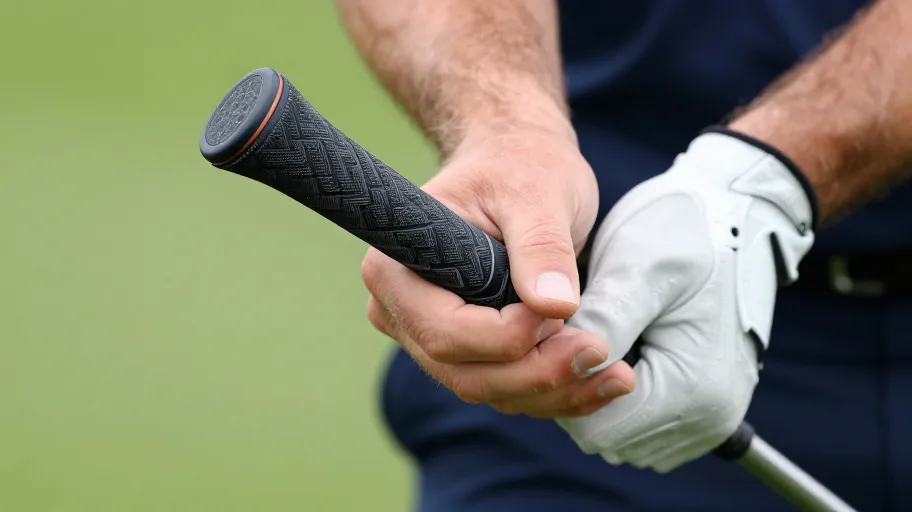
A close-up view of Rory McIlroy's grip tells you what to investigate, not what to buy. Use the SPEC–Sample–Approve (SSA) framework: document the grip specifications you believe you are seeing, request a sample of the comparable component you are sourcing, and only approve a batch after documented checks. Never treat imagery as verified fitment evidence.
SPEC: converting a close-up into a documented requirement
Close-up photographs and broadcast footage of a tour player's hands on the club are useful prompts. They raise the right questions: What core size is the grip? How many build-up wraps sit underneath? Is the grip a standard model, a modified version, or a prototype unavailable through retail channels?
None of those questions can be answered from the image alone. Tour equipment is individual. Players experiment with wrap counts, midsize and jumbo options, tape thicknesses and taper adjustments across tournaments and even across rounds. A grip that appears chunky in a close-up might be a standard core with multiple wraps, a midsize grip with no wraps, or something built specifically for that player.
For a component buyer, the productive move is to stop asking "what does Rory use" and start asking "what spec do I need for the club I am building or re-gripping?" Document the following before contacting any supplier:
- Shaft butt diameter of the exact club family and model you are fitting.
- Target finished feel: standard, midsize, jumbo, or a taper preference.
- Wrap plan, if any, and the tape specification you intend to use.
- Layer thickness of build-up tape, recorded so the build is repeatable.
- Grip model and core size you believe matches your requirement, stated as a hypothesis, not a fact.
This spec sheet becomes your reference point. Whether the inspiration came from a tour close-up or a customer request, the sourcing conversation should be anchored to measurements you control, not to imagery you cannot verify.
SAMPLE: evaluating before committing
Once your spec is documented, the next question is how the candidate component performs in hand. The only reliable evidence is a physical sample of the exact grip model and core size you intend to order, built on a shaft or mandrel matching your target butt diameter.
Sample evaluation checks worth recording:
- Visual and tactile check: surface texture, tack, seam condition and colourway consistency against the documented spec.
- Dimensional verification: measure the sample's core and outer dimensions with your own calipers and record the readings. Do not rely on catalogue imagery or the close-up photo that started the enquiry.
- Build test: install on the intended shaft family with your documented wrap plan and record the resulting feel and swing-weight effect.
- Durability observation: note wear behaviour over your own trial window, however long you choose to run it — that window is your project decision, not a supplier claim.
APPROVE: the sign-off gate
Approval is where informal sourcing becomes a documented decision. Before releasing a batch order, confirm the following in writing with the supplier and record the answers:
- Does the supplied sample match the production units you will receive, and how is that consistency assured?
- What is the current lead arrangement for your order quantity, and what quantity options exist for your project?
- What inspection or defect handling process applies if delivered grips do not match the approved sample?
- Can the supplier confirm fitment for your specific shaft butt diameter in writing?
- Who at your end signs the approval, and against which recorded measurements?
Keep the approved sample, the spec sheet and the supplier's written confirmations together as your audit trail. If any element changes — grip model, wrap plan, shaft family — the approval lapses and the cycle restarts at SPEC.
Decision table: mapping your situation to an action
| Sourcing scenario | Recommended action under SSA | Why |
|---|---|---|
| Inspired by a tour close-up, no spec yet | Complete the SPEC stage; write down shaft, core size target and wrap plan | Removes unverifiable assumptions before any supplier contact |
| Spec documented, no sample seen | Request a sample under the supplier's current stated terms; confirm terms in writing | Physical evidence beats imagery |
| Sample received, unmeasured | Run caliper checks and a build test; log all readings | Creates your own dimensional record |
| Sample approved verbally | Convert to written sign-off with the five approval questions | Verbal approvals leave no audit trail |
| Grip model or shaft family changed | Restart the cycle at SPEC with the new parameters | Fitment evidence does not transfer between models |
Questions to put to any supplier
- Can you confirm, in writing, that this grip model is available in the core size my spec requires?
- What are your current sample terms, and how do I obtain one sample for evaluation?
- How do you handle a delivery that does not match the approved sample?
- Can you document the batch consistency process for the units I would receive?
- What fitment guidance can you provide for my specific shaft family and model?
If a supplier cannot or will not answer these questions in writing, treat that as information about the sourcing relationship, not a reason to skip the gate.
Frequently asked questions
Can a close-up photo tell me the grip size a tour player uses? No. A close-up can prompt the right questions — core size, wrap count, model — but it cannot verify them. Tour builds are individual and change over time. Use imagery as a starting hypothesis and confirm your own requirement with measurements.
Should I copy a tour player's grip build for a customer's club? Only if the customer's hand measurements, the shaft's butt diameter and the intended wrap plan are all documented and match the spec. Sourcing decisions should rest on your recorded requirements, not on another player's setup.
How do I compare grip candidates fairly? Build each candidate to the same documented spec — same core size, same wrap plan, same tape — and record caliper readings and feel notes for each. Comparison without a controlled build produces noise, not evidence.
What if the sample does not match the production grips I receive? That is what the approval record is for. Compare delivered units against the retained approved sample and the supplier's written consistency confirmation, then raise the discrepancy through the process the supplier documented at approval.
Do I need a sample for every grip model I stock? That is a project decision. What the SSA framework requires is that no batch is approved without documented evidence for the exact model and spec being ordered. How broadly you apply that is your call.
Next step: 获取采购 Brief
Turn this framework into a working document. 获取采购 Brief and use it to structure your spec, sample request and approval sign-off for the grip component you are sourcing.
Before you go — run this quick checklist:
- Shaft butt diameter recorded for the exact club model
- Target core size and wrap plan documented
- Sample requested and supplier terms confirmed in writing
- Caliper measurements logged for the approved sample
- Written sign-off completed before any batch order
Master Your Swing, DIY Your Fit. DIY Golf is the premier destination for the technical golfer. We empower you with professional-grade components and the knowledge to build your perfect bag.


