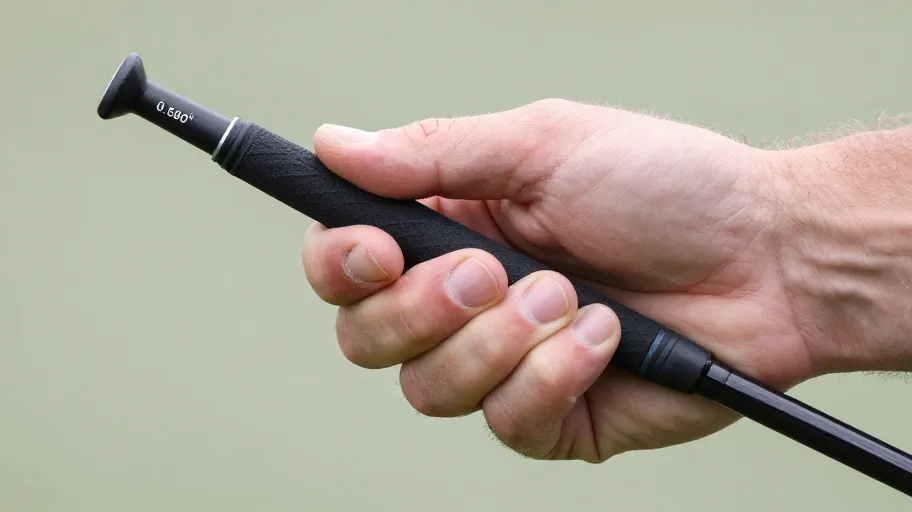
Rory McIlroy grips the club with an interlocking grip, and the search interest around "rory grip size" tells us something useful: golfers and builders are trying to connect a visible grip style with a measurable grip specification. For a sourcing decision, the interlock-or-overlap question is a preference input, while grip size, core size, taper and build-up are the specifications you actually document, sample and approve before ordering replacement grips for a specific club model.
Why a club builder treats grip style differently from a consumer
A recreational golfer asks "interlock or overlap?" and expects a swing tip. A club builder or a serious golfer sourcing components asks a different question: which grip specification, combined with my hand size and my preferred grip style, will produce the in-hand feel and control I want on the exact club I am re-gripping?
That reframing matters because grip style — interlock versus overlap versus baseball/ten-finger — is about how your hands join on the handle. Grip specification is about what is on the shaft: diameter, core, texture, taper profile, weight and any build-up wraps beneath the grip. Both belong in your decision, but only one of them arrives on a purchase order.
The Grip Decision File is a four-stage framework that keeps the two apart:
- Match — identify your grip style preference and the hand measurements that inform size.
- Document — write down every specification you need confirmed for the exact club family and model.
- Sample — request and evaluate sample grips against that written spec.
- Approve — sign off only when the sample matches the documented requirement.
Stage 1 — Match: style preference and hand reality
Start with the style question, honestly answered:
| Grip style | What it involves | Sourcing considerations to document |
|---|---|---|
| Interlock | Pinky of the trailing hand interlocks with the index finger of the lead hand; associated with players such as McIlroy and, historically, other major champions | Smaller or average hands may favour this; confirm grip diameter feel at the join point; check texture where fingers lock |
| Overlap (Vardon) | Pinky of the trailing hand rests on top of the lead hand's index finger | Larger hands may favour this; document how grip taper affects the resting finger |
| Ten-finger / baseball | All ten fingers on the handle | Confirm full-length texture and any mid-section profile; document diameter preference at both ends |
Note the careful wording: these are considerations to document, not claims about what will suit your hands. Verify by handling grips, not by reading opinions.
Stage 2 — Document: the specification that actually gets ordered
This is where most sourcing efforts fail — the preference is clear in the buyer's head but never written down. Before contacting DIY-Golf, produce a one-page document covering:
- Club brand, family, model and club(s) to be re-gripped.
- Grip style preference (interlock, overlap or ten-finger) and hand measurements.
- Grip size target: standard, midsize, jumbo, or build-up wraps under a standard core — and confirm with DIY-Golf how they define and measure size.
- Core size to match your shaft butt diameter — confirm the shaft measurement yourself rather than assuming.
- Material, texture and weight class preferences, if specified on the product page.
- Quantity, and whether the whole set uses one spec or the set is split (for example, different feel preference on the putter).
Stage 3 — Sample: what to evaluate and what to ask
A sample grip is a procurement tool, and its value depends entirely on the questions you ask with it. DIY-Golf's current sample policy has not been supplied for this article — whether samples are provided, what they include, who covers shipping, and any associated conditions must be confirmed directly with DIY-Golf before you plan around one.
When a sample is in hand, evaluate it against the Document stage:
- Diameter feel at the top, middle and lower sections of the grip, with your actual grip style applied.
- Texture under dry hands and, if relevant to your conditions, damp hands.
- How the grip sits on the shaft once installed, if installation is part of your scope.
- Consistency across multiple sample units, where more than one is provided.
Stage 4 — Approve: the questions that close the loop
Approval is a documented decision, not a feeling. Put these questions to DIY-Golf in writing:
- Does the grip I am specifying match the listed specification for my exact club family and model, and can you confirm fitment against the shaft butt diameter I measured?
- How do you define the size I have chosen, and what measurement method should I use to verify it on delivery?
- What is your current sample policy — availability, contents, shipping responsibility and any conditions — for this grip?
- What is the current lead time and shipping arrangement for the quantity I need, for my delivery destination?
- If a delivered grip differs from the approved sample, what is the process for raising and resolving the discrepancy?
The written answers become your approval record. Keep them with the sample.
Decision table: interlock vs overlap as a sourcing input
| Question to resolve | If your answer is interlock | If your answer is overlap |
|---|---|---|
| Where does the grip need the most feel? | At the join point where fingers lock | Along the top section where the pinky rests |
| What should the Document stage capture? | Texture and diameter feel at the lock zone | Taper profile and top-section diameter |
| What should the Sample stage test? | Applying your actual interlock on the sample grip | Applying your actual overlap on the sample grip |
| What could trigger a re-sample? | Texture wear or feel mismatch at the lock zone | Taper feel mismatch where the pinky sits |
Grip size: the specification behind the search
The related-search signal behind this article — "rory grip size" — points at a real gap in most buyers' process: size is discussed as a rumour rather than measured as a fact. Whatever grip size a touring professional uses is public trivia; the size your build needs is a measurement. Measure your hand, measure or confirm your shaft butt diameter, and ask DIY-Golf to confirm the sizing definition of every grip you are considering before the order is placed. If build-up wraps are part of your plan, confirm with DIY-Golf how wraps affect the final installed diameter and document the agreed approach.
FAQs
Does using an interlock grip like McIlroy mean I need a specific grip model? No verifiable link between a grip style and a required grip model can be claimed here. Style is how your hands join; the grip model is a specification you select and confirm with DIY-Golf for your exact club. Choose the grip on documented fit, not on an association with a professional's style.
Is a midsize or jumbo grip a substitute for changing my grip style? Size and style are independent variables. Some players adjust size to change in-hand feel; others adjust style. Treat them as separate line items in your Document stage and evaluate both on the same sample.
What should I do if the sample feels right but the delivered grips feel different? This is precisely why Stage 4 exists. Raise it against your written approval record and ask DIY-Golf to confirm the resolution process. Do not rely on verbal assurance at delivery.
Can I mix grip sizes across a set? That is a fitment decision you should document and confirm with DIY-Golf for your specific club set. Confirm what is available for each club in the set and record the agreed specification per club.
How many samples should I evaluate before approving? Only you and DIY-Golf can set that number for your project. What matters is that every sample unit is evaluated against the same written criteria from the Document stage, so the comparison is consistent.
Primary CTA
Ready to turn your grip preference into a documented, approvable specification? 获取采购 Brief from DIY-Golf — a structured request covering your club brand, family and model, your grip style and size inputs, and the confirmation points you need answered before ordering.
Checklist CTA
Not ready to commit? Use this five-point checklist to qualify your own project first:
- Club brand, family and model written down for every club to be re-gripped.
- Grip style preference (interlock / overlap / ten-finger) noted with hand measurements.
- Target grip size and core size recorded, with measurement method agreed.
- Questions about sample policy, lead time and shipping listed for DIY-Golf to confirm in writing.
- Approval criteria defined: what a sample must demonstrate before you sign off.
If you can tick all five, request the 采购 Brief and move from research to documented sourcing.
Master Your Swing, DIY Your Fit. DIY Golf is the premier destination for the technical golfer. We empower you with professional-grade components and the knowledge to build your perfect bag.


