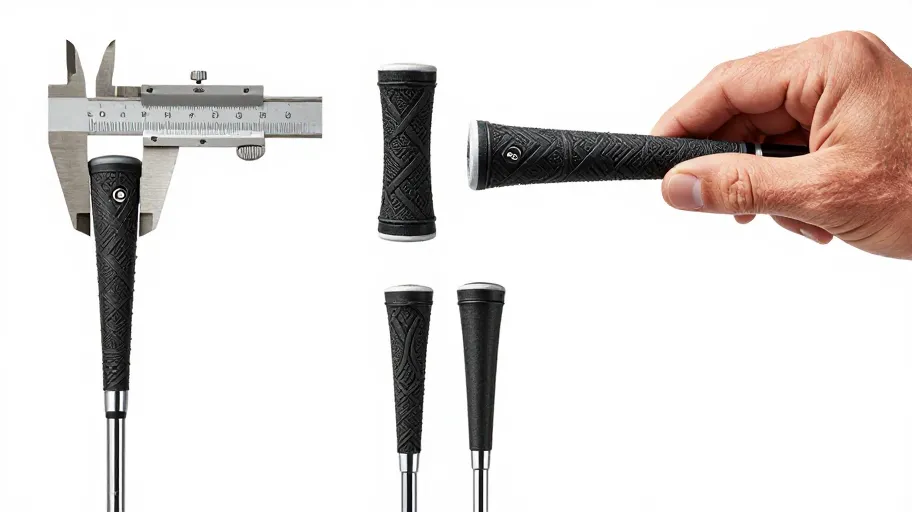
When golfers search for Scottie Scheffler's grip size, what they really need is a repeatable way to specify grip size for their own clubs. Rather than copying a tour number you cannot verify, work through a four-gate process — Measure, Match, Sample, Approve — so the grip you source fits your hands, your shaft and your documented build intent.
What is publicly discussed about Scheffler's grip size — and what it can and cannot tell you
Equipment coverage and public discussion have noted that Scheffler plays with a grip size on the larger end of the range, a setup many golfers associate with his swing characteristics. Two cautions apply before you treat any of this as a build spec.
First, tour-player equipment details are publicly discussed observations. Players change setups, commentators misreport dimensions, and manufacturer confirmations are inconsistent. None of it substitutes for a specification you can verify for the exact grip model, core size and build-up configuration in front of you.
Second, even a confirmed tour spec is a fitment answer for that player's hands, that swing and that club model. Your hands, your shafts and your clubs are different variables. The productive question is not "what does Scheffler use?" but "what grip size direction — standard, midsize, built-up or larger — is right for my club, and how do I confirm it before I commit?"
That reframing is exactly what DIY-Golf's component-selection and fitment guidance is built around: matching replacement parts to a specific brand, family and model, with the buyer documenting every choice.
The Grip Spec Confirmation Framework: Measure → Match → Sample → Approve
Use this framework for any grip sourcing decision, whether you are replacing a worn grip on one club or respecifying an entire set.
Gate 1 — Measure. Record what you are working with before you shop:
- Your current grip's stated size and any build-up wraps or layers.
- Your hand measurement — glove size and, if you use the common hand-length method, the measurement itself.
- The shaft butt diameter and taper profile of the specific shafts in your clubs. Butt diameter determines which grip core sizes seat correctly; this is where model-specific fitment matters most.
- Any swing tendency you are trying to influence. A grip change affects feel and hand action; do not assume a performance outcome — plan to verify it on the course or with your own launch data before and after.
Gate 2 — Match. Translate the measurements into a spec direction using the decision table below, then match to grip models that exist in that size for your shaft type. Confirm with DIY-Golf that the specific grip model, size and core configuration you want is available for your exact club family and model.
Gate 3 — Sample.
Gate 4 — Approve. Approve the spec only after a test installation and an on-course or practice evaluation. Document the approved configuration so any future rebuild is repeatable.
Decision table: choosing a grip size direction
| Your situation | Size direction to evaluate | What to confirm before buying |
|---|---|---|
| Hands measure large for glove size, or you frequently grip the club too tightly | Midsize or built-up configurations | Whether the candidate grip is available in the size, and whether build-up wraps alter the effective size and taper |
| Standard hands with no grip-pressure complaints | Standard size, possibly with targeted build-up on specific clubs | The exact core size that seats correctly on your shaft butt diameter |
| Joint discomfort or arthritis affecting grip comfort | Larger-diameter options, evaluated for comfort rather than performance claims | Material feel, weight change and counterbalancing effects — verify by feel and testing, not by published claims |
| Respecifying a full set to match one club you already like | Match the measured installed diameter of the reference grip | Availability of that diameter across every model in your set, including hybrids and wedges |
| Rebuilding a specific club model where taper interaction matters | Confirm taper compatibility first | Whether the grip's taper design suits your shaft's butt taper for that exact model |
Note the honest limitation: this table points you in a direction. It does not — and cannot — tell you a specific grip improves your ball flight. Any performance outcome must be verified through your own testing, before and after the change, on the clubs in question.
Concrete approval questions to ask before you buy
Because no sample, cost, shipping or production policy is published here, turn every unknown into a direct question. Before requesting any grip component from DIY-Golf, confirm:
- Which grip sizes and build-up options exist for the specific grip model and my specific club family and model?
- What is the correct core configuration for my shaft's butt diameter and taper?
- Is a sample available for the exact model and size I am considering, and what does the current sample policy cover?
- Who arranges and pays for sample shipping under the current policy?
- What lead times, order minimums and terms apply to my specific order scope — and are any of them different for a full-set order versus a single-club trial?
- What documentation will I receive — size specs, weight and swingweight notes, and installation guidance — so my build is repeatable?
- What is the current returns or issue-resolution process if the delivered component does not match the approved spec?
Asking these seven questions before any payment converts an uncertain purchase into an approved spec. DIY-Golf's sourcing brief exists to capture exactly this information against your club model.
Documentation: the part most builders skip
A grip change is only as good as its record. After approval, log:
- Grip model, stated size and any build-up layers or tape wraps.
- Installed length and any trim applied.
- Shaft model and butt diameter.
- Swingweight before and after the change, if you can measure it.
- Your on-course evaluation notes: grip pressure, feel at impact, and any observed ball-flight change you can attribute to the change.
This record is what lets you order the identical component again a year later, or replicate the setup across a second set — and it is what you hand to DIY-Golf when requesting replacement parts, so the next order matches the first.
获取采购 Brief
Bring your measurements and your club model, and DIY-Golf will return a model-specific sourcing brief covering component options, sample availability and the confirmation questions above — so you approve a spec instead of gambling on one. 获取采购 Brief to start the process for your exact brand, family and model.
Pre-purchase checklist
Run this checklist before any grip purchase. Copy it, complete it, and include it with your brief request:
- Current grip size and build-up measured and recorded
- Hand measurement and glove size recorded
- Shaft model and butt diameter recorded for every club in scope
- Size direction chosen using the decision table
- Candidate grip model and size confirmed available for my club family and model
- Sample requested and the current sample, shipping and fee policy confirmed directly with DIY-Golf
- Test installation completed and evaluated on course or in practice
- Approved spec documented for repeatability
FAQ
Is Scheffler's grip size a good spec to copy? Publicly discussed tour specs are unverifiable, changing and specific to that player. Use the reported direction — toward larger grips — as a hypothesis to test, then confirm fit for your own hands and shafts through the Measure → Match → Sample → Approve framework.
Will a bigger grip fix my hook or slice? Do not assume a performance outcome from a size change. Grip size influences feel and hand action, but any ball-flight effect must be verified with your own testing before and after the change on the clubs in question. If a supplier promises a launch-monitor result for a grip, ask for the evidence behind that claim.
Do I need different grips for different shafts? Butt diameter and taper differ between shaft models, so the same grip can seat differently across your set. Confirm core configuration against each shaft's butt diameter, club by club — especially when mixing shaft families.
Can I get a sample before ordering a full set? Ask DIY-Golf directly. Whether samples are available, what they include, who pays shipping and whether any fee applies are current-policy questions — confirm them in your brief request rather than relying on published assumptions.
What information should I include when requesting a sourcing brief? Your club's brand, family and model; your shaft model and butt diameter; your current grip size and build-up; your hand measurement; and your completed pre-purchase checklist. The more specific the input, the more specific the brief.
Master Your Swing, DIY Your Fit. DIY Golf is the premier destination for the technical golfer. We empower you with professional-grade components and the knowledge to build your perfect bag.


