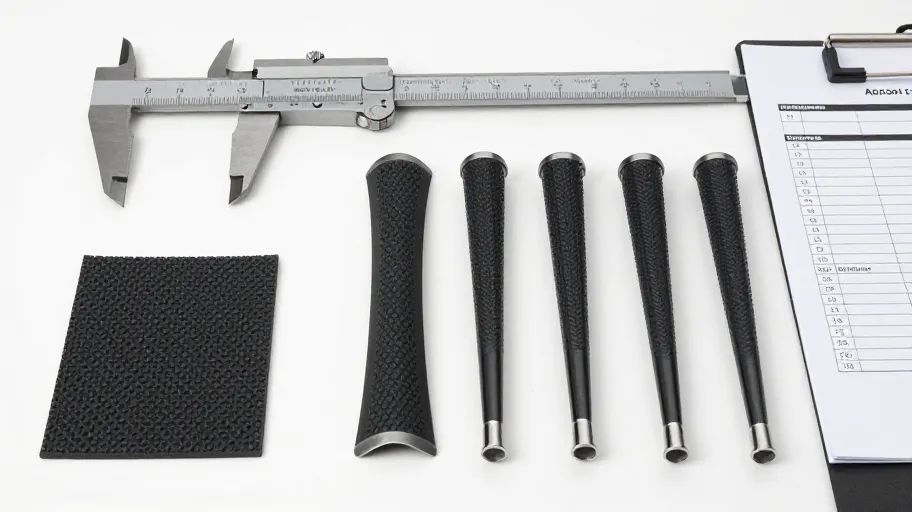
When you search for a "scottie scheffler grip," what you are really buying is a specification, not a name. The Spec–Sample–Approval Path turns that search intent into a sourcing process: first document the grip dimensions, material and texture you need for your exact club model; second, request samples against that written spec; third, run a documented approval checklist before you place any volume order. This guide walks through each step with the questions to ask and the records to keep.
Why the query is a specification question
Searches around a tour player's grip choice are useful as a starting reference, but they do not tell you anything verifiable about the product in front of you. A grip that works for a touring professional tells you nothing about whether it suits your shaft butt diameter, your swing characteristics, your installation method or your customers' expectations. Treat the query as a direction to investigate, then convert it into concrete attributes:
- Core size and how it interacts with your shaft's butt section.
- Grip weight and its effect on swingweight for the specific club family.
- Surface texture and material, and how those behave in the conditions your players actually face.
- Installation requirements — tape, solvent, air, or a specific technique.
None of these attributes can be assumed from a search result. Each one belongs in your specification worksheet, and each one should be confirmed with the supplier in writing.
Step one — Spec: build the worksheet before you contact anyone
The most common sourcing failure is contacting a supplier with a vague request. Before you ask for anything, complete a one-page specification worksheet. It should cover:
| Worksheet field | What to document | Why it matters |
|---|---|---|
| Target club | Brand, family, model, club type (e.g. driver, iron set) and shaft model | Fitment is model-specific; a grip that suits one shaft may not suit another in the same family |
| Core and butt interface | Your shaft's butt section description, as stated by the shaft manufacturer or measured on the club | Determines whether the grip seats correctly and whether any build-up is needed |
| Size intent | Desired finished size direction (standard, larger, smaller, or built up) — described, with any dimension confirmed against the manufacturer's published grip spec | Size affects feel and shot shape tendencies |
| Weight intent | Target grip weight range and its swingweight implication for the club | Changing grip weight shifts the club's balance point |
| Material and texture | Preferred material family and surface pattern, with notes on the conditions of use | Texture drives traction and wear expectations |
| Installation method | Solvent-based tape, air installation or other method you plan to use | Some grips and shafts pair better with certain methods; confirm with both suppliers |
| Volume intent | Whether this is a single reshaft, a full set build, or an ongoing build programme | Changes what you should ask about availability and supply continuity |
Two cautions. First, never assume a grip is compatible with your shaft model — confirm it against the shaft manufacturer's documentation or with a qualified builder. Second, do not rely on verbal descriptions of dimensions; ask the supplier to confirm each specification in writing for the exact product and variant you intend to buy.
Step two — Sample: ask before you order, not after
Sampling is where specifications stop being theoretical. But sample terms differ from supplier to supplier, and nothing in this article should be read as a description of any particular supplier's policy. Before requesting samples, put these questions in writing:
- Is a sample available for the exact model and variant in my worksheet, and is there a fee?
- Who arranges and pays for shipping, and what are the current terms?
- What is the current lead time from request to receipt?
- Can I receive samples of more than one candidate grip so I can compare side by side?
- What documentation accompanies the sample — published specifications, installation notes, care guidance?
- If the sample meets spec, what is the current process and timeline for moving to a volume order?
When the samples arrive, evaluate them against your worksheet, not against marketing language. Grip them on a build you already own. Test them in the conditions you play or build for. Record what you find. A sample that "feels good" is not an approved sample; a sample that matches your documented spec on core fit, size direction, weight, texture and installation behaviour is.
One honest caveat: a sample only tells you about the sample. If you later order at volume, confirm in writing that the production units will match the sample you approved, and ask what the current process is if they do not.
Step three — Approval: document what "approved" means
An approval is only useful if it is written down. Before signing off, complete a checklist like this one and keep it with the project file:
- Sample received matches the model, variant and specification line items in the worksheet.
- Core fit on the actual shaft has been checked by a builder, not assumed.
- Finished size and weight direction confirmed against the manufacturer's published grip spec and the club's stated balance intent.
- Texture and material assessed in the intended playing conditions.
- Installation method trialled on the sample with the planned tape, solvent or air method.
- Any build-up or sizing adjustments trialled and recorded.
- Written confirmation received that volume units will match the approved sample.
- Current order process, pricing, lead time and after-sales contact confirmed in writing.
- Photographs and notes filed with the project record.
If any box cannot be ticked, the grip is not approved — it is still under evaluation. This discipline protects club builders especially, because a grip that passes a single-club trial can still fail a full-set programme if the documentation gap is discovered late.
The DIY-Golf approach
DIY-Golf's public pages focus on component selection and golf club fitment guidance, which is exactly the material you need for step one: matching a grip candidate to your club's brand, family and model. The brief linked below is where the process becomes project-specific — you bring your worksheet, and the questions about samples, terms and lead times get answered directly rather than assumed.
FAQ
Is a tour player's grip choice a reliable specification for my build? It is a reference point, not a specification. Player preferences reflect their shafts, swing and conditions, none of which you can verify from a search result. Use the query to shortlist candidates, then document your own requirements and confirm each one for the exact product.
How do I know a grip will fit my shaft before ordering? Check the shaft manufacturer's published butt-section documentation and confirm compatibility with the grip supplier in writing for your exact shaft model. Never assume fitment across brands, families or model years.
Should I sample multiple grip candidates at once? Side-by-side comparison is more informative than sequential sampling, because it removes recall bias from feel judgments. Ask the supplier what candidates and sample arrangements are currently available.
What if the volume order differs from the approved sample? That risk is exactly why step three exists. Before ordering, get written confirmation that production units will match the approved sample, and ask what the current process is for raising and resolving a discrepancy.
Can DIY-Golf confirm specs for my specific club model? The public pages cover component selection and fitment guidance by brand, family and model. For anything project-specific — exact variant, sample availability, current terms — submit the brief and confirm directly rather than assuming.
Primary CTA: 获取采购 Brief
Ready to move from shortlist to specification? 获取采购 Brief — send your club model, shaft details and grip requirements, and receive a structured response covering candidate options, sample questions and the approval steps for your project.
Low-friction checklist CTA: Before you go, run the free pre-contact checklist above against your current grip candidate. If you cannot tick every box, you are not ready to order — and the brief will help you close the gaps.
Master Your Swing, DIY Your Fit. DIY Golf is the premier destination for the technical golfer. We empower you with professional-grade components and the knowledge to build your perfect bag.


