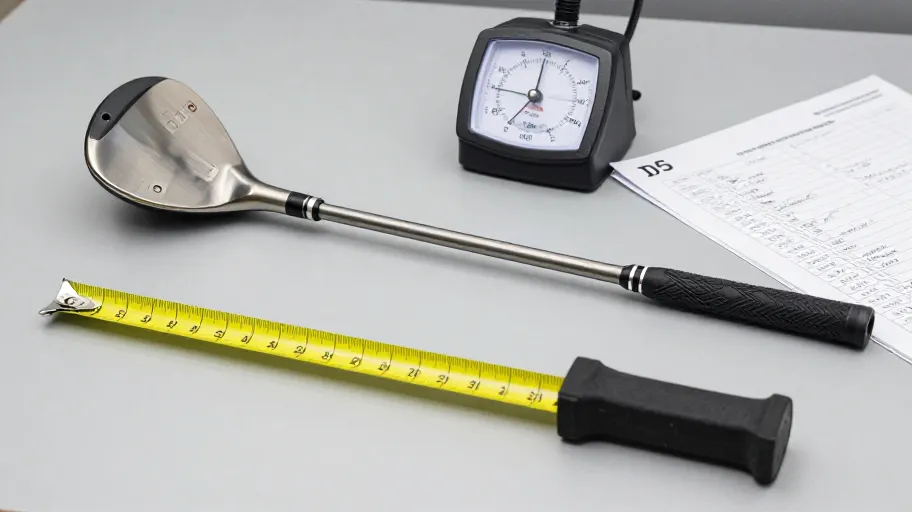
Swing weight is the balance point measurement of an assembled golf club, expressed on an alphanumeric scale such as D2. For component buyers, it means the head, shaft, grip and final length must be planned together: no single part determines the finished feel, and every specification should be documented and approved before you commit.
Why component selection starts with a swing weight target
When you source a replacement head, shaft or grip for a specific club family and model, you are not buying a part in isolation. You are buying one variable inside an assembly. A shaft that feels stable in one build can feel dead in another purely because the head mass or playing length shifted the balance point. Builders who skip this step end up re-ordering components after assembly disappoints.
The practical move is to fix a target swing weight range for the finished club first, then work backwards through component choices. That target should come from the clubs the player already performs with, or from a fitting session — not from a generic recommendation.
The Match–Measure–Approve framework
Use this three-stage framework to turn component research into a defensible purchase decision.
1. Match. Map every candidate component against your target swing weight budget. List the head mass as published by the manufacturer, the shaft's raw weight and trim instructions, the grip weight, and the intended playing length. If any of these figures is missing from a listing, that gap is your first question to the supplier — not a reason to assume.
2. Measure. Plan how you will verify the result. A swing weight scale is the reference instrument for this job. If you do not have one, decide in advance who measures the assembled club and how the reading will be recorded. Without a documented measurement, approval becomes opinion.
3. Approve. Approve the component set only when the measured result falls inside your documented target range, or when you have a deliberate, written reason to accept a deviation. This is where sampling matters: a physical sample lets you confirm the assembled reading before committing to a full order. Sample terms, fees and shipping arrangements vary — confirm the current policy directly with the supplier for the exact model you are sourcing.
Decision table: which component lever moves swing weight
This table ranks where to intervene, by build context. It is a planning aid, not a promise of a specific numeric outcome — final readings depend on the exact parts and build.
| Build context | First lever to examine | Why | What to confirm with the supplier |
|---|---|---|---|
| Replacing a shaft on an existing head | Shaft raw weight and trim code | Trimmed shaft mass shifts balance at the butt and tip; the same model can build differently by trim | Trim instructions, raw weight tolerance, tip/butt trim figures for your length |
| Replacing a head on an existing shaft | Head mass as weighed | Head mass sits at the far end of the lever; small changes move the balance point meaningfully | Actual weighed mass of the head, hosel compatibility with your shaft tip |
| Regripping only | Grip weight and tape build-up | Grip mass sits at the butt; heavier grips lighten feel without touching the head | Grip weight per unit, core size, build-up tape guidance |
| Full custom build | Playing length first, then all parts | Length moves every downstream reading; set length before locking components | Component weights, length plan, and whether the seller can pre-check the build |
| Fine-tuning after assembly | Tip weights, butt weights, lead tape | Small adjustable masses let you close the gap to target after measuring | Which adjustment options are compatible with the head and shaft model |
Approval questions to put to the supplier before ordering
Bring these to every component enquiry. Document the answers so approval is traceable.
- What is the weighed mass of this exact head model, and does the seller verify it before dispatch?
- What are the published raw weight and trim instructions for this shaft model at my target playing length?
- Is this grip model stocked in the weight I need, and what is the current availability for my quantity?
- What is the current sample policy for this component — is a sample available, and on what terms?
- What are the current shipping options and timelines for my destination and quantity?
- What return or exchange terms apply if a component arrives not matching the listed specification?
- Can the seller confirm fitment between this head, hosel and shaft tip for my exact model and generation?
None of these can be answered from this article alone. Policies and stock change; confirm each point in writing for the exact part number before approving the order.
Pre-order verification checklist
Use this low-friction checklist before any purchase:
- Target swing weight range documented from a reference club or fitting
- Playing length fixed and written down
- Head mass, shaft raw weight, trim instructions and grip weight all listed in one build sheet
- Fitment between head, hosel and shaft tip confirmed for the exact model generation
- Sample policy, fees and shipping terms confirmed directly with the seller
- Measurement method decided — who weighs the assembled club and on what scale
- Approval threshold written down: what deviation from target you will accept, if any
FAQ
Does swing weight matter more than total club weight? They measure different things. Total weight is mass; swing weight is balance. A club can have the right total weight and the wrong swing weight and feel unusable. Component buyers should document both figures in the build sheet.
Can I predict the finished swing weight from component specs alone? You can estimate it, and you should — but an estimate is not a measurement. Component listings state nominal figures; assembled results depend on trim, length, glue, grip tape and assembly method. Plan to measure the built club and approve against your documented target.
How do I adjust swing weight after assembly without new components? Common levers — in the sense of widely available, not guaranteed — include lead tape, tip weights and butt weights. Whether each option fits your exact head and shaft model is a fitment question to confirm with the supplier before ordering.
Should I order a sample before a full component order? If your budget allows for error to be eliminated cheaply, sampling is the safest approval route for any unfamiliar component. Whether a sample is offered, what it costs and who covers shipping are current-policy questions — confirm them directly rather than assuming.
Where should a swing weight target come from? From clubs the player already performs with, measured on a swing weight scale, or from a documented fitting session. Avoid adopting a target from a generic chart without reference to the player's existing equipment.
Next step
If you are sourcing components for a specific club model and need a structured document to send to a supplier, 获取采购 Brief and use it to capture specifications, sample questions and approval criteria in one place.
Or start smaller: copy the pre-order verification checklist above into your next build sheet and work through it line by line before you approve any component.
Master Your Swing, DIY Your Fit. DIY Golf is the premier destination for the technical golfer. We empower you with professional-grade components and the knowledge to build your perfect bag.


