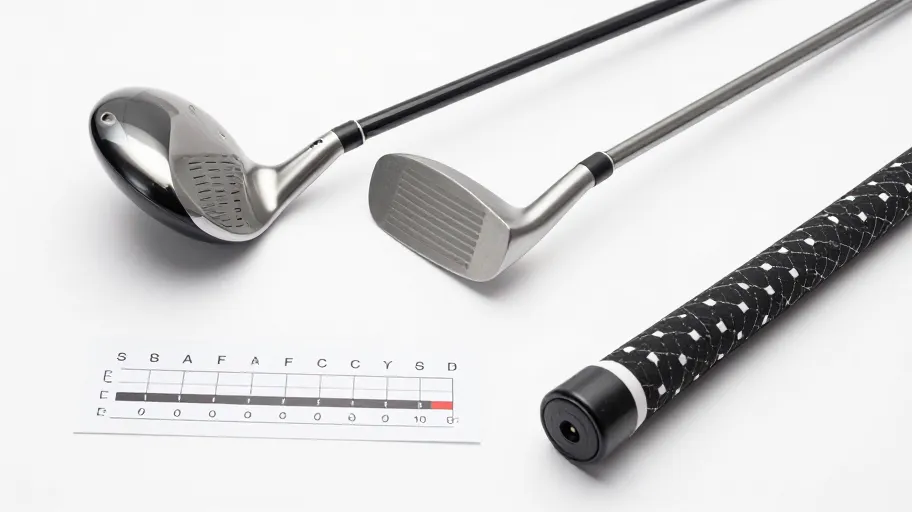
A swing weight guide for golf clubs maps how head weight, shaft weight, grip weight and cut length combine into the balance feel of a finished club. For component sourcing, the guide's job is narrow: convert a stated swing weight target for a specific club brand, family and model into documented component specs, then verify each spec with the supplier before approving an order. Every policy detail — samples, cost, shipping, tolerances — must be confirmed directly, because none of it can be assumed.
What a swing weight guide must contain for component sourcing
Most swing weight content is written for players choosing between finished clubs. As a builder or researcher sourcing components, you need a guide that does three things:
- Separates the target from the build. A swing weight letter–number scale value is an outcome, not an input. The inputs are the assembled components and their measured weights.
- Ties every variable to a documentable spec. Head weight, shaft raw weight, shaft cut length, grip weight, and any tip or butt trimming all belong on one spec sheet tied to your exact club model.
- Leaves policy questions open. The guide should tell you what to ask — not assert what a supplier's sample, fee, shipping or tolerance policy is.
The SPEC–BUILD–CONFIRM framework
Use this three-stage framework when translating a swing weight guide into a component order:
Stage 1 — SPEC. Write down the club brand, family, model, loft (for heads), the shaft model and flex, the intended playing length, and the target swing weight range. If you are replacing components in an existing club, record the measured as-built values first: current total weight, current balance point, current length. These measurements become your baseline.
Stage 2 — BUILD. Model how each candidate component moves the build. A heavier grip reduces swing weight; a lighter grip increases it; adding head weight increases it; trimming length from the butt reduces it. The direction of each effect is mechanical and reliable, but the magnitude depends on the specific components — which is why every magnitude must come from supplier-confirmed specs or your own measurement, not from generic assumptions.
Stage 3 — CONFIRM. Before approving any order, confirm with the supplier: the exact component part numbers, the measured weight values they will ship against, their tolerance on those values, their sample policy, and their documentation. Nothing in Stage 3 can be assumed from the model name alone.
Decision table: component variables and what to confirm
| Component variable | What it affects | Sourcing question to confirm with the supplier |
|---|---|---|
| Head model and weight | Primary driver of swing weight | What is the as-produced head weight for this exact model and loft, and what tolerance applies? |
| Shaft raw weight and balance point | Both swing weight and total weight | What is the raw shaft weight at the stated trim length, and is the balance point published? |
| Shaft trim code | Finished length and stiffness feel | Which trim instructions apply to this shaft model, and can they be supplied in writing? |
| Grip weight | Shifts swing weight down as weight rises | What is the grip weight for this grip model and size, within what tolerance? |
| Playing length | Directly changes swing weight | Can the supplier confirm the component geometry supports your intended finished length? |
| Interchangeable/adjustable weights | Adjustability range | What weight options exist for this club family, and what is the current availability of each? |
| Sample availability | Approval workflow | What is the current sample policy, and what does the reader need to confirm before requesting one? |
Note that no row above asserts a value, tolerance or policy. Each row converts an unknown into a documented question — the correct posture when sourcing components against a specific club model.
Sample evaluation and approval questions
When a sample arrives, evaluate it against your written spec, not against impressions. A workable sample approval set looks like this:
- Identity: Does the sample match the exact part number, model and specification quoted?
- Measurement: Does measured head weight, shaft weight and grip weight fall inside the tolerance the supplier stated in writing?
- Fitment: Does the sample physically interface with the intended club family — hosel diameter, shaft tip, grip core — as documented, not as assumed? Confirm fitment evidence for your exact model before relying on it.
- Consistency: If multiple samples are provided, do they measure consistently against each other?
- Documentation: Does the sample arrive with a spec sheet you can file against the order?
- Policy: What are the current sample, fee, shipping and reorder policies? Confirm these directly each time; this article does not state what any supplier's policy includes, who pays for transport, or whether any fee is applied toward an order — those answers must come from the supplier in writing.
Only after these questions are answered in writing should an order move to approval. If any answer is missing, the correct action is to document the gap and re-confirm, not to proceed on assumption.
Documentation and comparison method
To compare component options across suppliers, normalise the data into one table:
| Field | Option A | Option B | Status |
|---|---|---|---|
| Exact model / part number | To fill | To fill | Required |
| Head weight (stated) | To fill | To fill | Required |
| Shaft weight at trim length | To fill | To fill | Required |
| Grip weight | To fill | To fill | Required |
| Stated tolerance | To fill | To fill | Required — confirm in writing |
| Sample policy summary | To fill | To fill | Required — confirm directly |
| Fitment evidence for my club model | To fill | To fill | Required — no assumption |
This table is the comparison instrument. It deliberately has no assumed values: every cell is a fact to obtain. When two options are otherwise close, the tiebreaker is documentation quality — the supplier that states measured values and tolerances in writing gives you something you can approve against.
FAQ
1. Can a swing weight guide tell me the right target for my club model? It can frame the decision, but the target for a specific club brand, family and model must come from your own baseline measurements and fitting objectives. Document the target, then verify each component against it with the supplier.
2. Do replacement components automatically match a finished club's swing weight? Not automatically. Swing weight is an assembled outcome. If you change any component — head, shaft, grip or length — you must recalculate from the new component specs and confirm the values with the supplier before approving.
3. What should I ask a supplier about tolerances? Ask for the stated tolerance on head weight, shaft weight and grip weight for the exact part numbers you are ordering, in writing. Do not accept a tolerance inferred from a model name or a category description; the values must attach to your specific order.
4. How do I handle fitment questions for a specific club family? Ask the supplier for fitment evidence covering your exact club model — interface dimensions and compatibility documentation. Absent first-party evidence for that model, treat fitment as unverified and document it as an open item in your approval record.
5. What if the supplier's sample measurements differ from the spec sheet? Record the discrepancy, request clarification in writing, and withhold approval until the measured values and stated tolerances reconcile. A documented gap is a decision input; an unexamined one is a risk.
Next step
[获取采购 Brief] — request the sourcing brief and turn your swing weight target into a documented, supplier-confirmable component specification.
Low-friction alternative: if you are still assembling your spec, download or copy the approval checklist above and work through it against your club model before requesting anything. When your spec sheet is complete, the brief is the natural next document.
Master Your Swing, DIY Your Fit. DIY Golf is the premier destination for the technical golfer. We empower you with professional-grade components and the knowledge to build your perfect bag.


