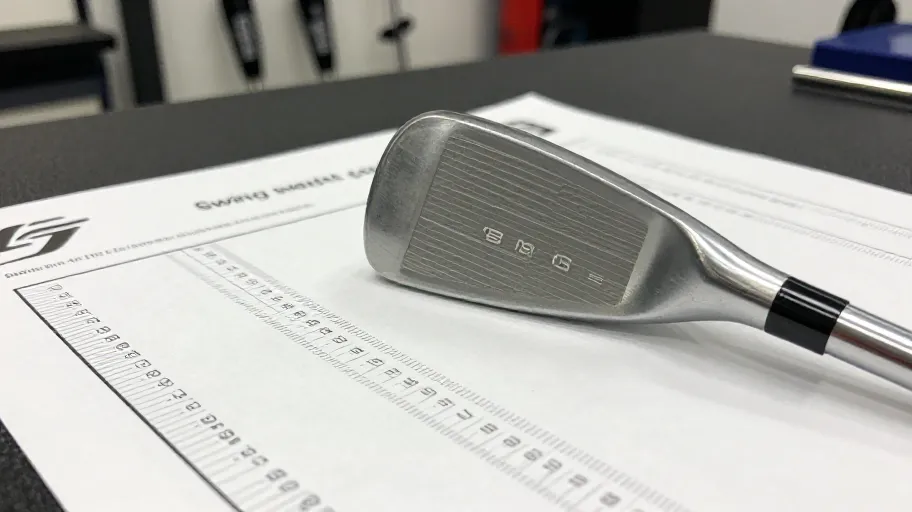
A swing weight guide iron is a reference club or component used to check, compare and reproduce a target swing weight when building or re-shafting irons within a specific brand family and model line. To source one well, match the documented specifications to your model, verify accuracy with a physical sample on your own scale, and record a written sign-off before committing to any volume. Everything else — pricing, sample terms, production policy — must be confirmed directly with the supplier in writing.
Why swing weight matching matters for your build
Swing weight is a match-and-repeat measurement, not an absolute quality score. When a club builder tunes a set of irons, the goal is consistency: each club should land on the intended swing weight point relative to the reference. A guide iron (or guide component set) gives you that reference. But the reference is only as useful as its documented construction — head weight, shaft, grip, length and assembly method all interact.
That is why this guide separates research from approval. Research tells you which candidate components are plausible for your brand family and model. Approval — a physical sample, measured on your equipment, against your target — tells you whether the candidate is right for your project.
The SPEC–SAMPLE–SIGN-OFF framework
Use this three-gate framework for any swing weight guide iron or related component purchase:
- SPEC — Collect written specifications for the exact component and model. Do not accept fitment claims without a part-level match to your club family.
- SAMPLE — Obtain a physical sample and measure it on your own swing weight scale and scale of record before any larger commitment.
- SIGN-OFF — Document what you measured, what you approved and under what conditions. Keep the record with the project file.
The framework exists because swing weight results depend on the complete assembly. A component that measures correctly on the supplier's bench may read differently on yours due to equipment, grip choice or assembly method. A documented sample evaluation closes that gap.
Decision table: screening candidate guide irons
| Criterion | What to ask or measure | Why it matters | Red flag |
|---|---|---|---|
| Part-level fitment | Does the component match your exact brand, family and model in writing? | Generic fitment claims don't survive a model-specific build. | "Fits most irons" with no model reference |
| Head weight documentation | Is the head weight stated and traceable for the exact part? | Head weight drives swing weight matching. | Weight given only as a range with no part number |
| Shaft and grip reference | Which shaft and grip was the reference swing weight measured with? | Swing weight is assembly-dependent, not head-only. | Reference measured with unspecified components |
| Length reference | At what finished length was the reference established? | Length changes swing weight readings. | No length stated |
| Sample availability | Can a physical sample be provided, and under what current terms? | You must verify on your own equipment. | Sample terms undefined or refused in writing |
| Measurement method | What scale and method did the supplier use? | Lets you compare their numbers to yours. | No method stated |
| Written confirmation | Will the supplier confirm specs and compatibility for your exact model in writing? | Creates an approval trail. | Verbal-only assurance |
Add or remove rows to fit your project, but keep the structure: written spec, measurable property, reason, red flag.
Sample evaluation: measure, then document
When your sample arrives, evaluate it as you would evaluate any incoming component:
- Measure swing weight on your own scale, more than once, and record each reading.
- Confirm the sample's part-level identity against the written specification.
- Compare the sample's measured values against the supplier's stated values and note any difference.
- Photograph the sample alongside the spec sheet and your readings.
- Record the conditions: scale used, temperature if relevant, grip and shaft fitted, finished length.
If the readings differ from the stated specification, ask the supplier to explain the difference before approving. The explanation may be legitimate — assembly reference differences, for example — but it must be documented, not assumed.
Approval questions to send in writing
Before approving any guide iron or component order, send these questions to the supplier and keep the answers on file:
- Can you confirm in writing that this component matches the exact brand, family and model I am building?
- What are the documented specifications — head weight, reference shaft, grip, finished length — for this exact part?
- What measurement method and equipment produced the stated swing weight reference?
- Can I obtain a physical sample, and what are the current sample terms, costs and shipping arrangements?
- What are your current production, lead-time and shipping terms for the quantities I am considering?
- What happens if a delivered component does not match the documented specification?
- What is the process for approving or rejecting a production batch against the approved sample?
None of these questions assumes any specific policy. Every answer is project-specific and must come from the supplier directly.
Frequently asked questions
Is a swing weight guide iron the same as a standard iron component? Not necessarily. A guide iron is a reference assembly used to check and reproduce a target swing weight. Whether a standard component can serve as your reference depends on its documented specifications for your exact model — confirm in writing before relying on it.
How accurate does my own scale need to be? The honest answer is: consistent enough to detect differences that matter to your builds. Verify your scale against a known reference, document your method, and use the same setup for sample evaluation and production checks so comparisons stay valid.
Can I approve a component from a specification sheet alone? You can shortlist from a spec sheet, but approval should follow a physical sample measured on your own equipment. The SPEC gate selects candidates; the SAMPLE and SIGN-OFF gates protect your project.
What if the supplier won't confirm fitment for my exact model? Treat that as a screening result, not a negotiation point. Without written, part-level confirmation, you cannot document an approval trail, and any mismatch discovered later becomes difficult to resolve.
How do I handle differences between my measurements and the supplier's? Ask for the supplier's measurement method, equipment and assembly reference, then reconcile the difference in writing. If it cannot be reconciled, do not approve — move to the next candidate.
Get the Sourcing Brief
[Get the Sourcing Brief (获取采购 Brief)] — a structured, model-specific questionnaire covering specifications, sample terms, measurement methods and approval conditions. Use it with any supplier, keep the answers on file, and build a documented trail from shortlist to sign-off.
Not ready yet? Start with the checklist
[Download the sample approval checklist] — a one-page list of the measurements, confirmations and documentation steps above. Work through it for any guide iron or component candidate before you commit.
Master Your Swing, DIY Your Fit. DIY Golf is the premier destination for the technical golfer. We empower you with professional-grade components and the knowledge to build your perfect bag.


