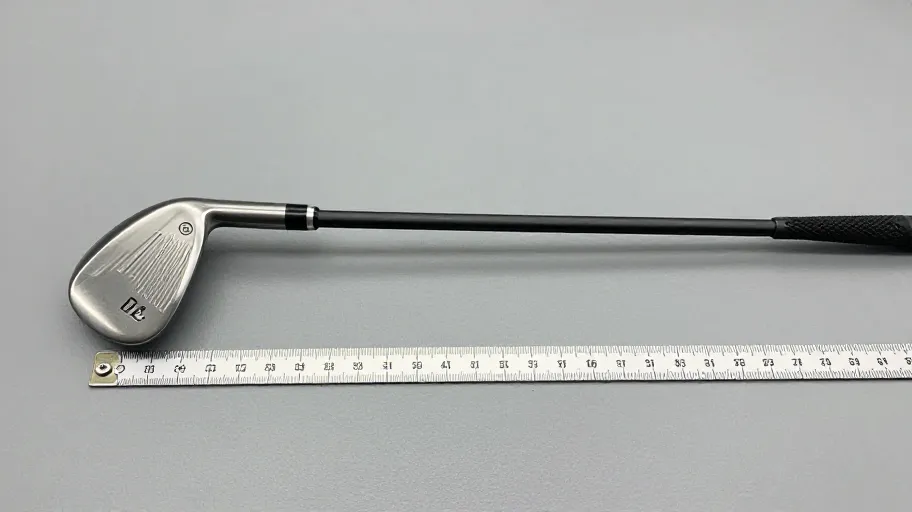
Swing weight is the balance point measurement of an assembled club, expressed on an alpha-numeric scale, that describes how heavy the club feels during the swing. For component sourcing, it is not a property of any single part: it emerges from the interaction of head weight, shaft weight and balance, finished length, and grip weight. Set your target swing weight first, then specify every component against it, validate with a built sample, and approve the documented result before ordering in volume.
What swing weight is — and what it is not
Swing weight describes mass distribution, not total mass. Two clubs can have identical total weight and very different swing weights because the balance point sits in a different place. When you replace a shaft, change grip style, or trim a club to length, you shift the balance point and therefore the swing weight — even when every component is "correct" on paper.
For a club builder or component buyer, this creates one core sourcing problem: catalogues list static component data, but the number that determines feel at impact is produced only when the parts are assembled. That gap between specification and assembled reality is where most disappointing builds are born. Closing it requires a deliberate approval process, not a larger catalogue.
The SPEC–SAMPLE–APPROVE framework
Use this three-stage ladder for every swing-weight-sensitive component purchase:
Stage 1 — SPEC. Define the target swing weight for the finished club, per club family and model, in writing. Record the assembled length, head weight configuration, shaft model and weight, and grip model and weight you intend to use. Identify which component you will treat as the adjustment variable — head weights, lead tape, or a shaft trim plan — before you order anything.
Stage 2 — SAMPLE. Have the supplier assemble (or let you assemble) one club per specification and measure it on a swing weight scale. Document the measured value against the target. Do not approve based on catalogue math alone; assembled measurement is the only first-party evidence that counts.
Stage 3 — APPROVE. Approve in writing only when the measured sample matches the agreed target within the tolerance you defined at the SPEC stage. If the sample deviates, adjust the stated variable, re-sample, and re-measure. Lock the approved specification sheet as the reference for all subsequent orders.
What deviation is acceptable, how samples are handled, and what happens if a sample does not match are all project-specific. Confirm the current policy directly with the supplier before committing.
Decision table: swing weight scenarios and actions
| Scenario | Swing weight risk | Recommended action |
|---|---|---|
| Replacing a shaft in an existing club family | New shaft weight and balance point shift the result | SPEC: record the original measured swing weight as the baseline before disassembly |
| Changing grips only | Grip weight changes the balance point | SPEC: compare grip weights in writing; re-measure after fitting |
| Building a matched set from components | Each club's head weight and length interact differently | SPEC per club; SAMPLE the longest and shortest club first |
| Sourcing adjustable head weights | Weight port options alter fine-tuning range | Ask which weight configurations the supplier can document per model |
| Re-shafting with a lighter shaft family | Large downward shift expected | Define the compensation plan (length, weighting, tape) before ordering |
| Buying for resale or client builds | Feel consistency across builds matters commercially | APPROVE: retain the measured spec sheet for every delivered build |
Approval questions to send the supplier
Put these questions in writing and attach the answers to your order:
- Can you supply the measured component weights — head, shaft cut to length, and grip — for the exact brand, family and model I am ordering?
- What is your process for confirming an assembled swing weight target before a production or volume order?
- How are samples handled for a first build, and how is a sample deviation resolved? Confirm the current policy directly.
- Which component do you recommend as the adjustment variable for this specific club family, and on what documented basis?
- Can the approved specification sheet be referenced on repeat orders so the same configuration is reproduced?
- What evidence will you provide with delivery — measured swing weight per club, or component data only?
These questions do not assume any particular policy; they force the supplier to state theirs on record.
FAQ
Is swing weight the same as total weight? No. Total weight is the mass of the assembled club; swing weight describes how that mass is distributed relative to a fixed fulcrum. Two clubs of identical total weight can feel very different.
Can I calculate swing weight from component data alone? You can estimate it, but estimation is not verification. Component data gets you close; only assembling and measuring the club on a swing weight scale confirms the result. Treat calculation as a SPEC-stage tool and measurement as the APPROVE-stage gate.
Which component changes swing weight the most? There is no universal answer — it depends on the magnitude of change in each component and the club's length. A shaft swap, a grip change and a length trim can each dominate in different builds. Define your adjustment variable at the SPEC stage rather than assuming one component is decisive.
How do I keep swing weight consistent across a set? Document a target per club, control finished length and grip weight across the set, and verify with per-club measurements on the same scale. Consistency comes from the process, not from matching catalogue entries.
Should I approve a build without a measured sample? For a swing-weight-critical specification, no. The measured sample is the only first-party evidence that the assembled club meets the agreed target. Approve against documentation, not against claims.
Next step
If you are sourcing components for a specific club family and swing weight is part of your acceptance criteria, 获取采购 Brief — request the sourcing brief and use it to lock your SPEC–SAMPLE–APPROVE record before you place the order.
Alternatively, start small: download the free component approval checklist and run your next single-club order through the SPEC–SAMPLE–APPROVE ladder. One documented build teaches you more about a supplier than a page of catalogue data.
Master Your Swing, DIY Your Fit. DIY Golf is the premier destination for the technical golfer. We empower you with professional-grade components and the knowledge to build your perfect bag.


