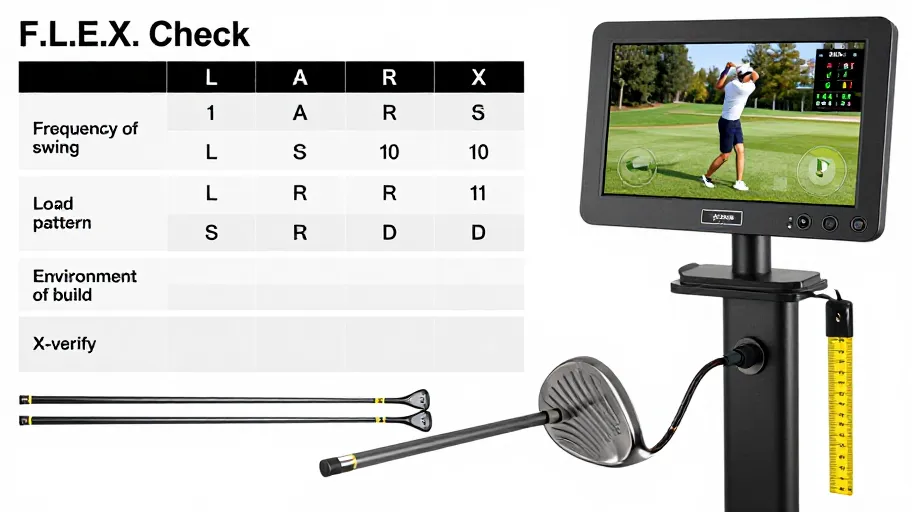
What flex golf shaft do I need? The honest answer: the flex that matches your measured swing speed, tempo and release, installed in your exact clubhead with your intended playing length — not the letter printed on a chart. Use the F.L.E.X. Check: Frequency of swing, Load pattern, Environment of build, X-verify. Confirm every spec against your model before approving an order.
Why generic flex charts can't answer this for you
Every experienced club builder reaches the same conclusion: flex is not a fixed property of the shaft. It is the interaction between the shaft's stiffness profile, the clubhead weight, the playing length, the grip and the golfer's swing. A shaft marked "S" from one manufacturer can deflect differently than another "S" — and the same shaft behaves differently in a 200-gram driver head versus a 230-gram head.
That is why a specification-confirmation approach works better than a chart lookup. You are not asking "what letter am I?" You are documenting a build and verifying that each component — shaft, head, adapter, grip, length — is compatible and will produce the feel and flight you intend.
The F.L.E.X. Check framework
Use these four steps in order, and write the answers down. This documentation becomes your sourcing brief.
F — Frequency of swing. Start with measured clubhead speed (driver) or iron speed, not estimates from a range session. If you have access to a launch monitor, capture speed, carry and dispersion over a meaningful number of shots. If you don't, note that in your brief and flag it as an open measurement.
L — Load pattern. How you deliver the shaft matters as much as how fast you swing. A smooth tempo with a late release loads the tip differently than an aggressive transition with an early release, even at identical speed. Describe your transition (smooth, moderate, firm) and release (late, neutral, early) in writing.
E — Environment of the build. Record the intended head model and weight, tip diameter, hosel type or adapter, intended playing length, grip weight and any tip-trimming plan. This is where most fitment errors are caught — before purchase, not after.
X — X-verify. Cross-check your conclusion against at least one independent input: a prior fitting with documented specs, a comparable build you have played, or the shaft manufacturer's published measurements for the exact model. Where a flex label and measured behaviour disagree, trust the measurement and ask the supplier to confirm in writing.
Decision table: mapping your inputs to flex candidates
| Swing speed (driver) | Transition / release | Flex candidate | Verification needed before ordering |
|---|---|---|---|
| Under 75 mph | Smooth or moderate | A-flex or Ladies | Confirm tip diameter for your head; verify intended length |
| 75–90 mph | Smooth, late release | Senior / A-flex or light R | Confirm weight match and trimming guidance |
| 80–95 mph | Moderate, neutral | Regular | Compare shaft weight against current build; confirm adapter fit |
| 90–105 mph | Firm, neutral or early | Stiff | Verify head weight and playing length; document butt-trim plan |
| 100+ mph | Firm to aggressive, late release | X-Stiff or beyond | Confirm tip-section availability and measured profile data from supplier |
Treat this table as a starting hypothesis, not a verdict. Your iron flex may differ from your driver flex because head weights and lengths differ — confirm each club category separately.
Model-specific confirmation: the part most buyers skip
Before approving any purchase for a specific club brand, family and model, record and verify:
- Tip diameter and hosel geometry for the exact head model — confirm in writing, do not infer from the family name.
- Playing length you intend, and whether the raw shaft length supports it.
- Shaft weight and balance point relative to the head and grip you will use.
- Adapter compatibility, if your model uses an adjustable hosel system — confirm the shaft's tip prep suits that adapter.
- Torque and launch profile as published for the exact shaft model and flex you are sourcing.
Any one of these can invalidate an otherwise correct flex choice. Document all five.
Sample and approval questions for any supplier
No sample policy, fee structure, shipping arrangement or lead time was supplied for this article, so treat each of these as open questions to confirm directly before committing:
- What is the current sample policy for this shaft model and flex, including any fees and who covers shipping?
- Can you confirm in writing the tip diameter, weight and measured profile for the exact flex being supplied?
- What is the current lead time and stock position for this model?
- What return or exchange terms apply if the shaft does not match the documented specification?
- Can you provide the manufacturer's trimming and installation guidance for this model?
Keep the answers attached to your build sheet. If a supplier will not confirm a point in writing, that itself is useful sourcing information.
FAQ
Is a stiffer shaft always better for accuracy? No. A shaft that is too stiff for your load pattern can produce weak, low flights and inconsistent strike. Match the flex to measured speed and load, then verify with on-course or monitor evidence for the completed build.
Should my irons and driver use the same flex? Not automatically. Head weights, lengths and swing speeds differ between categories. Confirm each category against its own measurements rather than carrying one flex letter across the set.
Do flex labels mean the same thing across brands? No, and builders should not assume they do. Where available, compare published measurements for the exact model and flex, and ask the supplier to confirm the profile in writing.
How do I handle a shaft for a hybrid or fairway wood? The same F.L.E.X. Check applies, with extra attention to tip diameter and insertion depth for the exact head model. Confirm both with the supplier before ordering.
What if my measurements sit between two flexes? Document both candidates, note your priority (control versus distance), and ask the supplier for measured profile data on both before approving one.
Get the sourcing brief template
Ready to document your build properly? 获取采购 Brief — download the DIY-Golf sourcing brief template and send one structured document that any supplier can approve without a chain of follow-up questions.
Low-friction checklist CTA
Not ready to source yet? Grab the free Flex Confirmation Checklist: five measurable inputs and five supplier questions, ready to fill in before you spend anything.
Master Your Swing, DIY Your Fit. DIY Golf is the premier destination for the technical golfer. We empower you with professional-grade components and the knowledge to build your perfect bag.


