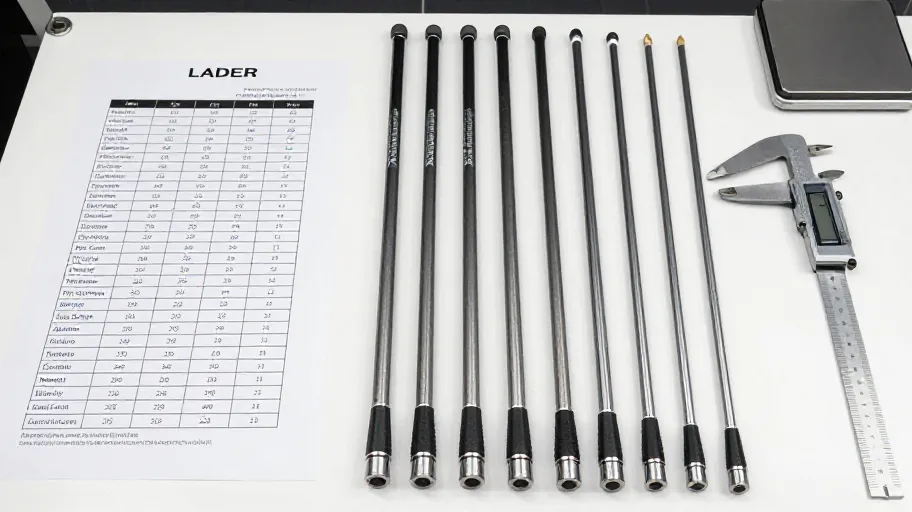
The question "what golf shaft do I need" is best answered not with a brand name but with a written specification: flex, weight, profile, tip and adapter fit, length and build details, confirmed against your exact club model before you order. Use the Shaft Specification Ladder below to convert a desired feel into a documented, verifiable spec sheet you can hand to a builder or supplier.
What the question actually means for your club model
When a golfer or club builder asks what golf shaft do I need, the honest answer depends on three inputs you should pin down first:
- The exact club identity — brand, family and model, plus the generation where relevant. A shaft spec that fits one model in a family may not transfer to another, because head weight, hosel design and adapter systems differ.
- The intent of the change — a like-for-like replacement, a tune of launch and feel, or a repair after a break. Each intent changes which spec fields matter most.
- The evidence you already have — the shaft currently in the club, any markings on it, your own launch or feel observations, and any fitting data you personally possess.
Treat anything you cannot verify about a specific product as an open question rather than an assumption. The framework below exists to separate what you know from what you must confirm.
Rung 1 and 2: Flex, weight and profile
Flex and weight are the two fields buyers get wrong most, because a flex label is a category, not a measurement. Two shafts both marked "stiff" can differ in torque, bend profile and feel.
Use this starting-point table to frame your choice, then verify the actual spec sheet of the shaft you are considering:
| Your situation or descriptor | Reasonable starting frame | Fields to verify on the actual spec sheet |
|---|---|---|
| Smooth, slower tempo; wants easier launch | Softer flex category as a starting frame | Actual flex letter, weight, torque value, bend profile |
| Confident tempo; wants stability without harshness | Stiffer flex category as a starting frame | Actual flex letter, weight, torque value, bend profile |
| Replacing a broken shaft with like-for-like intent | Match the markings and measurements of the removed shaft | Tip trim spec, raw length, adapter compatibility |
| Tuning launch or spin for a specific head | Change one variable at a time, ideally with data you have gathered | Weight difference vs. current shaft, profile family |
| Building for multiple players with different swings | Document each player's frame separately; do not average | Per-player flex, weight, length entries |
Two cautions apply. First, do not assume a flex label from one shaft family predicts feel in another family — read the specific spec sheet. Second, if you have launch data from your own fitting or monitor use, treat it as evidence for that session and club only; do not generalise it into a product claim.
Rung 3: Tip diameter, adapter fit and trim instructions
This is where orders go wrong. Modern drivers and woods use adapter sleeves; irons and wedges use parallel or tapered tip designs. The tip diameter, adapter system and trim instructions must all match your exact club model.
Before ordering, confirm each of these for your specific head:
| Check | Why it matters | How to verify |
|---|---|---|
| Tip diameter matches the hosel or adapter | A mismatch makes installation impossible or unsafe | Measure the hosel bore or confirm the adapter part number for your model |
| Adapter sleeve brand and generation match your head | Adapter systems are model-specific | Match the adapter part number against your club's documentation or the head itself |
| Tip trim instructions are written down | Trim affects flex and feel; a wrong trim changes the build | Request the manufacturer's trim chart for the exact shaft model |
| Parallel tip section length suits the head depth | Deep-bore heads need sufficient parallel section | Confirm against the head's bore depth specification |
Do not accept "it should fit" as an answer. Ask for the part numbers and written fitment confirmation for your exact brand, family and model, and keep them in your record.
Rung 4: Length, grip and the complete build spec
Length decisions cascade: playing length affects swingweight, and swingweight affects feel. Document the full build, not just the shaft:
Build-spec checklist
- Playing length measured from your current club, or a target length you can justify
- Raw shaft length and whether it supports that build after trimming
- Grip model and grip cap contribution to swingweight
- Target swingweight or a note that you will verify after assembly
- Ferrule requirement, if any
- Epoxy and installation notes, if a third party builds the club
- A photograph and written record of your current shaft's markings
A completed checklist is the difference between an order and a specification. It is also what makes any later comparison or correction possible.
Rung 5: Sample, verification and approval
If you are ordering components in any quantity beyond a single personal build, or you are a club builder sourcing for clients, treat the first unit as a verification step rather than a purchase decision. Because no supplier's sample policy was supplied for this article, everything in this rung is framed as questions you must confirm directly:
Approval questions to put in writing before you commit
- Does a sample of the exact shaft model and flex exist, and what is the current sample policy, including any cost and who covers shipping?
- Will the sample be the same production batch or specification as the order quantity?
- Can the supplier provide the shaft's written spec sheet — weight, torque, flex, raw length, tip diameter — for the exact model?
- What is the written fitment confirmation for my exact club brand, family and model, including the adapter part number?
- What are the current lead time, minimum order quantity and payment terms for the order quantity I need?
- What is the current policy if a received unit does not match the approved sample or spec sheet?
- Can markings, labels or packaging be confirmed in writing before production?
Approve in writing. Keep the spec sheet, the sample observations and the supplier's written answers together. If a later shipment differs from the approved reference, that document set is what allows a factual conversation rather than a dispute.
Ready to document your shaft spec? 获取采购 Brief — request our sourcing brief template, complete with the specification fields and approval questions above, so your next shaft order is written, verifiable and comparable.
FAQ
How do I know what golf shaft do I need for my exact driver model? Identify the brand, family, model and generation, note the markings on your current shaft, then confirm tip diameter and adapter part number for that specific head. Match or deliberately change one spec field at a time, and verify every field against the actual spec sheet of the shaft you plan to buy.
Does flex mean the same thing across shaft brands? No. Flex labels are categories, and bend profiles, torque values and weights differ between families. Use the flex label as a starting frame, then compare the written specifications — not just the letter — of the specific shaft model.
Can I reuse the adapter from my current shaft? Only if the adapter part number matches both your head and the new shaft's tip specification. Adapters are model- and generation-specific. Confirm the part number against your head's documentation before assuming reuse is possible.
Should I order a sample before committing to a quantity? If the order is beyond a single build, a sample-and-approve step reduces the risk of a specification mismatch. Sample availability, cost, shipping responsibility and return terms are supplier-specific and current-policy-dependent — confirm each directly in writing before you rely on it.
What information should I keep on file for a shaft order? The written spec sheet, the adapter and trim confirmations, the build checklist, photographs of the current club, and the supplier's written answers on sample, lead time, quantity and mismatch policy. That file is your basis for comparison, correction and future repeats.
Low-friction next step: grab the shaft spec checklist above, photograph your current club's shaft markings, and note your club's brand, family and model. With those in hand, 获取采购 Brief and turn a guess into a document.
Master Your Swing, DIY Your Fit. DIY Golf is the premier destination for the technical golfer. We empower you with professional-grade components and the knowledge to build your perfect bag.


