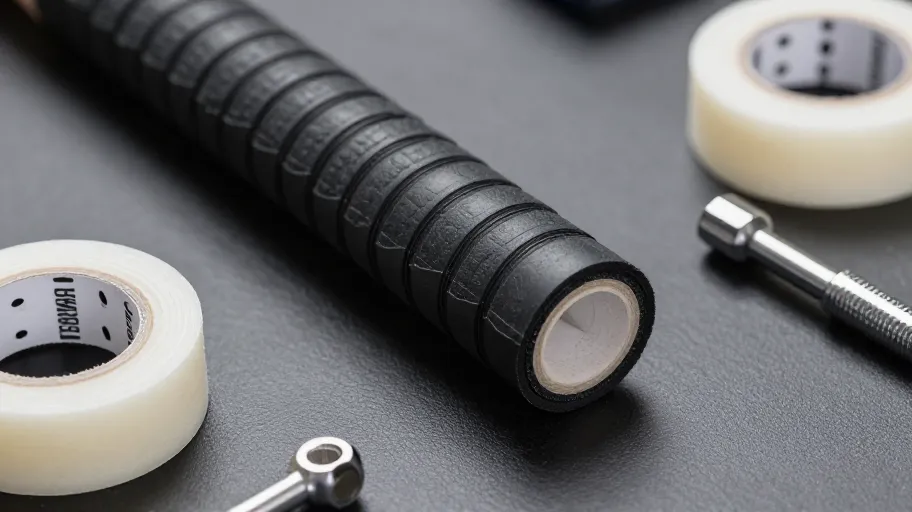
Scottie Scheffler has been widely reported to use a standard-size grip on his clubs with additional build-up tape beneath to fine-tune feel, rather than a factory midsize grip. Tour setups change between events, so treat any reported spec as a starting point to verify and document — not a fixed specification to order against.
What "grip size" means when you are ordering components
When club builders ask what grip size a player uses, three separate variables are in play, and conflating them causes most ordering errors:
- Core diameter. The internal diameter of the grip, which must pair with the butt diameter of the shaft. A mismatch here affects installation and final feel.
- Grip model and wall thickness. Two grips with the same core can present different outer diameters because of wall thickness and material.
- Build-up layers. Tape wraps under the grip increase the effective outer diameter without changing the grip model. This is how many touring professionals fine-tune size quarter-point by quarter-point.
A reported "standard grip with build-up" tells you the starting model but not the final effective size. To source components, you need the model, the core, the number of build-up layers and the butt diameter of the target shaft — documented together.
Interpreting a tour player's grip spec: the SPECS-VERIFY framework
Use this six-step framework to move from a headline about a tour player to a documented, orderable specification.
S — Source the spec. Record where each reported detail comes from and when it was reported. Tour setups are re-evaluated season by season, and a two-year-old report may describe equipment the player has since replaced. Keep dated notes.
P — Place it in context. A tour player's grip choice reflects their swing mechanics, hand size and shot pattern. Scheffler's reported setup is context for understanding options, not a recommendation to copy directly. For a client build, the starting point is the player in front of you, not the tour professional.
E — Evaluate build layers. If a report says "standard grip plus build-up," the build-up is part of the specification. Document the target effective outer diameter so the finished build can be measured against it after installation.
C — Cross-check against the target club model. Confirm the butt diameter of the shaft family you are building or re-gripping before selecting a core size. Fitment questions belong at the model level, not the brand level.
S — Signal approval questions to the supplier. Before ordering, put the questions in the next section to your supplier in writing and keep the responses with your spec sheet.
V — Verify on receipt. Measure the grips you receive against your documented specification before installation. If anything differs from what was confirmed, raise it before the grips go on.
Decision table: translating a tour-inspired setup into a component order
| Situation | Component decision | Verify before ordering | Approval trigger |
|---|---|---|---|
| Replacing grips on an existing build, keeping current feel | Match the documented grip model, core and build-up count of the outgoing setup | Butt diameter of the installed shaft; current build-up configuration | Supplier confirms the exact model and core in writing |
| Copying a reported tour setup for a client | Select the reported model, then size build-up layers to the client, not the professional | Client's hand measurements and preference testing; shaft butt diameter | Client tests a mock-up and approves before full set |
| Building new clubs from components | Choose grip core to match the selected shaft family's butt diameter | Shaft family spec sheet for the exact model | Shaft and grip specs cross-checked against each other |
| Player wants a different feel without a full re-spec | Adjust build-up layers in small increments on one or two clubs first | Baseline measurements of the current build | Trial clubs approved before the remaining set is changed |
| Reported spec is old or unsourced | Treat as a hypothesis; document multiple sources with dates | Whether any two independent reports agree on model and size | Spec confirmed by at least one recent, dated source |
Approval questions for any supplier
Before committing to an order, send these questions and keep the answers with your project file. None of the answers can be assumed — every policy is supplier-specific and must be confirmed currently, in writing.
- What is the exact model, core diameter and batch designation of the grip you will ship for this order?
- Can you confirm in writing that this grip pairs with the butt diameter of the shaft model I have specified?
- What is your current sample policy, and what does it require from me to obtain a sample of this exact model?
- What are your current cost, minimum order quantity and lead-time terms for this model, and are those terms quoted for the current period?
- What is your current shipping arrangement, and what documentation will accompany the shipment?
- If a delivered grip does not match the confirmed specification, what is your documented resolution process?
A supplier who answers these questions precisely and in writing gives you a documentable approval trail. One who answers vaguely gives you a reason to keep comparing.
Frequently asked questions
Does a standard grip with build-up tape feel the same as a midsize grip? Not necessarily. Build-up layers are placed selectively, so the effective diameter can vary along the length of the grip, while a factory midsize grip has a uniform profile. The two routes can end at a similar measurement but produce a different feel. Test both if the player is sensitive to taper.
How many build-up layers equal the next size up? There is no universal conversion, because tape thickness and installation method vary. Build up in small increments on a test club, measure the finished outer diameter, and record the configuration that the player approves.
Should I copy a tour player's grip size for a client build? Use it as reference context, not as a specification. The player's hand size, swing and preference testing should drive the final decision. Document whatever you settle on so future re-grips reproduce it exactly.
How do I confirm fitment for a specific club model? Work from the shaft family's butt diameter for the exact model, then select a grip core to match. Confirm the pairing with your supplier in writing before ordering, and verify measurements on receipt.
Frequently enough that dated sourcing matters. Record the date of any report you rely on, and re-verify before repeating a build that was documented more than one season ago.
Next step: document your spec
If you are moving from research to an order, the next move is documentation, not purchase.
获取采购 Brief — request the sourcing brief and turn the questions in this article into a written spec your supplier can confirm against.
If you are not ready for that yet, work through the verification checklist first:
Low-friction checklist before you order:
- Dated source recorded for every reported spec detail
- Grip model, core and build-up configuration documented together
- Target shaft model's butt diameter confirmed against the grip core
- All six supplier approval questions answered in writing
- Measurement plan defined for verifying grips on receipt
Master Your Swing, DIY Your Fit. DIY Golf is the premier destination for the technical golfer. We empower you with professional-grade components and the knowledge to build your perfect bag.


