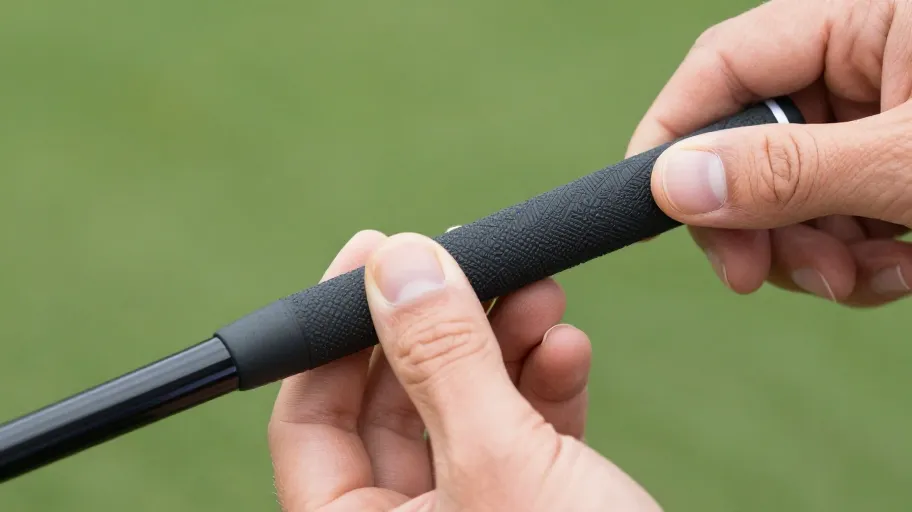
When people ask what is Rory McIlroy's grip style like?, the useful answer for a buyer is not a tour anecdote but a specification: a midsize-profile grip held in an interlocking lead-hand position, with moderate texture and a taper that favours a lighter, more rotational swing. Treat any public description of a tour player's grip as a starting hypothesis — then verify every attribute against the exact grip model, your club family and your own fitment notes before you order anything.
Why this question matters if you build or tune clubs
For a golfer, "what grip does he use?" is curiosity. For a club builder or a buyer sourcing replacement components, it is a specification question hiding inside a celebrity question. The grip is the only part of the club you actually touch, and small changes in profile, size or taper change feel and face control in ways that are easy to feel and hard to reverse once a shaft is epoxied.
So the practical move is to stop treating the search result as an answer and start treating it as a brief. What the reader needs is not "his grip" — which may involve tour-only availability, custom builds or details that no public page can confirm — but a defensible grip specification for the club in their own build queue. That is what the framework below is for.
One caution before we go further: DIY-Golf cannot and does not claim that any specific grip in its catalogue replicates a tour player's exact setup, and it does not claim any endorsement. Use the player's publicly described style as inspiration for attributes, then approve the actual component on its own evidence.
The Grip Specification Ladder
Use this five-rung ladder to convert a vague style description into an orderable spec. Work top to bottom; each rung is a question you can answer in writing.
- Profile — Is the grip cylindrical or does it have a reminder rib or reduced-taper shape? This determines how consistently the hands return to the same position.
- Size — Standard, midsize, undersize, or a build-up of extra wraps? Size interacts with hand size and grip pressure. Never assume; measure or test.
- Texture — Corded, rubber compound, or smoother tacky surface? Texture affects performance in the conditions you actually play in.
- Taper — Does the grip thin toward the lower hand, and by how much relative to the model's published spec? Taper changes how the lower hand releases.
- Installation — Solvent-and-tape, air, or double-sided tape with build-up wraps? Installation affects final effective size and must be documented for repeat orders.
Write each rung down before you contact a supplier. A grip ordered without a written profile, size and taper spec is a guess with a part number.
Decision table: matching grip attributes to your build
This table is a planning aid, not a fitment guarantee. Confirm every attribute against the specific grip model and your club's brand, family and model before ordering.
| Your situation | Profile to consider | Size direction | Texture consideration | What to verify with the supplier |
|---|---|---|---|---|
| Driver or fairway rebuild, want a lighter feel | Reduced taper, no rib | Standard or light build-up | Moderate rubber compound | Published weight and butt diameter for the exact model |
| Iron set replacement, consistency across the set | Same profile across all irons | One consistent size, documented wrap count | Compound that suits your climate | Whether the model is stocked in the sizes you need |
| Wedge-focused tuning, wet conditions | Rib or reminder if you want positional feedback | As fitted | Grip texture rated for damp conditions by the manufacturer's own literature | Manufacturer's published performance description — not marketing claims |
| Player comparing against a described tour style | Match the described profile attributes only | Match described size only if tested | Match feel on a sample, not on reputation | Whether a sample of the exact model is available and on what current terms |
Samples and approval: the questions to ask before you commit
This is where most grip orders go wrong — not in the product, but in the process. Before you place any order for replacement or tuning grips, get written answers to these approval questions:
- Is a sample of the exact grip model available, and what is the current sample policy? Do not assume the terms; confirm them directly.
- Which version of the model am I getting? Grip models get revisions. Ask for the model code and revision so the sample matches the production unit.
- What are the published butt diameter and weight for the size I'm ordering, and can they be documented on the order?
- Is the grip confirmed suitable for my exact club family, model and shaft — including any .600 vs .580 butt-diameter match? Verify this per model; do not accept a blanket yes.
- What installation method do you recommend for this model, and does it change the effective size?
- How will the order be documented so a reorder next season matches this one?
If a supplier cannot answer these in writing, treat that as a signal to slow down, not to proceed on trust.
Low-friction next step — the pre-order checklist:
- Club brand, family and model written down exactly
- Shaft butt diameter confirmed
- Target grip profile, size and taper noted
- Sample request sent and current sample terms confirmed in writing
- Installation method and wrap count recorded
- Approval sign-off noted before full order
FAQ
Is a tour player's grip style a reliable template for my own grip choice? Only as a starting hypothesis. A touring professional's grip reflects their hand size, swing characteristics and possibly custom builds that are not available to buy. Use the described attributes — profile, size, taper, texture — as a specification to test, then approve the component on a sample and your own fitment, not on the association.
What does "rory mcilroy putter grip" tell me about putter grip selection?
Can I just order the same grip size a tour player uses? You can order it, but whether it fits you is a separate question. Grip size interacts with your hand size and grip pressure, and the wrong size can work against everything else in the build. Test on a sample or through your own fitting notes before committing to a full set.
What should a sourcing brief for grips contain? Minimum: club brand, family and model; shaft butt diameter; target grip model and size; desired profile (ribbed or round); taper preference; texture; installation method; and the quantity per club. The more precise the brief, the fewer round-trips before approval.
How do I make sure a reorder matches my original build? Document everything from the first order: exact model code and revision, size, wrap count, installation method and the sample you approved. Send that document back with every reorder request so both sides are approving against the same reference.
Ready to specify your build?
If you know the club family and model you're working on and want grip options specified against it, 获取采购 Brief from DIY-Golf. You'll receive a request built around the Grip Specification Ladder — profile, size, texture, taper, installation — for the exact components you're considering, with sample and approval terms confirmed directly for your order before you commit.
Master Your Swing, DIY Your Fit. DIY Golf is the premier destination for the technical golfer. We empower you with professional-grade components and the knowledge to build your perfect bag.


