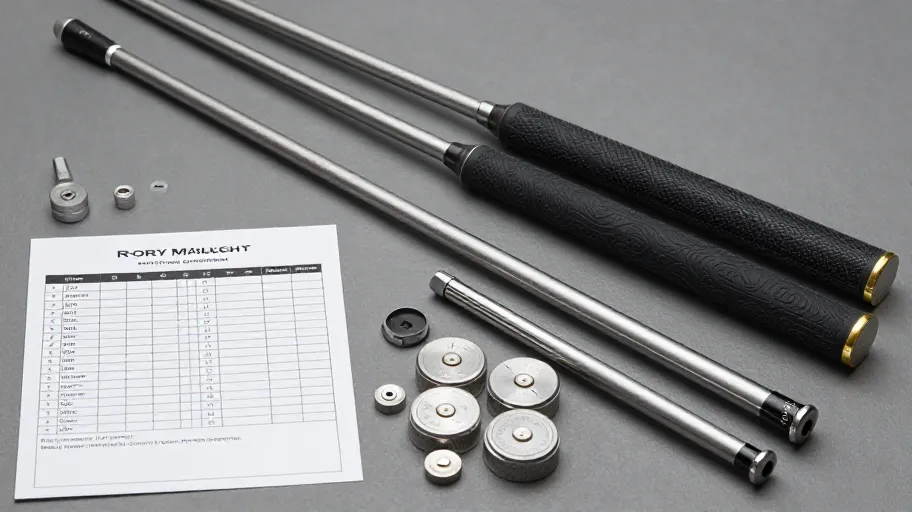
Rory McIlroy's swing weight is widely reported in tour-spec discussions, but DIY-Golf does not hold verified first-party measurement data and will not state a figure as fact. What matters for a club builder is the process: define a target swing weight, balance head, shaft, grip and length, then confirm each component against documented specifications before approving a purchase.
Use the S-W-C-D gate before you buy
When a builder asks what swing weight a tour professional plays, the productive version of that question is: what swing weight should my build target, and how do I verify the components can reach it? The S-W-C-D gate gives you a repeatable approval sequence:
- S — Spec. Write down your target swing weight, club length, shaft model and weight, grip model and weight, and head model. A target without a written spec is an opinion, not a build plan.
- W — Weight-mass budget. Swing weight is a balance relationship, not a single number. Every gram added at the head moves the reading in one direction; every gram in the shaft or grip moves it differently depending on distribution. Build a ledger before choosing components.
- C — Confirmation. Ask the supplier to confirm the as-shipped head weight, shaft weight tolerance behaviour, and grip weight for the exact model and batch you intend to order. Do not assume published catalogue figures match current inventory.
- D — Documentation. Record what was confirmed, by whom, and when. This is your approval record if the assembled club misses target.
Why tour specs are inputs, not specifications
Tour players have their equipment built, measured and adjusted under controlled conditions, and their settings change week to week. A figure reported about any professional — including McIlroy — is a research signal, not a sourcing document. Three practical cautions:
- Provenance. Ask where a number came from. If it cannot be traced to a measured build sheet, treat it as unverified.
- Transferability. A tour setting reflects one player's dynamics, club length, shaft profile and grip choice. Copying the reading without copying the underlying build logic does not transfer the feel.
- Fitment risk. Chasing a specific reading with lead tape or component substitutions after purchase is more expensive than budgeting weight before purchase.
The takeaway: use a tour figure, if you trust its source, to frame a conversation with your fitter or supplier — then verify against the components you will actually assemble.
The weight-mass budget decision table
Use this table to plan how each component decision affects your ability to reach a target swing weight. This is a decision aid, not a claim about any specific product's measured result.
| Component decision | What to record | Effect on swing weight control | Approval question before purchase |
|---|---|---|---|
| Club length | Finished playing length | Length changes the balance reading directly; set it first | "What finished length is this build specified to?" |
| Head model | As-shipped head weight for the exact model | Head weight is your primary tuning lever | "Can you confirm the head weight for this model and current batch?" |
| Shaft | Raw weight and balance point of the exact shaft | Heavier shafts shift the balance; trim length interacts | "What is the shaft weight, and how does trimming affect it?" |
| Grip | Grip weight | Grip weight moves the reading in the opposite direction to head weight | "What does the grip weigh, and what alternatives are available?" |
| Tuning allowance | Adjustable weights or tip/hoop options | More allowance means more post-assembly correction ability | "What adjustment range does this head family support?" |
Approval questions to put to your component supplier
Before approving any order, get these answered in writing for the exact brand, family and model:
- What is the as-shipped head weight for the exact model and current production batch?
- What shaft weight and balance-point data can you provide for the exact shaft model I am considering?
- What grip weights are available in the models that fit this build?
- What is your current policy on samples, sample fees and shipping for sample orders? (Confirm directly — no policy is stated here.)
- What is your current lead time and any minimum order quantity for this component? (Confirm directly.)
- What is your process if a received component does not match the confirmed specification?
If a supplier cannot or will not answer these for your specific model, that itself is decision-relevant information.
Pre-purchase checklist
- Target swing weight written down with rationale
- Finished club length specified
- Head, shaft and grip models identified by exact name and version
- Weight-mass budget drafted using confirmed component data
- Supplier answers to all six approval questions received in writing
- Current sample, fee, shipping and order policy confirmed directly
- Build sheet template ready to record the assembled result
Frequently asked questions
What is a swing weight in practical terms? It is a measure of how the club's mass is distributed relative to a fulcrum — a proxy for how heavy the head feels during the swing. It does not equal total weight; two clubs of identical total weight can read differently.
Should I copy a tour player's swing weight for my own build? Only as a starting point for discussion. Verify the source of any reported figure, then set a target based on your length, shaft and grip choices, and confirm components against that target.
Can I adjust swing weight after assembly? Adjustable-weight heads, lead tape and grip changes can move the reading, but each has fitment and aesthetic trade-offs. Budget the weight before purchase rather than correcting after.
How do I know a component will actually deliver the spec I ordered? You cannot know in advance without confirmation. Ask for as-shipped weight data for the exact model and batch, document it, and measure on arrival before approving the build.
Where do I record all of this? A one-page sourcing brief — target spec, component list, supplier confirmations and build-sheet results — is the working document that turns research into an approvable purchase.
Get the sourcing brief
Curiosity about a tour setting becomes a good build only when it is converted into a documented specification. 获取采购 Brief and use the S-W-C-D gate to plan, confirm and approve your next component order with evidence rather than assumption.
Low-friction next step: download or copy the pre-purchase checklist above and complete one line per component before you enquire.
Master Your Swing, DIY Your Fit. DIY Golf is the premier destination for the technical golfer. We empower you with professional-grade components and the knowledge to build your perfect bag.


