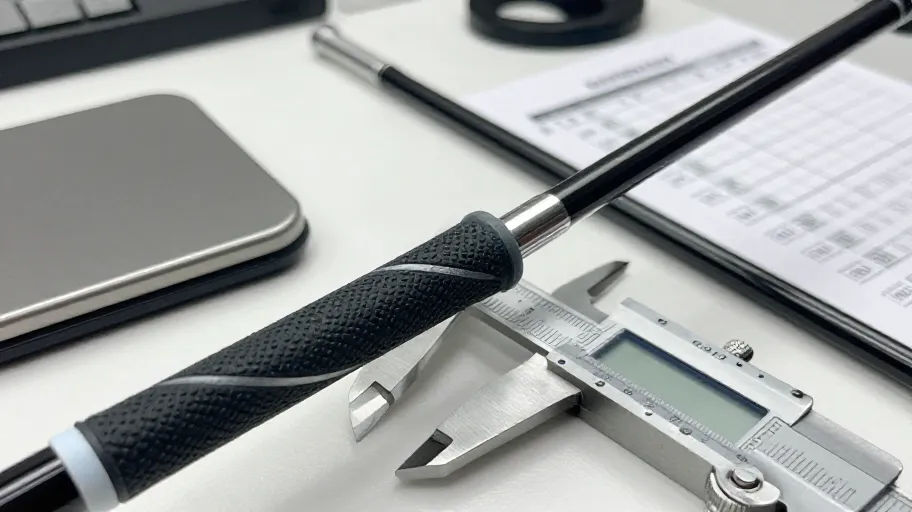
What is the proper grip on a golf club? The proper grip is the one whose size, texture and weight you can verify against your exact shaft and club model, then approve as a documented sample before you order. The Size–Texture–Weight Approval Ladder below turns that verification into four steps any club builder can run.
Step 1 — Size: verify core diameter against the shaft, not against a rule of thumb
Grip size is a relationship, not a number. A grip's stated core size only delivers the intended final diameter when it is installed on a shaft with the matching butt diameter, with the agreed number of tape wraps. Change the shaft or the tape build-up and the effective size changes too.
Verify before ordering:
- The stated core size of the grip you are considering.
- The butt diameter of the shaft on the exact club model you are retuning.
- How many tape wraps your build plan assumes, and whether the supplier's sizing guidance assumes the same.
- Whether the player's hand measurement and release pattern support the size you have calculated, or whether a build-up is needed instead of a different core size.
If any one of these is unconfirmed, the size decision is unconfirmed. Ask the supplier to confirm the sizing assumption in writing for your specific combination.
Step 2 — Texture: treat feel as a verification item, not a marketing claim
Texture descriptions are useful for shortlisting, but they are not evidence. Ribbed versus round profiles, corded versus rubber compounds, tacky coatings versus firmer compounds — each changes how the club releases in the hands, and no two players describe the same surface the same way.
Step 3 — Weight: check the grip against your swingweight plan
Grip weight changes how heavy the head feels. If you are retuning a specific club model — a driver, an iron set, a wedge — the grip you choose can move the assembled club away from the swingweight target you built to. Before ordering, confirm:
- The stated grip weight of each candidate.
- The swingweight target recorded on your build sheet for that club model.
- Whether the supplier can confirm the finished assembled weight behaviour for your shaft–grip combination, or whether you will measure it yourself at assembly.
Document the assumption on the build sheet so the next retune starts from facts rather than memory.
Step 4 — Approval: a documented sample before volume
For club builders ordering more than a handful of units, the Approval step is where a sourcing Brief earns its keep. A sample approval is only meaningful if it is documented: record the exact grip model, core size, weight, texture and installation method you approved, and require that production against that specification. If you cannot document what you approved, you have no basis for comparing delivered goods.
Grip decision table — measurable fields to compare
| Verification item | What to confirm | Where to get it | Why it decides the purchase |
|---|---|---|---|
| Core size | Stated core diameter and matching butt diameter | Supplier spec sheet plus your shaft data | Determines final installed grip size |
| Grip weight | Stated uninstalled weight | Supplier spec sheet | Protects your swingweight target |
| Profile | Ribbed or round | Supplier spec sheet | Affects hand placement and release consistency |
| Compound and texture | Named compound family, requested sample | Supplier spec sheet plus sample in hand | Determines feel, traction in conditions you play |
| Model match | Fitment to the exact club brand, family and model | DIY-Golf fitment guidance plus supplier confirmation | Prevents ordering a grip that does not suit the shaft |
| Sample status | Approved and documented sample in hand | Direct confirmation with DIY-Golf | Converts spec-sheet claims into verified fact |
Fill this table in per candidate grip. If a row cannot be filled, that grip is not ready to be ordered.
Matching the grip to the exact club brand, family and model
Readers of a components store are rarely shopping blind — they are retuning a known club. That changes the question. "Will this grip work?" becomes "Will this grip work on a [that shaft] butt diameter in [that model], at [that target weight], with [that tape build]?" Every answer should be traceable to a spec sheet or a confirmed statement, not to a category-level assumption. DIY-Golf's fitment guidance pages exist to support exactly this verification; use them, and where a detail is missing, ask for it in writing rather than inferring it from a sibling model in the same family.
Approval questions to put to the supplier
Before you commit to any order, put these questions in writing and keep the answers with your build documentation:
- Please confirm the stated core size and weight for this grip model, per the current specification sheet.
- Please confirm this grip suits the butt diameter of the shaft fitted to my club model.
- What is your current sample policy for this model, including any fee and shipping arrangement, so I can confirm it directly?
- Can you confirm in writing that delivered goods will match the sample I approve, on size, weight and texture?
- What documentation accompanies a production order — spec sheet, batch identification, or other records I can attach to my build file?
- If the delivered grips do not match the approved sample, what is the current process for raising it?
These questions convert uncertainty into a documented position. Any supplier unwilling to answer them in writing is telling you something about the risk of the order.
Pre-order checklist
Copy this checklist into your build file and complete every line before ordering:
- Club brand, family and model written down, with shaft fitted and its butt diameter.
- Target swingweight recorded from the build sheet.
- Grip core size and weight confirmed against the current supplier spec sheet.
- Profile (ribbed/round) and compound family confirmed.
- Sample obtained where available, and the current sample policy confirmed directly with DIY-Golf.
- Approved sample documented (model, size, weight, texture, installation method).
- Supplier's written confirmation that production will match the approved sample.
- Fitment guidance for the exact model reviewed on DIY-Golf.
If any line is open, send the open lines to DIY-Golf as your sourcing Brief rather than guessing.
FAQ
Does grip size really depend on the shaft, not just my hands? Yes. Hand size and release pattern inform the target size, but the delivered size depends on the grip's core size, the shaft's butt diameter and the tape build-up. All three must be verified together for the exact club model.
Can I judge grip texture from a description? Use descriptions to shortlist, not to decide. Request a sample where available and confirm the current sample policy directly with DIY-Golf, since sample arrangements are order-specific.
Will a heavier grip change how my club plays? Grip weight shifts head-feel relative to your swingweight target. Confirm the stated weight and check it against your build sheet before ordering, especially when retuning a club you have already frequency- or swingweight-matched.
Do I need a sample for a single-grip order? A documented sample matters most for volume or repeat orders, but even a single-grip purchase benefits from confirming the spec sheet in writing. Decide based on how much rework risk you are willing to carry on the build.
How do I know the grip fits my club model? Review DIY-Golf's fitment guidance for the model, then ask the supplier to confirm the shaft and butt-diameter match in writing for your specific combination. Never infer fitment from a sibling model in the same family.
Request your sourcing Brief
Send DIY-Golf your club brand, family and model, the shaft fitted, your size and swingweight targets, and the open verification lines from the checklist above. You will receive a sourcing Brief built around confirming the specification, sample policy and documentation for your exact build — so every grip decision rests on verified facts, not assumptions.
Master Your Swing, DIY Your Fit. DIY Golf is the premier destination for the technical golfer. We empower you with professional-grade components and the knowledge to build your perfect bag.


