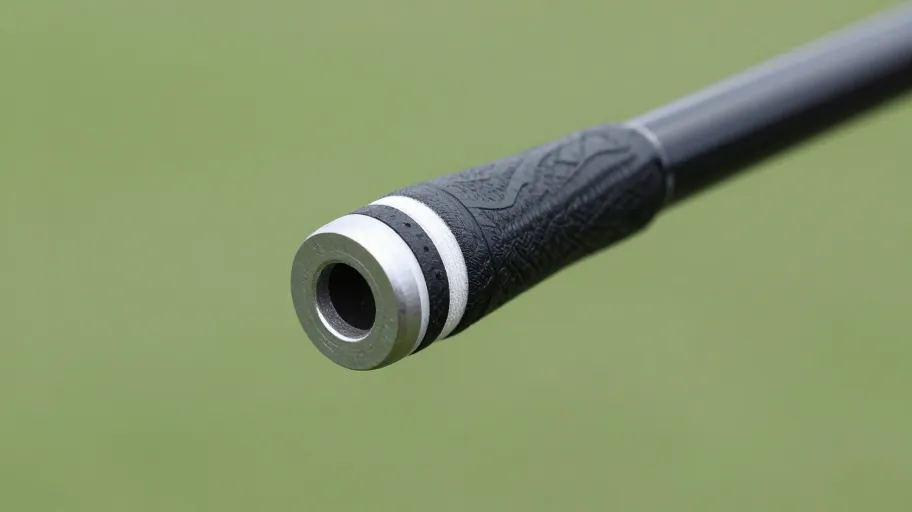
The honest answer: no first-party, currently verifiable specification was supplied for this article, and tour setups change week to week. Public equipment reports about Scheffler's grips should be treated as research inputs, not confirmed specs. What a builder actually needs is not the player's label but the installed outcome: the grip's core size, any build-up layers, the shaft's butt diameter and the resulting installed size on the club in hand. This guide shows how to document that target, compare candidate components against it, and approve an order only after written supplier confirmation.
The FIT step: define the target before you source
Grip "size" is a nominal category, not a fitment guarantee. A grip labelled standard, midsize or oversize only produces a specific installed feel when paired with a specific shaft butt diameter and a documented number of build-up layers. Before researching what any tour player uses, record your own target:
- The exact club family and model you are regripping or building.
- The measured butt diameter of the shaft (measure, don't assume from a brochure).
- The target installed grip size you are trying to reproduce or approach.
- The hand-size or feel objective the player has stated in words.
- Any reference the player has given, such as "like Scheffler's" — treated as a direction, not a spec.
Once those five items are written down, the tour-player question becomes answerable in a useful way: you are no longer chasing a label, you are matching an installed outcome. If public reports say a tour player uses a particular grip model or size, verify the report's date and source, then test whether that nominal size produces your target installed size on your measured butt diameter. It may; it may not. Only your own measurement settles it.
The COMPARE step: a decision table for candidate grips
Use this table to evaluate each candidate grip against your documented target before requesting samples or quotes. Score each row as confirmed, unconfirmed or not applicable, and refuse to move a row to "confirmed" without written evidence from the supplier for the exact product and model.
| Evaluation row | What to document | Why it matters | Evidence needed to confirm |
|---|---|---|---|
| Nominal grip size (standard / midsize / oversize) | Label claim from the product listing | Sets the starting point for installed size | Supplier product sheet for the exact model |
| Core size / inside diameter | Core spec of the grip | Determines wall thickness on your shaft | Supplier spec sheet |
| Your shaft butt diameter | Measured value on your shaft | Installed size = grip + shaft interaction | Your own calibrated measurement |
| Build-up plan | Number and type of layers, if any | Adjusts installed size toward target | Your build sheet |
| Material and texture | Stated compound and surface pattern | Affects feel, not just dimension | Supplier datasheet |
| Model and batch identification | Exact model name and version | Prevents substitution during fulfilment | Written confirmation on the quote |
| Fitment claim for your club model | Whether the supplier states it fits your shaft | Protects against mismatched orders | Written statement from supplier for your exact shaft |
| Sample and ordering policy | Current sample availability, fees, shipping terms, returns | Unknown at research stage; policy varies | Direct written confirmation — confirm current policy directly |
No row in this table can be filled in from a tour report alone. The tour question narrows your candidate list; your measurements and the supplier's written answers complete it.
The APPROVE step: concrete questions before you commit
Send these questions to the supplier in writing and approve the order only when each answer is on record for the exact product and model:
- Please confirm the nominal size, core size and model version of the grip you will ship — in writing, on the quotation.
- Please confirm the grip's compatibility with a shaft butt diameter of [your measured value].
- What is your current policy on samples for this model — availability, any fees, shipping terms and return handling? Confirm current policy directly, as nothing here can be assumed.
- Can you supply a product datasheet covering material, weight and texture for this exact model version?
- How do you handle a shipment where the model version differs from the quoted specification?
- What documentation accompanies the shipment so I can verify model and batch on receipt?
Any answer that arrives as a verbal assurance, an unversioned brochure or a "should fit" should be escalated to a written confirmation or treated as unconfirmed. That discipline is what separates a documented build from a guess.
Why the tour-player question is still useful
Asking what size grip a player like Scheffler uses is a legitimate research entry point. It tells you a touring professional has chosen a size direction worth testing, and it gives you vocabulary for the feel you are chasing. But the sourcing decision belongs to your measured shaft, your stated objective and your supplier's written answers. A grip that matches a tour label but installs differently on your butt diameter has not reproduced anything.
A second caution: public equipment reports can be outdated, second-hand or mixed across club types. A player may use different setups in different clubs or change during a season. Verify the report's date and source, and treat it as one input into the FIT step, not the conclusion.
Approval checklist before ordering
Complete every line before approving a purchase order:
- Measured and recorded the shaft butt diameter for the exact club model
- Defined the target installed size and stated feel objective in writing
- Verified the date and source of any tour-equipment report used as reference
- Completed the COMPARE table for every candidate grip
- Received written model-version confirmation on the quotation
- Received written compatibility confirmation for the measured butt diameter
- Confirmed current sample, fee, shipping and return policy directly with the supplier
- Confirmed shipment documentation for model and batch verification on receipt
获取采购 Brief — download the sourcing brief to capture every row above as a written requirement you can send to suppliers and keep on file for approval.
FAQ
Can I assume a tour player's grip size fits my build? No. A nominal size only becomes an installed size when paired with a specific butt diameter and build-up plan. Measure your shaft, define the target, then compare.
How do I verify what a tour player is using? Look for dated, first-party or on-record sources, and note the club type and date of the report. Treat the finding as a research input and confirm your own fitment independently.
Should I order standard, midsize or oversize? That depends on your measured butt diameter, target installed size and stated feel objective. Complete the FIT step first; the label follows from the target, not the reverse.
What should I ask the supplier about samples? Ask for the current policy in writing — availability, any fees, shipping terms and return handling — for the exact model and version. Do not infer the policy from a listing; confirm it directly.
How do I prevent receiving a different version than quoted? Require the model name and version on the quotation and on shipment documentation, and verify both on receipt against your approval checklist.
Prefer a lighter first step? Use the approval checklist above as your working document and 获取采购 Brief when you're ready to formalise the requirement.
Master Your Swing, DIY Your Fit. DIY Golf is the premier destination for the technical golfer. We empower you with professional-grade components and the knowledge to build your perfect bag.


