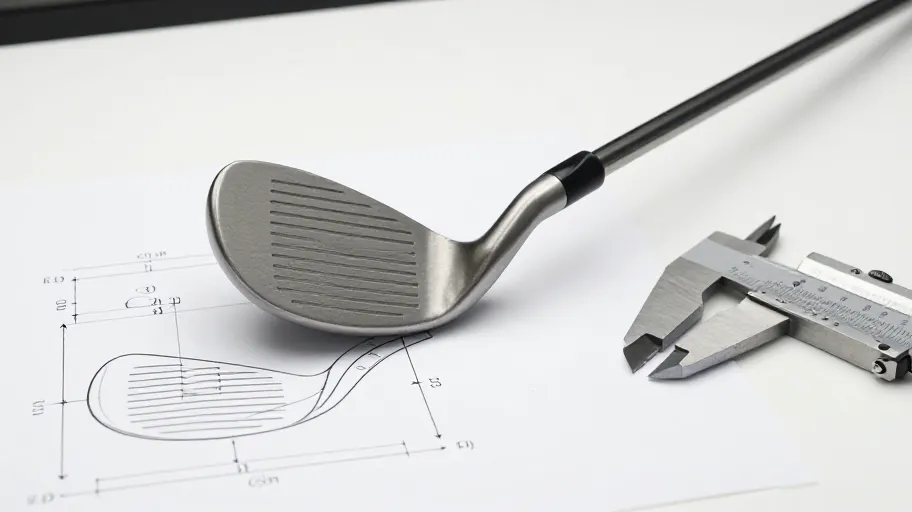
The best rust proof golf clubs are not the ones with the boldest finish name — they are the ones whose material, finish and dimensions you can verify against a drawing and a physical sample before you approve production. Use the Drawing-to-Sample Verification Loop: request the technical drawing, compare it line by line against the sample you receive, document every approval in writing, and only then confirm the order. This article gives you the framework, a decision table, and the exact questions to send.
Why "rust proof" is a sourcing question, not a product label
When you are researching components for a specific club brand, family and model, the phrase "rust proof" appears everywhere and proves very little on its own. A plated finish, a stainless construction and a raw forged head all resist corrosion in different ways, and none of them can be judged from a photograph. As a sourcing adviser, my recommendation is simple: treat every rust claim as an open question until you hold two things in your hands — a technical drawing and a sample — and have compared them.
That is what the Drawing-to-Sample Verification Loop is for. It converts a vague finish claim into a sequence of documented checks, so the decision you make is based on evidence you can point to later, not on a product page description.
The Drawing-to-Sample Verification Loop
The loop has four stages:
- Drawing request. Ask for the technical drawing for the exact head or component you are evaluating — not a family-level brochure. Confirm which model, loft, finish and hosel specification the drawing refers to.
- Sample comparison. When the sample arrives, compare it against the drawing on every line you can check: finish appearance, markings, bore or hosel details, and any weight or dimensional callouts the drawing includes.
- Documented questions. Anything that differs, or that the drawing does not state, becomes a written question to the seller. Verbal answers do not count in this loop.
- Approval record. Keep a single document — an email thread or a sheet — recording what was approved, by whom, and on what date. If a later batch differs from the approved sample, this record is your reference point.
The loop matters most for rust resistance, because the finish is the part of a club head you cannot inspect remotely. A sample that looks correct in one photograph may differ from the drawing in plating coverage, surface texture or marking detail, and only a side-by-side comparison reveals that.
Decision table: comparing drawing and sample
Use this table as your working sheet. For each row, record "matches / differs / not stated" and follow up on every entry that is not "matches."
| Check point | What to compare on the drawing | What to verify on the sample | If it differs |
|---|---|---|---|
| Finish designation | The exact finish name or code called out | Visual appearance under daylight and indoor light | Ask which designation governs: drawing or sample |
| Surface texture | Any texture or finishing callout | Feel and appearance, including grooves and sharp edges | Request clarification in writing |
| Markings and logos | Position, size and depth of engravings | Actual stamping or engraving on the head | Photograph both and ask which is correct |
| Hosel / bore detail | Hosel type and any relevant callouts | The actual bore or hosel on the sample | Confirm before any shaft assembly |
| Weight callouts | Any weight values stated on the drawing | Weigh the sample if you have scales, or ask for measured values | Ask how variance is handled and confirmed |
| Material designation | Material called out for the head | Ask what documentation supports the material claim | Request the supporting document before approval |
| Corrosion expectation | Any finish or coating note on the drawing | Ask what the finish is and how it should be maintained | Get the care and exposure guidance in writing |
Two notes on using the table. First, "not stated" is not a failure — it is a prompt for a question. Second, never approve on the strength of the drawing alone or the sample alone; the loop only works when the two agree, or when a difference has been explicitly resolved in writing.
Approval questions to send before you commit
Copy these into an email and send them to the seller for the exact component and model you are evaluating. Keep the answers with your approval record.
- Which exact drawing version applies to the sample I received, and can you confirm the drawing matches the current specification?
- What is the finish called in your specification, and what documentation describes that finish?
- How should this finish be cared for, and what exposure conditions should I avoid, so I can judge whether it suits how the clubs will be used?
- If my sample is approved, how do you confirm that later units match the approved sample?
- What is your current sample policy, including any fees and shipping arrangements, for this component? Please confirm the current terms directly, as policies differ by product and I want the terms that apply to this order.
- Can you confirm this component's compatibility with my club brand, family and model, based on first-party information for that exact model?
Question 5 is deliberately open. Sample fees, who pays shipping, and whether any fee applies to a later order are matters of current policy that only the seller can state for the specific product — so ask, get the answer in writing, and file it. Do not assume the answer from a previous order, a forum post, or another product line.
Question 6 matters because fitment claims are model-specific. A component that suits one club family may not suit another, even within the same brand. If the seller cannot confirm compatibility for your exact model from their own information, treat fitment as unresolved until you have verified it.
FAQ
Does a stainless construction mean a head cannot rust? Different constructions and finishes behave differently, and I will not generalise about materials in this article. What matters for your decision is what the drawing states, what documentation the seller provides, and what care guidance they confirm in writing. Judge the specific component, not the category.
Can I approve a component from a drawing alone? I advise against it. The Drawing-to-Sample Verification Loop exists precisely because drawings and physical samples can differ. Compare both, resolve every difference in writing, then approve.
What if the sample looks fine but the drawing is missing detail? Treat missing detail as a question, not a pass. Ask the seller to confirm the unstated specification in writing before you approve. An approval based on an incomplete document gives you nothing to compare against later.
How do I compare two sellers fairly on rust resistance? Use the same decision table for both. Request the same documents from each, compare each sample against its own drawing, and record answers to the same approval questions. A side-by-side comparison only works when the evidence format is identical.
Should I verify fitment before or after sample approval? Before, ideally in parallel. There is little value in approving a sample for a component that turns out not to fit the exact club model you are building for. Confirm compatibility first, then run the drawing-to-sample loop.
Checklist
- Identified the exact club brand, family, model and component to source
- Requested the technical drawing for that exact component
- Received a sample and compared it against the drawing using the decision table
- Photographed any differences and asked for written clarification
- Asked and documented the finish specification and care guidance
- Confirmed compatibility with the exact model from first-party information
- Confirmed the current sample policy in writing, directly with the seller
- Filed a dated approval record before committing to the order
Get the full verification checklist
The steps above compress into a one-page checklist you can use per component and per supplier. It covers the drawing request, the sample comparison rows, the approval questions and the sign-off record.
Download the checklist and run it before your next sourcing decision — it takes minutes to complete and turns "rust proof" from a claim into a documented approval.
Master Your Swing, DIY Your Fit. DIY Golf is the premier destination for the technical golfer. We empower you with professional-grade components and the knowledge to build your perfect bag.


