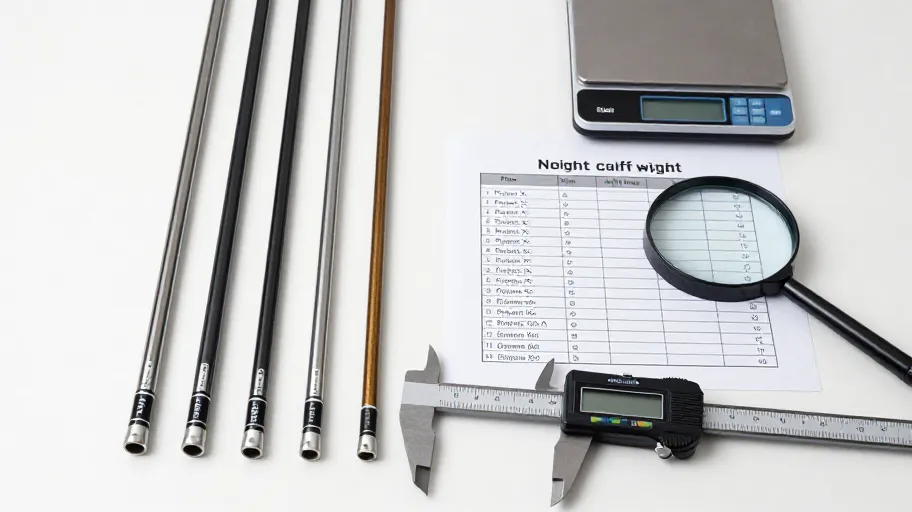
A golf shaft weight chart is a comparison tool, not a purchase decision: it tells you the nominal weight of shafts at different flex and model points so you can plan a build for a specific club — but it is only trustworthy once you have verified what each figure represents, at which measurement point, and for which exact club family and model. Before you shortlist suppliers, compare their charts on five details: the specification basis, the weight range covered, the evidence behind each number, the terms for exchanging incorrect components, and the documentation supplied per unit. We call this the SWEEP check, and this article walks you through each pillar with the exact questions to ask.
Why a weight chart alone is never enough
Two suppliers can publish charts that look identical and still differ in what those numbers mean. One may list the manufacturer's nominal uncut shaft weight; another may list an as-measured weight after trimming and assembly. Neither approach is wrong in itself — the risk is that you compare figures that were captured on different bases. That is why the chart is the starting point of your research, and the verification questions below are what turn it into a defensible shortlist.
The SWEEP framework
S — Specification. Confirm the chart states the exact product line, flex, and model family it applies to. A weight figure attached to a generic description ("stiff flex iron shaft") rather than a specific model and generation is not verifiable. Ask which generation of the club family the chart corresponds to, since weight specs can change between generations.
W — Weight range. Check that the chart covers the range you actually need for your build — for example, the span between the lightest and heaviest option you are considering for that club head. A chart that only covers part of the range forces you to mix data sources, which reintroduces the comparison problem.
E — Evidence. Ask what each figure represents: manufacturer nominal specification, an uncut shaft measurement, or a cut-and-assembled measurement. Ask at which measurement point the weight is taken, and whether tolerances apply per unit. Do not accept a chart that cannot answer these questions.
E — Exchange terms. Before ordering, confirm directly with the supplier what happens if the delivered component does not match the chart: what their current process is for an incorrect or mismatched item, who covers what, and what documentation they require. No policy detail should be assumed; every supplier's terms differ and must be confirmed in writing before you commit.
P — Per-unit documentation. Ask whether the supplier can document the actual weight of the specific units shipped, not just the nominal chart value. For a tuned build — where you are matching shafts across a set or dialling in a single club — per-unit documentation is the difference between a chart you trust and a chart you hope is right.
Decision table: comparing weight chart details before shortlisting
| Detail to compare | What to look for | Red flag | Question to put to the supplier |
|---|---|---|---|
| Model and generation coverage | Chart names the exact club family, model and generation your build targets | Generic descriptors with no model reference | "Which generation of this club family does this chart apply to?" |
| Measurement basis | Chart states nominal, uncut, or as-measured for every entry | Mixed bases within one chart with no labels | "Is this figure nominal spec or a measured value, and at what point?" |
| Flex-to-weight mapping | Each flex entry maps to a stated weight rather than a range you must infer | One weight figure covering multiple flexes | "What is the specified weight for this exact flex?" |
| Tolerance handling | Chart or datasheet states whether per-unit variation exists and how it is documented | No mention of variation or documentation | "Can you document the measured weight of the units you ship to me?" |
| Mismatch process | Supplier confirms their current process in writing before you order | Vague answers, or terms only after payment | "What is your process if the delivered shaft weight does not match the chart?" |
Approval questions for your shortlist
Run every candidate supplier through these questions before you approve them:
- "For my exact club brand, family and model, which chart entries apply, and which do not?"
- "What measurement basis does each figure use — nominal, uncut, or as-measured?"
- "Can you supply the measured weight of the specific units you would ship me?"
- "What is your current process, in writing, if a delivered component does not match the published chart?"
- "Can you provide a sample or test unit, and what are the current sample, cost and shipping terms?" Confirm all of these directly with the supplier; do not rely on assumptions or second-hand summaries.
- "What documentation accompanies each order — datasheets, per-unit records, or batch references?"
Suppliers who answer these in writing, with specifics tied to your model, move up the shortlist. Suppliers who answer generically, or only after you commit, should stay on the research list until they can.
Sequencing your research correctly
Work model-first, not chart-first. Identify the exact club brand, family and model you are building for, then filter each candidate supplier's chart down to the entries that apply to that model, then run the SWEEP check on the surviving entries. Reversing the order — starting from a weight figure and working backwards to a club — is how mismatched orders happen.
FAQ
Do shaft weight figures differ between suppliers for the same shaft? They can, because figures may be captured on different bases — nominal specification versus measured values — and because charts may cover different generations of a club family. Always ask each supplier which basis their chart uses rather than assuming the figures are equivalent.
Is a heavier or lighter shaft right for my club? That depends on your build goal, your club head, and your swing characteristics, and this article cannot make that call for you. Use the chart to identify which weight options exist for your exact model, then confirm the fitment choice with the fitment guidance and, where available, a qualified fitter's input for your specific case.
Can I trust a chart that does not state tolerances? Treat it as incomplete rather than wrong. Ask the supplier directly whether per-unit variation applies and what documentation they can provide for the units you would receive. A supplier who can document the actual units is a stronger shortlist candidate than one who can only point to a nominal figure.
What should I confirm before paying for a sample unit? Confirm directly with the supplier: whether a sample is available for your exact model, what it costs, who covers shipping, and what their current terms are for that arrangement. Do not assume any of these details; ask and get the answer in writing.
Should I combine weight data from several charts? Only if you have confirmed that every source uses the same measurement basis and applies to the same model generation. If you cannot confirm that, keep each supplier's data separate and compare suppliers, not merged figures.
Your next step
Before you place any order, put the SWEEP questions to each shortlisted supplier and record their answers in writing. The fastest way to keep that organised is to work through a structured checklist — it turns the questions above into a fill-in sheet you can compare side by side.
Download the checklist to run every candidate supplier through the same verification steps, and keep your weight-chart research documented from first query to approved order.
(Quick check before you go: does each chart on your shortlist state its measurement basis, model generation, and mismatch process in writing? If any answer is missing, that supplier is not yet shortlist-ready.)
Master Your Swing, DIY Your Fit. DIY Golf is the premier destination for the technical golfer. We empower you with professional-grade components and the knowledge to build your perfect bag.


