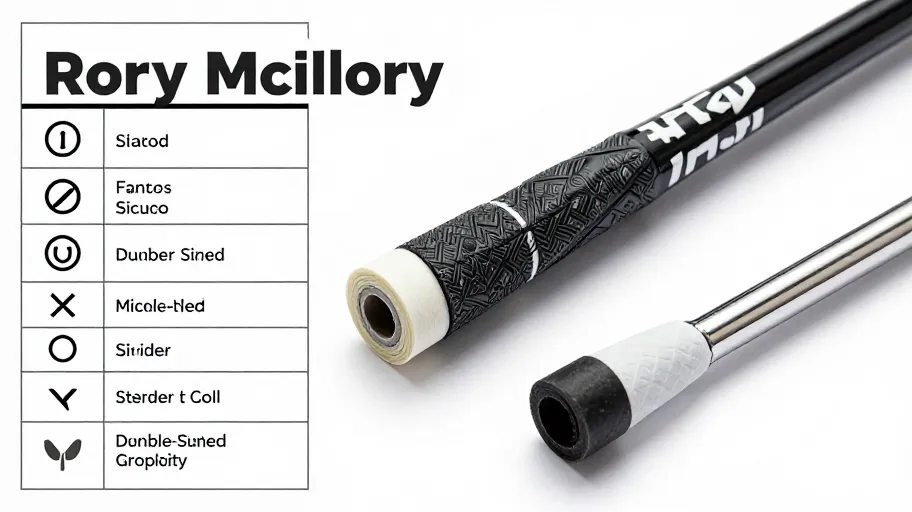
Rory McIlroy plays grips built larger than a standard men's size — described in tour reports as a standard core grip built up with extra tape wraps to reach roughly a midsize feel in the lower hand. His exact tape count varies by set and should be verified against current WITB listings. What matters for sourcing is not his number, but how you translate grip size into a documented spec for your own builds.
What a tour spec tells you — and what it does not
A tour player's grip configuration answers one question: what that player and their fitter settled on for that player's hands, swing and release pattern. It does not confirm fitment for your hands, your shaft butts or your clients' builds. Treating a tour spec as a purchase spec skips the measurement work that prevents re-gripping a whole run of clubs at your own cost.
The honest way to use the McIlroy query is as a starting point for a sizing conversation. From there, apply a repeatable framework so every grip you shortlist has a documented rationale a client or colleague can audit.
The Grip-Hand-Match (GHM) framework
The GHM framework runs three verification layers in order. Each layer must pass before you move to supplier shortlisting.
Layer 1 — Grip core. Confirm the grip's core inside diameter against your shaft butt diameter. A mismatch here means the installed size will not match the labelled size, regardless of what is printed on the box. Ask the supplier to state the core ID in writing for the exact product and model you are quoting.
Layer 2 — Hand build-up. Measure the golfer's glove size and, better, the actual hand circumference and finger length. Decide between undersize, standard, midsize, jumbo, or standard-plus-tape. Tour players solve this with tape wraps; builders solve it with a documented measurement on file for every client.
Layer 3 — Match to the build. Verify the grip choice against the shaft butt diameter, any taper, the install method (tape, solvent, air), and the finished feel target. Record the outcome so the same client can be re-served without re-guessing.
Decision table: from hand data to grip category
| Hand measurement signal | Grip category to evaluate | Key verification question for the supplier |
|---|---|---|
| Small glove size, lighter grip pressure, slicer tendency | Undersize or standard core | "Can you confirm the core ID and outer diameter for this exact model?" |
| Medium to large glove, neutral release | Standard core, standard wrap count | "What is the installed diameter at the butt and at 6 inches down?" |
| Large glove, strong lead hand, hook tendency | Midsize or standard plus build-up tape | "Does this model come in a midsize core, or is build-up the documented route?" |
| Extra-large glove or arthritic hands | Jumbo or layered build-up | "What is the maximum recommended build-up before the grip distorts?" |
| Match set for a client run | Mixed categories, same model family | "Can you supply consistent batch documentation across sizes in one order?" |
Note that the middle row is where the McIlroy-style configuration sits: a standard core, built up to a midsize feel. Whether that is right for your build is a measurement question, not a copy question.
Pre-shortlist supplier approval questions
Before any supplier earns a place on your shortlist, get written answers to these. Do not treat silence as approval — treat it as disqualification from this round.
- Can you confirm the core ID and wall construction for the exact product, model and size I am quoting?
- Can you state the expected installed diameter range for my shaft butt measurement?
- What dimensional documentation ships with the product, and can you share a sample data sheet before I order?
- What is your current sample policy — cost, shipping terms and whether any fee is applied against a later order? Confirm the current policy directly; nothing can be assumed from prior orders or category norms.
- What are your current lead time and minimum order terms for this model, and can they be confirmed in writing at quotation?
- How do you handle dimensional rejects or mislabelled sizes in a delivered batch, and what is the claim process?
- Can you supply the same model and size consistently across repeat orders, and how is that consistency documented?
None of the above presumes an answer. Every commercial and technical term must come back in writing from the supplier for the exact product and model.
Documentation and inspection checklist
Run this checklist at goods-in for every grip order:
- Core ID on the product matches the written quotation.
- Model, size and quantity match the order confirmation.
- Installed diameter spot-checks on a sample of grips from the batch.
- No distortion, seam defects or surface faults in the opened sample.
- Batch or lot reference recorded against the client or build sheet.
- Any discrepancy photographed and reported within the supplier's stated claim window.
- Supplier's written sample, fee and claim policy filed with the order record.
This checklist is what turns a curiosity query into a professional sourcing record. Download the full version below and attach it to every quotation you collect.
[下载核对清单]
Frequently asked questions
Is Rory McIlroy's grip size a good default for clients with large hands? It is a reference point, not a default. His configuration is a standard core with build-up tape to reach a larger feel. Whether that suits a given client depends on measured hand size, release pattern and shaft butt diameter — verify each with the GHM framework rather than copying the spec.
Does grip core size have to match shaft butt diameter? The grip core must suit the shaft butt for the labelled size to install correctly. Always confirm the supplier's stated core ID for the exact model against your measured butt diameter before ordering.
Should I order midsize grips or standard grips plus build-up tape? Both routes can reach a similar installed feel, but they differ in consistency and cost across a run of builds. Ask suppliers to document the installed diameter for each option, then compare on your own measurements and order economics — confirm current pricing directly.
How do I verify a supplier's grip dimensions before committing to a bulk order? Request a written data sheet, confirm the current sample policy directly, and inspect delivered grips against the documentation checklist above. Do not rely on catalogue labels without written confirmation for the exact product and model.
Can a tour player's grip spec change between events? Yes. Tour configurations are adjusted as equipment and preferences change, so treat any published spec as a snapshot and verify against current listings before citing it in client work.
Before you shortlist: capture the spec, then compare
The McIlroy question gets you to the right category faster. The GHM framework and the checklists above get you to a defensible purchase decision. Record the spec, collect written answers from each supplier, and only then compare.
[下载核对清单]
Master Your Swing, DIY Your Fit. DIY Golf is the premier destination for the technical golfer. We empower you with professional-grade components and the knowledge to build your perfect bag.


