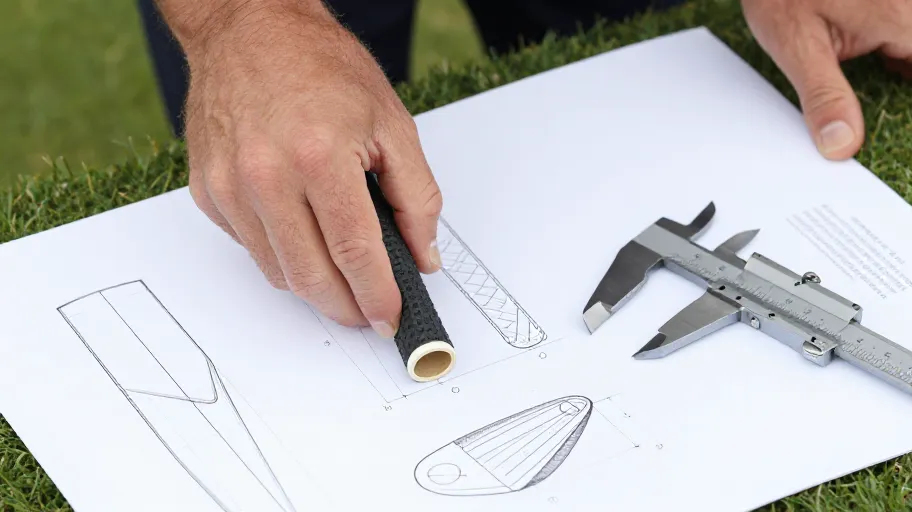
Rory McIlroy is widely described as playing with a fairly strong left-hand grip, meaning his lead hand is rotated away from the target so more knuckles are visible at address. For club builders and component researchers, however, the useful question is different: what grip geometry, size and material characteristics support a player who holds the club this way, and how do you verify that a candidate component matches your specification? That verification runs through drawings, samples and documented supplier confirmation — never assumption.
What "strong grip" actually means
In instruction language, grip strength refers to hand position, not how tightly the club is squeezed. A strong lead-hand grip shows the hand rotated toward the trail side, with additional knuckles visible from the player's view. A neutral grip shows fewer; a weak grip shows fewer still. The label describes rotation, not force or component quality.
This distinction matters in sourcing because the word "grip" does double duty. One meaning is technique; the other is the physical component — the rubber or polymer sleeve bonded to the shaft. When a builder researching replacement components types a question about a strong grip into a search box, the results mix swing instruction with product pages, and neither answers the procurement question underneath.
Why the technique question is a sourcing question in disguise
A player with a strong hand position interacts with the grip component differently than a player with a neutral hold. Hand rotation changes where pressure concentrates, how the taper feels through the swing, and how the player perceives size. If you are specifying a replacement grip for a specific club family and model, the relevant questions become concrete:
- What butt diameter and core size does the target club's shaft require?
- What outer diameter and taper profile suits a player who rotates the lead hand strongly?
- Does the sample's patterning and texture support consistent hand placement at that rotation?
- Does the drawing supplied by the vendor match the sample you receive?
None of these can be answered from a product listing alone, and none should be answered by assumption. They are answered by comparing drawings against samples and documenting what you find.
The SAMPLE-COMPARE framework
When evaluating grip components from any vendor, work through this sequence:
- S — Specification: request the drawing and written specification for the exact product code, not a family-level datasheet.
- A — Alignment: check that the sample's markings, logo placement and label information match the drawing revision you were sent.
- M — Material: ask the supplier to state the material and construction in writing, and compare it against what you observe in the sample.
- P — Patterning: document the surface texture, alignment aids and any reminder rib or visual guide, and note whether the drawing specifies them.
- L — Log the sample: record batch or lot identifiers, date received and who handled it, so later comparisons are traceable.
- E — Evaluate fitment intent: confirm the intended shaft butt and core dimensions with the supplier in writing before ordering.
- C — Compare across vendors: evaluate competing samples against the same criteria on the same day, with the same measuring tools.
- O — Omit nothing: every unanswered question goes into your supplier correspondence, not into a mental note.
- M — Make the approval conditional: approval depends on documented confirmation, not on verbal reassurance.
The framework's value is that it produces a written record. When a shipment later differs from what you approved, the record is what protects the decision.
Decision table: comparing samples and drawings
| Evaluation point | What to check | What to document | What must be confirmed with the supplier |
|---|---|---|---|
| Core and butt geometry | Drawing states the core size; sample is measured and compared | Measured values, drawing revision reference | Which exact shaft butt diameter the product is intended for |
| Outer diameter and taper | Sample dimensions at multiple points along the length | Measurement method, tool used, readings | Whether taper is consistent with the drawing and within agreed acceptance criteria |
| Material and construction | Written material statement vs observed sample feel and finish | Supplier's written statement, dated | Material grade, construction method, and any stated performance characteristics |
| Surface pattern and alignment aids | Texture, ribs, visual guides present or absent on sample and drawing | Photographs of sample alongside drawing extract | Whether pattern variants exist under the same product code |
| Label and traceability | Markings, batch identifiers, revision labels | Lot numbers and received dates | Traceability of the production lot the order will come from |
| Fitment to target club | Whether the component is stated to fit the specific club family and model | The supplier's written fitment statement | Compatibility for your exact club model, confirmed in writing before ordering |
| Commercial terms | Sample policy, fees, shipping arrangements, timelines | The supplier's current written policy | Everything — no commercial term should be carried over from a previous enquiry |
Supplier approval questions
Before approving any grip component, put these questions to the supplier in writing and keep the replies:
- Can you supply a current drawing and specification sheet for the exact product code, with a revision number and date?
- Does the sample you sent correspond to that drawing revision, and how do you confirm the correspondence?
- What shaft butt diameter and core size is this product specified for, and is it stated to fit the specific club family and model I am working with?
- What material and construction do you state for this product, and will you confirm that in writing?
- What is your current policy on samples, including any fees, shipping arrangements and timelines?
- What acceptance criteria apply if a delivered batch differs from the approved sample?
- What traceability information accompanies each shipment?
These questions are deliberately open. The answers belong to the supplier, and they change over time, which is why the record matters more than any single reply.
Sample-comparison checklist
Use this list for every candidate grip component:
- Current drawing received, with revision number and date
- Written specification sheet matched to the product code
- Sample logged with batch identifier and received date
- Sample markings compared against drawing
- Core and butt geometry confirmed with the supplier in writing
- Fitment to the exact club family and model confirmed in writing
- Material statement received and compared against the sample
- Surface pattern and alignment aids documented with photographs
- Commercial terms (samples, fees, shipping) confirmed as current policy
- Acceptance criteria for delivered batches agreed and recorded
- All open questions tracked in written supplier correspondence
To work through the full evaluation process for multiple vendors side by side, 下载核对清单 and run each candidate through the same documented sequence.
FAQ
Is a strong grip the same as gripping the club tightly? No. In golf instruction, a strong grip describes hand rotation at address — how many knuckles of the lead hand are visible — not how hard the player squeezes the club. Grip pressure is a separate concept.
Does a player's hand position change which grip component I should specify? It can affect what feels right in terms of taper, texture and size, which is why fitment and feel should be verified with the individual player and the specific club model rather than assumed from technique descriptions alone.
How do I compare grip samples from different suppliers fairly? Evaluate all samples against the same criteria — drawing alignment, stated material, measured geometry, pattern documentation — on the same day with the same tools, and record everything. The SAMPLE-COMPARE framework above gives you the sequence.
Can I rely on product listings to confirm fitment to my club model? No. Fitment claims should be confirmed in writing with the supplier for your exact club family and model before ordering. Listings and third-party descriptions are not first-party evidence.
Who confirms sample fees, shipping and timelines? The supplier, directly, in writing, at the time of your enquiry. These terms are project-specific and can change, so treat every previous answer as out of date until reconfirmed.
If you found this evaluation method useful, 下载核对清单 to keep the full supplier-approval sequence at hand for your next component comparison.
Master Your Swing, DIY Your Fit. DIY Golf is the premier destination for the technical golfer. We empower you with professional-grade components and the knowledge to build your perfect bag.


