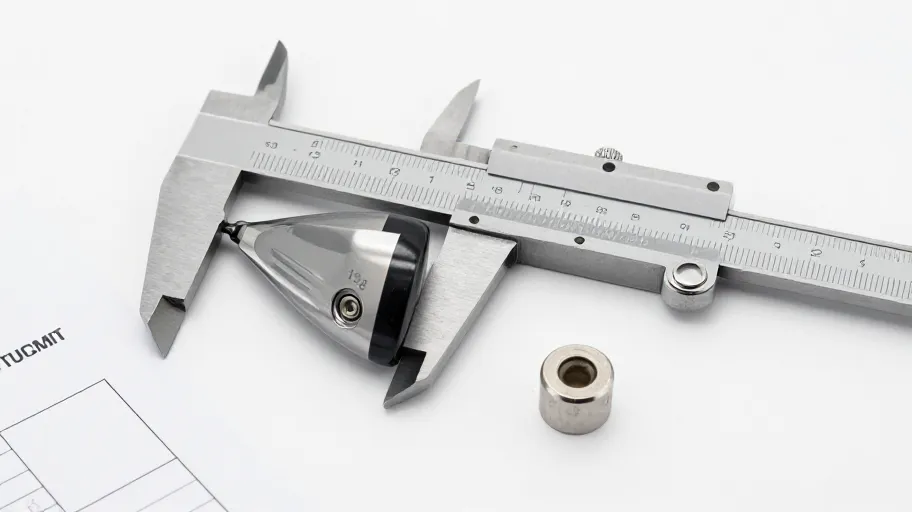
A driver weight replacement is only safe to order once three things are confirmed: the physical port or screw interface matches your exact head (Port), the mass and marking match the specification you need (Spec), and you have evidence beyond photographs — measurements, documentation or direct written confirmation — that the part is what it claims to be (Proof). Verify all three before you buy.
Why photographs alone cannot confirm a weight replacement
A sole weight is a small, unremarkable-looking object. In a listing photo, a 6-gram and a 14-gram weight from two different driver generations can look nearly identical. Photos cannot show you:
- The thread pitch, screw head system or torx/spline pattern underneath.
- Whether the part was made for a fixed glued-in port or a movable adjustable-weight track.
- The actual mass, as opposed to the number printed or engraved on it.
- Whether the underside geometry seats flush in your specific head.
This is why experienced club builders treat a listing image as a starting point, never as confirmation. The component that matters is defined by interface and mass, and neither is visible from the outside.
The Port–Spec–Proof framework
Port — the physical interface. Identify your driver's brand, family, model and generation first, because the weight system is specific to each head design. Confirm the port type: a screwed-in sole weight, a sliding or interchangeable track weight, a fixed epoxy-set weight that requires removal, or a hybrid design. If you cannot name the port type for your exact model, check the manufacturer's product documentation or the store's fitment guidance before proceeding.
Spec — the measurable specification. Confirm the mass you actually need, in the marking convention your head expects, and whether your build calls for a single weight or a set. If your goal is restoring a stock configuration after a lost weight, the target is the original specification for that model. If your goal is tuning, define the target mass and the balance outcome you want — and be prepared to measure the actual part on arrival rather than trusting a marking alone.
Proof — evidence beyond the photo. This is where most purchase decisions fail. Before approving any driver weight replacement, ask the seller for verifiable evidence: the measured mass of the actual stock being shipped, written confirmation that the part matches your stated model, and clear terms for what happens if it does not. Do not accept a listing description as proof; ask for confirmation tied to the specific item.
Decision table: match your replacement reason to the right checks
| Your situation | What matters most | Questions to resolve before ordering |
|---|---|---|
| Original weight was lost | Exact interface and mass match to the model | Which generation and variant is my head? What was the stock mass marking? Does the seller confirm both in writing? |
| Weight was damaged or stripped | Interface condition and removal method | Can the damaged weight be removed without harming the head? Does the seller or a builder confirm the replacement seats correctly? |
| Tuning swing weight or draw/fade bias | Mass options and port/track compatibility | Which masses are available for my port type? Is the movable-weight system model-specific? What balance outcome am I targeting? |
| Upgrading or experimenting with a different head configuration | Cross-model compatibility — assume none until confirmed | Has the seller explicitly confirmed this weight works in my model, or is it listed only for a different family? |
| Building for a customer (club builders) | Documentation and accountability | Can the seller provide measured specification evidence and written model confirmation I can attach to the build record? |
Concrete approval questions to send before you buy
Copy these into a message to the seller. A careful seller will answer them directly; evasive answers are themselves a signal.
- "My driver is [brand], [family], [model], [generation/year]. Please confirm in writing that this weight fits that exact head."
- "What is the measured mass of the specific unit you will ship, and how is it verified?"
- "What is the port or screw interface, and does it match my head's original system?"
- "What are the current terms if the part does not fit or does not match the stated specification?" — confirm this directly; no listing photo answers it.
- "Can you provide a photo or document of the actual stock, including the underside, not only the top marking?"
Approve the purchase only when every answer is explicit and tied to your stated model. If any answer is vague, treat the part as unverified and keep looking.
Frequently asked questions
Do driver weights fit across different brands or model generations? Assume no until the seller confirms otherwise in writing. Weight systems are specific to head designs, and even within one brand the interface can change between generations. The brand-family-model check is the first step, not a formality.
Is the number marked on a weight reliable? Treat the marking as a claim, not a measurement. Part of the Proof step is asking how mass is verified and, ideally, checking the part yourself on arrival with a scale before installation. If a marked mass turns out to differ from the measured mass, you want to discover that before epoxy or a torque wrench is involved.
Can I tune swing weight by swapping sole weights? Changing head mass shifts the balance of the club, but the outcome depends on your whole build — head, shaft, length and grip. Use the Port–Spec–Proof checks to confirm the part fits and matches the mass you specified; for predicting the resulting feel, consult the store's fitment guidance or a qualified builder rather than a listing page.
What if my original weight is stuck or stripped? The replacement and the removal are two separate problems. Confirm the replacement's interface match first, then ask a qualified builder or the seller what removal approach applies to your port type. Do not order a replacement on the assumption that removal will be straightforward.
How do I know a seller's description is accurate? You cannot know from a description alone — that is the entire point of the Proof step. Ask the five approval questions above, request evidence tied to the specific unit, and confirm exchange terms directly before ordering.
Check brand, family and model first
Before you compare a single listing, confirm your driver's exact brand, family and model. Everything downstream — port type, mass options, compatibility and the questions you ask a seller — depends on that identification. Check it now using the fitment guidance on our component-selection pages, then work through Port, Spec and Proof with any seller you are considering.
Your pre-purchase checklist (save or copy this):
- Brand, family, model and generation identified and written down.
- Port or track type named for my exact head.
- Target mass and marking convention defined (stock restoration or tuning target).
- Written model-match confirmation received from the seller.
- Measured-mass evidence requested for the specific unit.
- Exchange and mismatch terms confirmed directly with the seller — not assumed from a listing.
- Underside/interface photo or document requested for the actual stock.
If you cannot tick every box, you are not ready to order — you are ready to ask one more question. That is the correct order of operations for a driver weight replacement, and it is how a club builder would approach your build.
Master Your Swing, DIY Your Fit. DIY Golf is the premier destination for the technical golfer. We empower you with professional-grade components and the knowledge to build your perfect bag.


