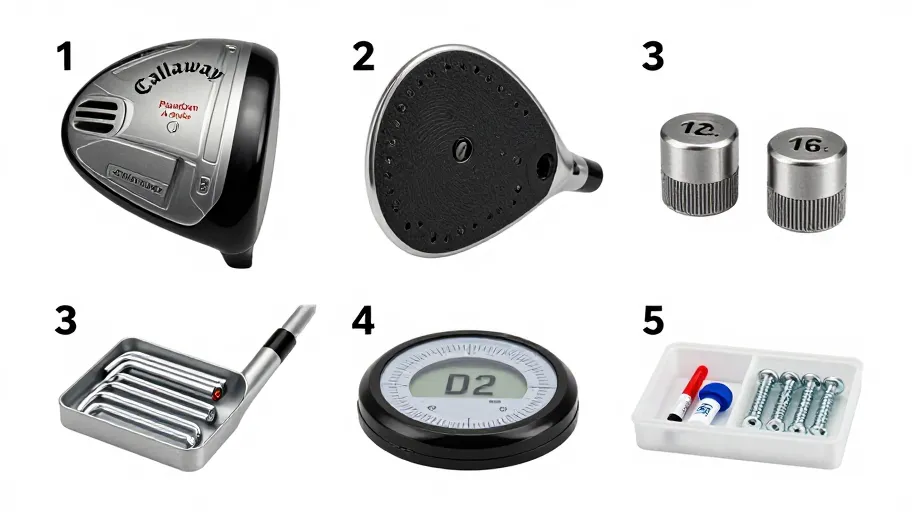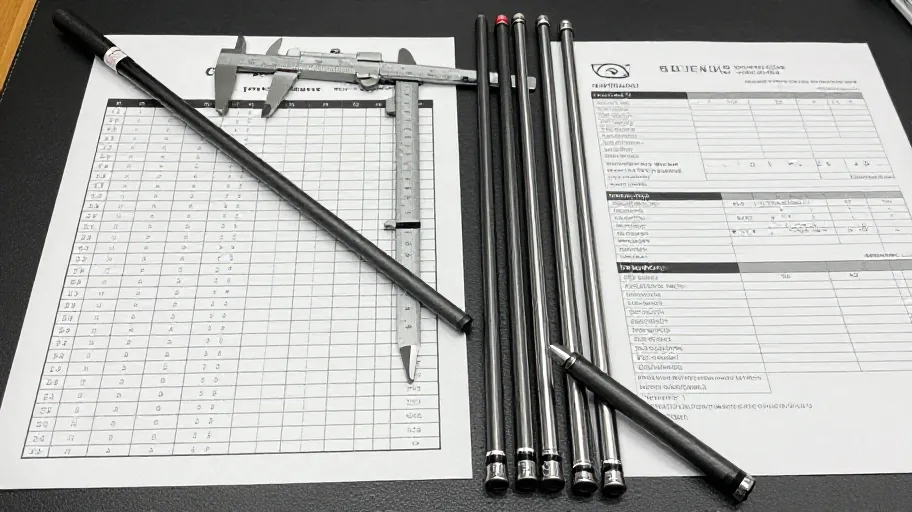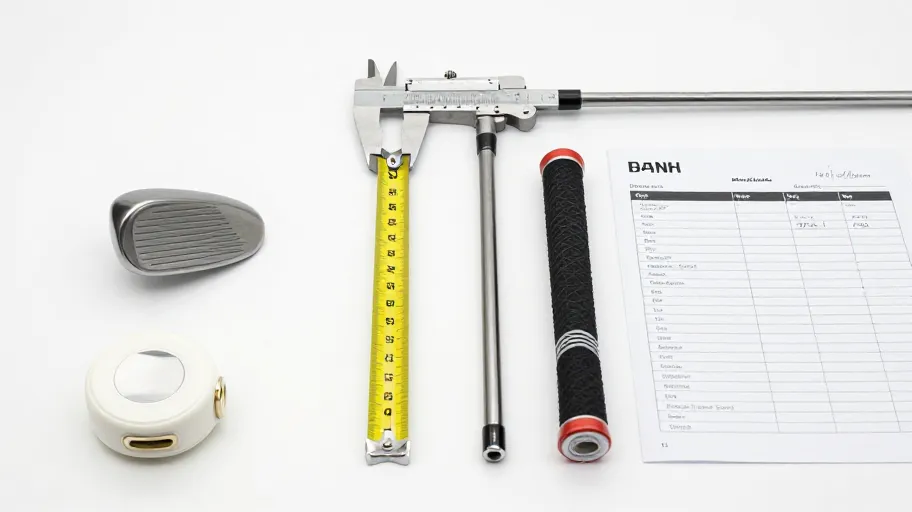
A golf club fitting guide for component buyers starts with the club you already own, not with the part you want. Document the existing spec of your exact brand, family, model and generation — hosel or adapter type, shaft tip and butt diameters, playing length, grip core — then match every candidate component against that record before ordering. This article gives you a repeatable framework, a decision table and the questions to confirm with the store.
The S.P.E.C.-Check framework
When you buy components rather than finished clubs, you inherit the fitment risk. The seller cannot see your clubhead; only you can verify what you actually hold. S.P.E.C.-Check keeps that verification in order:
- S — Spec. Extract the written specification of your clubhead and shaft: model name, generation or year if the family has been revised, hosel or adapter designation, bore type and depth, tip diameter, butt diameter, playing length, swingweight, grip core and layers of tape.
- P — Platform. Confirm the platform the component must interface with — adjustable adapter systems differ between and within families, and a shared model name does not prove a shared interface. Record the adapter generation and any markings on the existing part.
- E — Evidence. Measure what you can and photograph what you cannot. Calipers on tip and butt diameters, a straightedge or rule on length, a photo of hosel markings. Compare your measurements against the listing description word by word.
- C — Confirmation. Put every remaining unknown to the store in writing before checkout and approve the order only after the answers match your spec sheet.
The point of the sequence is that no stage can substitute for the one before it. Browsing adapters before you know your bore type, or choosing a grip before you know your butt diameter, moves the decision backwards.
Decision table: which existing spec drives which component choice
| Component decision | Existing spec that controls it | What to verify before ordering |
|---|---|---|
| Shaft selection | Tip diameter, hosel bore type and depth, adapter generation, intended playing length | Confirm the listed tip diameter matches your measured tip or the hosel bore; confirm adapter compatibility for the exact model and generation |
| Adapter / hosel replacement | Clubhead family, adapter generation, screw and ferrule configuration | Confirm the adapter is listed as compatible with your exact clubhead model and generation, and that fasteners are included or sourced |
| Grip replacement | Butt diameter of the installed shaft, grip core size, tape build-up | Confirm grip core against measured butt diameter and your tape preference |
| Ferrules, collars, spacer rings | Hosel diameter and design | Confirm listed dimensions match your measured hosel; ask about dimensional suitability for your model |
| Extension / cutting work | Current playing length, butt diameter, target length | Confirm the extension diameter matches the butt bore and that cutting will not affect adapter or tip fit |
| Head replacement or swap | Shaft tip diameter, adapter system, swingweight target | Confirm the new head's bore accepts your measured tip and adapter |
Approval questions to confirm in writing before ordering
No sample, cost, shipping, return or production policy was supplied for this article, so each of the following is a project-specific question for you to put to the store — not a statement of what any policy is:
- Is this component listed as fitting my exact model, generation and adapter configuration — and can you confirm that in writing against the spec sheet I send you?
- What is your current return or exchange policy if the component does not fit my documented spec?
- What is the current price, stock position and shipping arrangement for this exact item?
- If a sample or trial unit is available, what does the current sample policy cover, and who bears which costs? Confirm the current terms directly.
- What tolerances apply to the listed dimensions, and can you confirm the dimensional suitability for my measured values before I approve the order?
- Are all fasteners, ferrules or ancillary parts required for installation included, or must they be ordered separately?
Record the answers next to your spec sheet. An answer you cannot point to later is an answer you did not receive.
Build your fitment checklist
A checklist turns one nervous purchase into a repeatable process. For each club you service, document:
- Brand, family, model and generation photographed and written down
- Hosel/adapter designation and any markings recorded
- Tip diameter measured and cross-read twice
- Butt diameter measured and cross-read twice
- Bore type and depth recorded
- Current playing length and swingweight noted
- Grip core size and tape build-up noted
- Candidate component listing compared line by line against the spec sheet
- Written confirmation from the store on fitment, price, stock, shipping and returns
- Order approved only after every mismatch is resolved
FAQ
Do model names guarantee fitment? No. Model families are revised across generations, and shared names do not confirm shared interfaces. Treat the model name as a starting point and verify against your measured spec and the adapter generation.
Which measurements matter most for shaft buying? Tip diameter and the hosel or adapter configuration control whether the shaft installs at all; butt diameter controls grip fit; playing length and swingweight control feel. Verify all four rather than prioritising one.
Can I rely on the listing dimensions alone? Use them as the comparison target, not a substitute for your own measurements. If your caliper reading and the listing disagree, stop and confirm with the store before ordering.
What should I do if my club uses an adjustable adapter? Record the adapter generation and every marking on it, then confirm in writing that the replacement adapter or shaft is compatible with that exact system for your clubhead model and generation.
How do I handle policies I am unsure about, such as samples or returns? Confirm the current policy directly with the store in writing before you commit. Do not assume terms; policies differ by product and change over time.
Next step
Build a model-specific fitment checklist. Take the checklist template above, fill in every field for the exact club in front of you, and send it with your enquiry so the store can verify fitment against your documented spec rather than a guess.
If you are not ready to enquire yet, that is fine — start with the low-friction option: copy the ten-line checklist, complete it for one club, and file it. You will use it every time you source components for that model again.
Master Your Swing, DIY Your Fit. DIY Golf is the premier destination for the technical golfer. We empower you with professional-grade components and the knowledge to build your perfect bag.