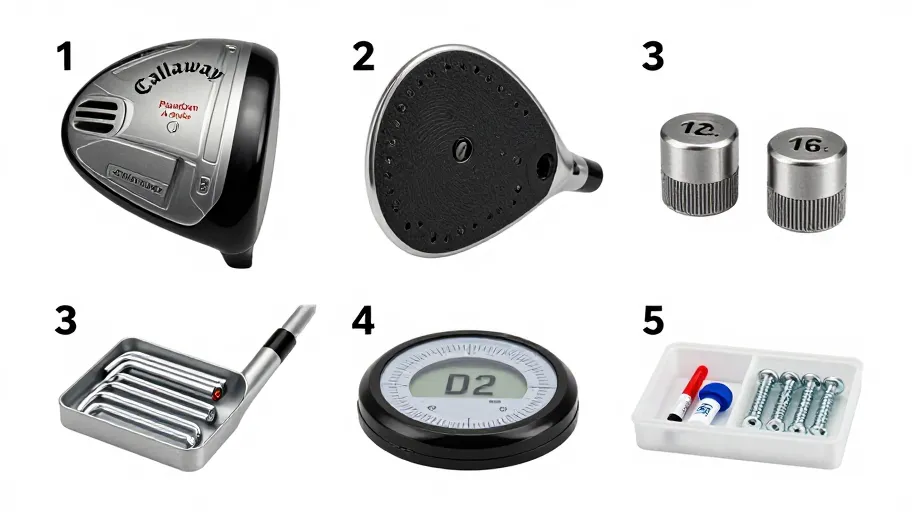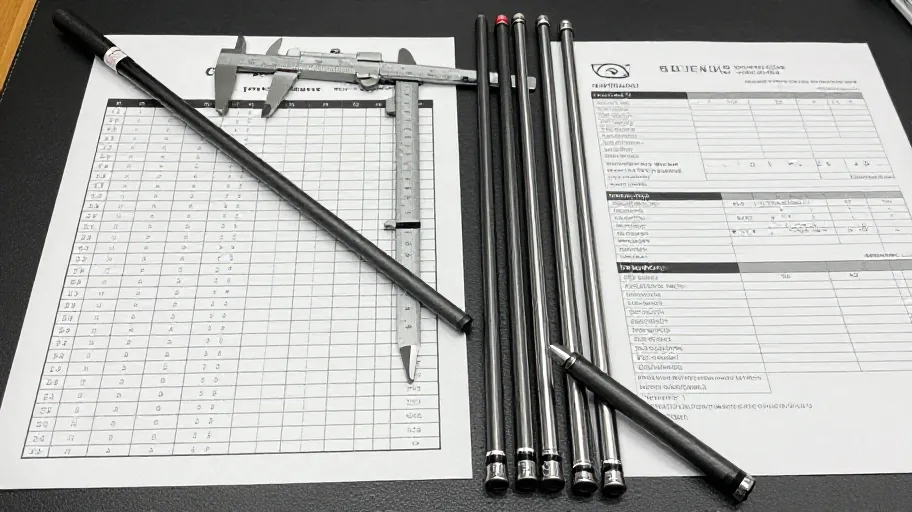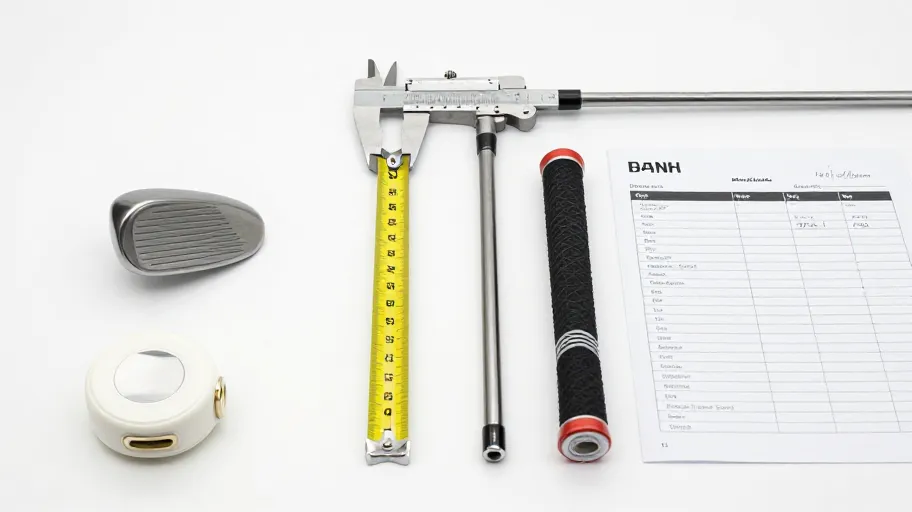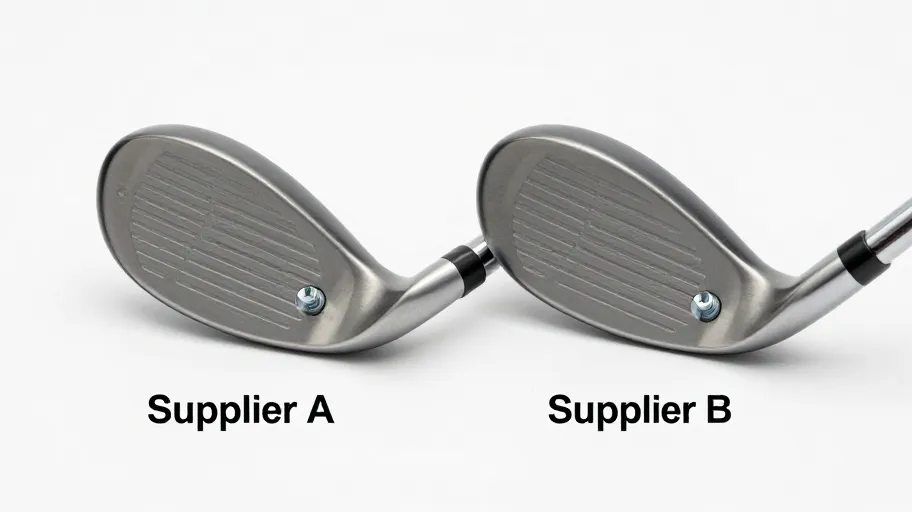
To compare two supplier quotes for golf club weights, lay both documents side by side and read them line by line against one specification baseline: the exact club brand, family and model, the weight value, the thread or mounting interface, and the material description. Wherever a line differs, ask both suppliers the same written question. Never approve a quote whose fitment language does not name your model.
Why two quotes for the same component can say different things
Golf club weights are precision components. A hot-melt port weight, a backweight, a tip weight and a sole port weight can all be described as "golf club weights" in a quote, yet none of them interchange. Two suppliers can each send an accurate quote for a genuinely different part, and the difference can hide inside one adjective — "internal," "threaded," "port-style" — that neither side flags as important.
The purpose of a line-by-line comparison is not to find the cheaper quote. It is to establish that both suppliers are quoting the same physical component for the same club model, and that any difference you find is a documented, explainable difference rather than an ambiguity. Only after that baseline holds does the commercial comparison become meaningful.
The SPEC-Compare framework
Use the SPEC-Compare framework to force both quotes into the same shape:
- S — Specification. Weight value, units, material description, and the installation interface (thread, press-fit, adhesive, port). Both quotes must state these in writing.
- P — Part number evidence. A supplier reference, manufacturer part number, or written spec sheet that ties the quote to an identifiable item — not just a product name.
- E — Exclusions. What the quote does not include: packaging, fitment verification, returns handling, shipping. These must be confirmed directly; no assumption is safe.
- C — Compatibility confirmation. A written statement naming your exact club brand, family and model as the intended fit. A generic "fits most drivers" line is not model-level confirmation.
If a quote fails any letter, it is not yet comparable — it is incomplete.
Decision table: two quotes, line by line
| Comparison line | What to read for | If the quotes differ | Approval action |
|---|---|---|---|
| Weight value and units | Exact figure, grams or as stated, no ranges | Ask both to restate a single confirmed value | Approve only after written confirmation |
| Club model named | Your specific brand, family and model appears | Request model-level fitment statement from each | Reject any quote that won't name the model |
| Interface description | Thread, port, press or adhesive mount type | Ask which physical interface each quote assumes | Confirm against your club's port or cavity |
| Material description | Named material, not "steel finish" style vagueness | Ask for a written material spec from each | Document before approving |
| Part number or reference | Supplier code or manufacturer part number | Ask whether the codes map to the same item | Do not approve unmatched references |
| Quantity and unit basis | Whether pricing is per piece, per set or per pack | Ask both to restate the unit basis | Verify before any commitment |
| Inclusions and exclusions | What is and is not covered by each quote | Ask each supplier to state current policy directly | Confirm in writing; assume nothing |
| Lead time and shipping terms | Stated terms, if any | Ask each to state current terms | Treat as project-specific; confirm directly |
| Returns and fitment support | Whether fitment checks are offered | Ask for the current policy | No policy stated = unresolved risk |
Approval questions to send both suppliers
Send the identical question set to both suppliers. Identical wording is what makes the answers comparable.
- "Please confirm in writing that this weight is specified for the [brand, family, model], including the mounting interface."
- "What is the exact weight value, and in what units is it stated?"
- "What material is the weight made from, and can you provide a written specification?"
- "Does your reference number map to a specific manufacturer part number?"
- "What is your current policy on returns or exchanges if the component does not fit? Please confirm the current terms directly."
- "What are your current shipping terms and availability for this item?"
- "Is any part of this quote conditional, quoted as an estimate, or subject to change before dispatch?"
Do not rely on verbal answers. An answer that is not written into the quote or a follow-up email is not part of the quote.
Verification gaps that make comparisons fail
Unmatched interfaces. If one quote describes a threaded weight and the other a port-fit weight for the same club family, one of them does not fit your club, regardless of how similar the descriptions read. Verify against the club itself, not the quote's wording.
Range-priced weights. A quote expressed as a range ("approximately X grams") cannot be compared with one expressed as a single value. Ask for a single confirmed figure.
Generic fitment claims. "Fits most modern drivers" is a marketing line, not a fitment confirmation. Model-level confirmation is the only level that matters for a build or a tuning plan.
Silent exclusions. The absence of a shipping, packaging or handling line is not the same as inclusion. Ask each supplier what the quote does not cover and record the answer.
Different unit bases. One quote priced per piece and another per pack can look close on paper while describing different quantities. Confirm the unit basis on both.
FAQ
Can I compare golf club weights quotes purely on specification sheets? Specification sheets are the strongest evidence available in a quote, but they still need model-level fitment confirmation. A spec sheet proves what the component is; it does not, on its own, prove that it fits your exact club. Ask for both.
What if a supplier refuses to name my club model in writing? Treat that as unresolved. A supplier may know the component fits and still decline to state it — but you have no documentation either way. Move forward only if you can independently verify the interface and weight specification, or choose a supplier who will confirm in writing.
How do I handle quotes that use different material descriptions? Ask each supplier to state the material specification in the same terms and to confirm it in writing. Descriptive differences can be wording choices or genuine specification differences; only a written restatement from both suppliers lets you tell them apart.
Should I ask both suppliers the same questions? Yes, in identical wording. Comparison depends on symmetry. If you ask one supplier about returns and not the other, the resulting documents are no longer comparable line by line.
What do I do once both quotes pass every line? Document both approved versions, keep the written confirmations attached to each, and only then compare the commercial terms. Approval of specifications comes before any commercial decision.
Before you add any component
Use the fitment selector before adding a component. It is the step that confirms model-level compatibility for your exact club before the comparison effort is spent on a part that does not fit.
If you are not ready to select yet, run the free line-by-line checklist first:
- Both quotes state a single confirmed weight value with units
- Both name your exact club brand, family and model
- Both describe the same mounting interface
- Both provide a part number or written spec reference
- Both state current shipping, returns and availability terms in writing
- Identical questions were sent to both suppliers
- All written answers saved with the quotes
- Fitment selector run before any component is added
Master Your Swing, DIY Your Fit. DIY Golf is the premier destination for the technical golfer. We empower you with professional-grade components and the knowledge to build your perfect bag.