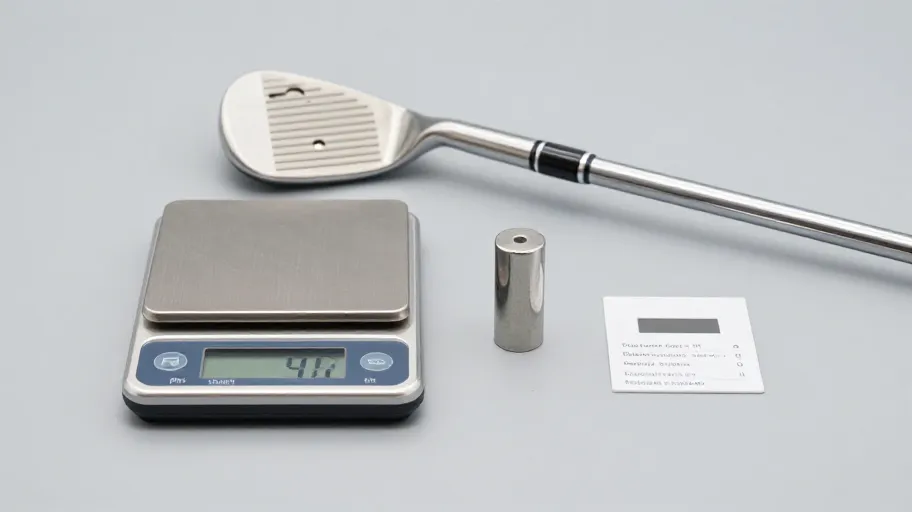
Golf club weights decisions fail at the brief stage, not the product stage: a single gram figure cannot confirm fitment. Before you source any weight, document four things — target effect, port or thread spec, counterweight format, and how the reference weight was measured. Verify each against the exact club model, then approve.
Why the first brief on golf club weights is incomplete
When a buyer sends a one-line request — "I need a heavier weight for this club" — the supplier is left guessing. Weight affects total mass, balance point and feel, but none of that can be evaluated until the mechanical interface and the reference conditions are pinned down. The weight itself is one input; the missing measurements are what determine whether the component will install at all.
Treat the first brief as a draft, not an order. The W-S-C-P check below turns that draft into something a supplier or fitment selector can actually act on.
The W-S-C-P check for weight sourcing
| Step | What you confirm | Why it matters |
|---|---|---|
| W — Weight target | The effect you want: total weight change, swingweight shift, or feel adjustment | Different goals point to different weight placements (head, port, shaft tip, grip end) |
| S — Screw and port spec | Thread type, port diameter, and seating depth for the exact club model | A weight that threads into one family may not seat in another; never assume cross-family fitment without model-level confirmation |
| C — Counterweight compatibility | Whether the system uses a weighted grip plug, port weight, or interchangeable cartridge | Format determines which product lines are even candidates |
| P — Placement and measurement discipline | How the reference weight was measured — installed, uninstalled, with wrench, with adhesive residue | An undocumented reference figure cannot be compared to anything |
The framework does not promise a result. It guarantees that the questions you send to a supplier are answerable, which is what moves a fitment decision from guesswork to verification.
The measurements that go missing in the first brief
1. The port or thread interface
The single most consequential omission. Two weights at the same gram value can have different threads, seat depths and driver interfaces. When you brief a weight, capture the club family and model, and ask the supplier to confirm the matching interface for that exact model rather than a general family match.
2. The reference measurement conditions
A weight spec means nothing without its context. Was the figure taken on its own or installed? Rounded or exact? If your reference number came from a different measurement condition than the product listing's, the comparison is void. Document your own measurement conditions when you send the brief.
3. The cumulative system, not the single component
Headweight, backweight, shaft mass, grip mass and any added material interact. A buyer who briefs only the replacement weight ignores what else is already in the club. List every weight-affecting element in the club as built before choosing the replacement.
4. The adjustment range around the target
Buyers brief a destination ("make it heavier") without stating the range they would accept or the ceiling the build must not cross. Give the supplier or selector a working range and a hard limit, both as project-specific numbers you set — not figures borrowed from another build.
5. The installation and removal plan
Whether the weight needs a specific tool, adhesive, or heat for removal affects which formats are serviceable for your workflow. Confirm tooling and removal method for the exact product before approving, since no first-party policy details were supplied for this article.
Decision table: match your brief to the right verification step
| Your situation | Verification step before adding to cart | Approve when |
|---|---|---|
| Replacing a lost OEM-style weight | Confirm thread and seating spec for the exact club family and model | Supplier or selector confirms the interface in writing for that model |
| Tuning swingweight upward | Document current total mass, balance point and target range | The chosen increment sits inside your documented range and the port accepts it |
| Adding a backweight or counterweight | Confirm the counterweight format matches the grip/shaft system in the build | Format compatibility confirmed for the exact component model |
| Switching between weight families | Request model-level cross-family confirmation; do not extrapolate from one family to another | Explicit confirmation for your model, not a family-level generalisation |
| Matching a reference club's feel | Recreate measurement conditions; record every mass element in both clubs | Both builds documented under comparable conditions before comparison |
Approval questions to send with any weight order
- Which exact club family and model does this weight interface with, confirmed at product level rather than family level?
- Under what measurement condition is the stated weight taken — and does that match how I measured my reference?
- What tooling, torque guidance or adhesive is needed for installation and later removal of this specific product?
- What is your current policy on samples, returns and exchanges for this item? (Policy details were not supplied for this article; confirm directly before ordering.)
- Is stock confirmed for the exact gram value and format I selected, at the time of order?
None of these questions presupposes an answer. Their job is to convert unknowns into written confirmations you can file with the order.
Pre-order fitment checklist
- Club brand, family and model recorded in writing
- Port thread, seat depth and driver interface confirmed for that exact model
- Counterweight or weight format matched to the system in the build
- Reference weight measurement conditions documented
- Total mass inventory of the club as built (head, shaft, grip, added material)
- Target range and hard limit set by you, in your own numbers
- Sample, return and stock policy confirmed directly with the supplier
- Fitment selector run before adding the component
FAQs
Do all weights with the same gram value fit the same club? No. Fitment depends on the thread, port and seating interface, not the mass figure. Two weights at identical mass can be mechanically incompatible. Confirm the interface for your exact club model before ordering.
Can I confirm fitment from the club family alone? Family-level information narrows the candidates but does not confirm fitment. Ask for model-level confirmation, and treat cross-family assumptions as unverified until a supplier or selector confirms them in writing.
How do I compare my current weight to a listed replacement? Only under comparable measurement conditions. Record how your reference weight was measured — installed or standalone, with or without tooling residue — and ask how the listed figure was measured. Without matched conditions, the comparison cannot be relied on.
Will a heavier weight change my swingweight by a predictable amount? That depends on your build, and no performance outcome can be claimed here without first-party evidence for the exact club and component. Set your own target range, document the build, and test on the bench before finalising.
What if the supplier cannot confirm the interface for my model? Treat the order as unapproved. Move to a verified alternative for your exact model or request written confirmation first. An unconfirmed interface is the point where most weight-buying mistakes are made.
Before you add any weight component
Use the fitment selector before adding a component. It is the step that converts your documented brief into a model-level compatibility check — and it takes less time than an uninstall and return.
Not ready to order yet? Take the low-friction route: copy the pre-order checklist above, fill it in for your club, and keep it with your build notes. A completed checklist makes every future component decision faster.
Master Your Swing, DIY Your Fit. DIY Golf is the premier destination for the technical golfer. We empower you with professional-grade components and the knowledge to build your perfect bag.


