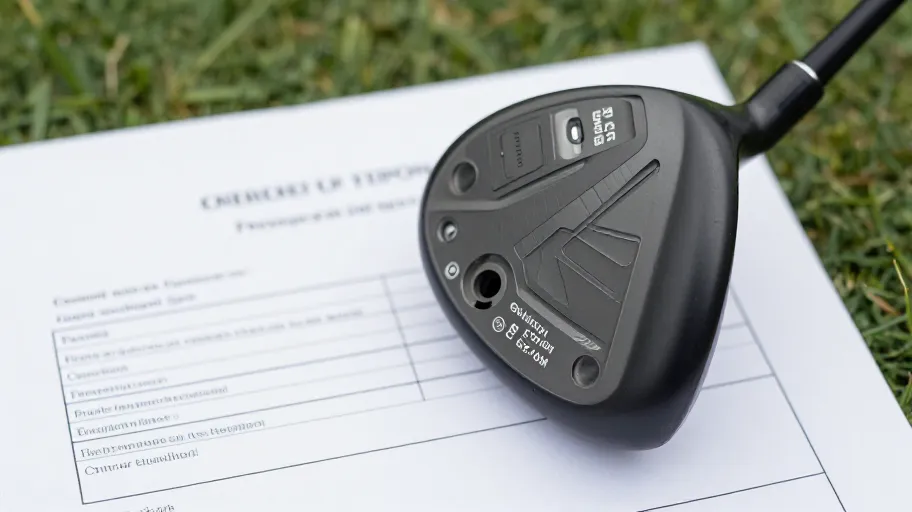
Before a supplier can quote any golf club weight, you need to hand over four verified items: the exact weight specification, the socket or port geometry on your club head, the model family and year, and written confirmation evidence for that exact combination. Without these, any quote you receive is a guess about fitment. The fitment selector exists so you can confirm the match before adding a component.
Why weights are a compatibility problem first
Golf club weights look like the simplest component in a build: a small metal part that threads or press-fits into a sole, toe or back port. That apparent simplicity is exactly why sourcing goes wrong. Two club heads from the same brand family, released in adjacent model years, can use different thread patterns, socket depths or weight-step increments. A weight that fits one head may not seat, may not thread, or may not sit flush on the other.
A quote for a golf club weight is therefore not just a price on a part. It is a compatibility confirmation exercise. The more precisely you describe the target club and the intended tuning range, the more accurate the quote and the fewer rounds of clarification you and the supplier need.
The W-S-P-C framework
Use this four-part framework to structure every request:
- W — Weight spec. State the target weight value, the increment steps you want, and the material the weight is made from, if the supplier offers options. If you are tuning rather than replacing, state the swing-weight or mass change you are aiming for and let the supplier map it to a component.
- S — Socket geometry. Describe or photograph the port on the club head: thread form and direction if threaded, socket shape and depth, whether the weight seats flush, and what tool interface is used. If you cannot measure it precisely, photographs next to a scale reference plus the model identity let the supplier verify against their own records.
- P — Platform (model family). Give the brand, model family, model name and, where relevant, the model year or version. Adjacent versions within a family can differ in weighting systems, so "same family" is not sufficient on its own.
- C — Confirmation evidence. Ask the supplier to confirm in writing that the quoted component is verified to fit the exact model you named. Keep that confirmation with your order records.
Decision table: weight categories and what to verify
| Weight category | What it attaches to | What you must verify before quoting | Risk if skipped |
|---|---|---|---|
| Interchangeable sole/port weights | Threaded or slotted port in the sole | Thread form, socket depth, seating height, tool interface, weight increments | Weight does not thread in or sits proud of the sole |
| Back/tip weights (shaft-tip style) | Shaft tip or hosel bore | Bore diameter, insertion depth, retention method, mass range | Loose fit or interference with the shaft |
| Adjustable sliding-rail weights | Track or rail system on the head | Rail geometry, carriage interface, locking mechanism, model-year match | Carriage will not seat or lock |
| Hot-melt and flow materials | Interior of the head via access port | Approved access method, target mass, application approach with your club builder | Rework to correct mass placement |
| Counterweight / grip-end weights | Grip end of the shaft | Shaft butt diameter, retention method, intended mass range | Poor retention or unintended feel change |
This table does not assert that any specific component fits any specific club. It defines what must be verified for each category before a quote means anything.
Approval questions to put in writing
Send these with your request and keep the answers on file:
- Can you confirm, in writing, that this exact component fits the [brand, model family, model, year] I named?
- What measurement or photo set would you need from me if you cannot confirm fitment from the model name alone?
- Which weight increments are available for this component, and how do they map to my stated tuning goal?
- What tool or installation method does this weight require?
- If the component does not fit on arrival, what is the process for resolving it? Confirm the current policy directly.
- Are there variants of this model family that use a different weight system, and how do we make sure mine is the one covered?
Documentation checklist for your records
- Brand, model family, model name and year recorded verbatim
- Socket or port photographed with a scale reference
- Target weight or tuning goal stated numerically
- Supplier's written fitment confirmation attached to the order
- Tool and installation requirements noted
- Quote cross-checked against the confirmed component identifier, not a general description
Frequently asked questions
Can a supplier quote golf club weights from the club model name alone? Sometimes the model name is enough for the supplier to verify internally, but you should not assume it. Ask for written confirmation that the model you named is the one the quote covers, and supply photographs if there is any ambiguity.
How do I know which weight value to request? State your objective — a replacement at the original mass, or a tuning change toward a target swing weight — and let the supplier map it to the available increments. Document the starting condition of the club before you begin.
What if my club model has been through several versions? Record the version identifier, not just the family name. Ask the supplier directly whether different versions within the family use different weight interfaces, and get the answer in writing.
Should I ask about the resolution process before ordering? Yes. Ask in advance what happens if the component does not fit on arrival, and confirm the current policy directly. Relying on assumptions here is how disputes start.
Is a written fitment confirmation really necessary for a small component? Fitment errors on small components are among the most frustrating to resolve because the cost of the part can seem minor next to the round trips. A one-line written confirmation closes that gap before it opens.
Next step
Use the fitment selector before adding a component — it is the fastest way to confirm that the golf club weight you are considering matches your exact club model.
Low-friction alternative: if you are not ready to select yet, start with the documentation checklist above. Five minutes of records now prevents most fitment questions later.
Master Your Swing, DIY Your Fit. DIY Golf is the premier destination for the technical golfer. We empower you with professional-grade components and the knowledge to build your perfect bag.


